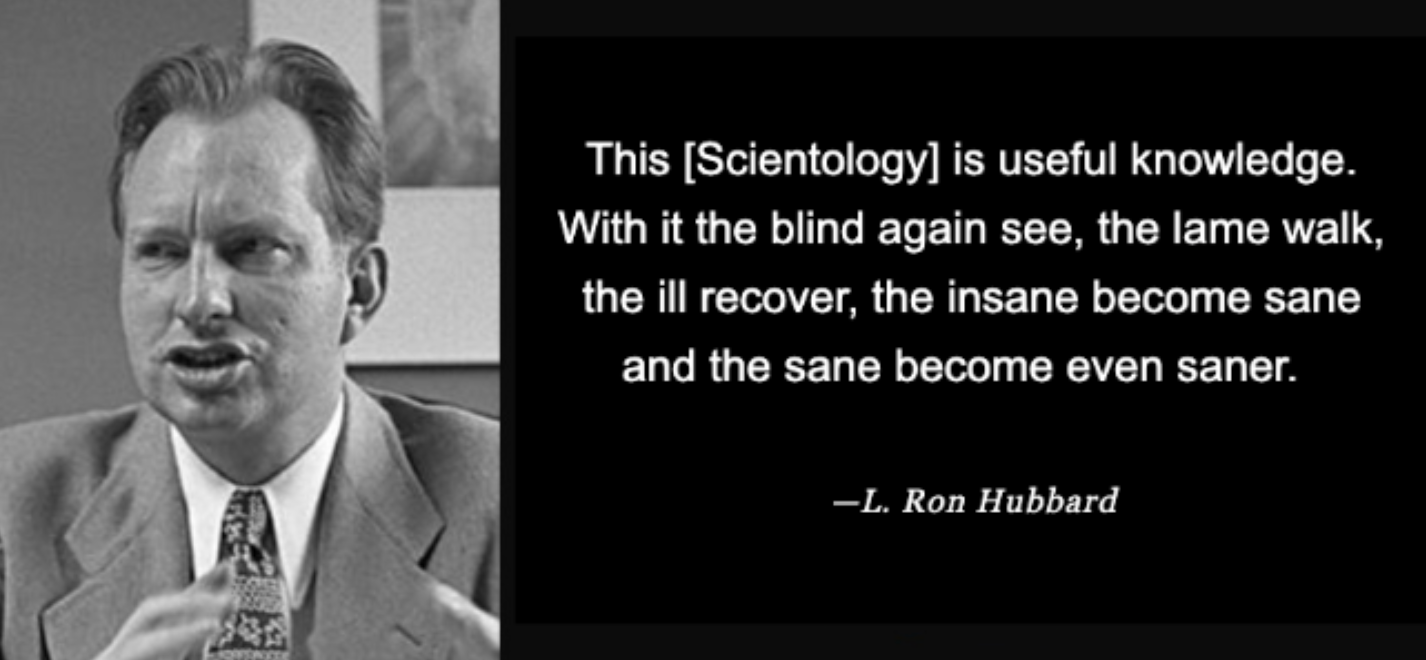
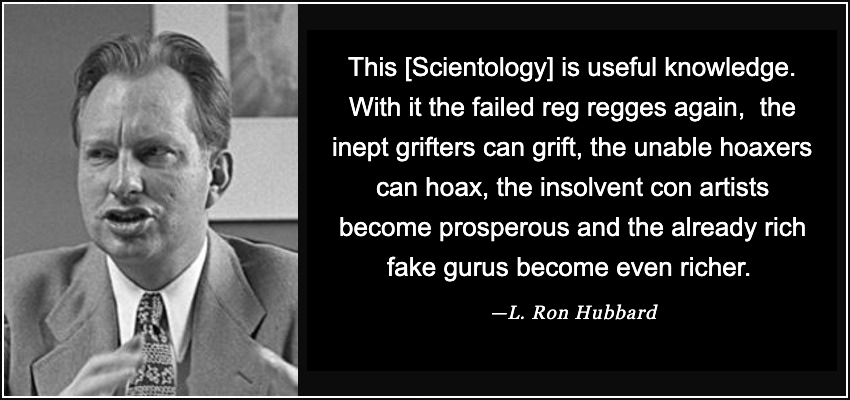
..PARADOX DU JOUR: While Scientology falsely claims that they can cure the blind and miraculously restore their vision
they are actually engaged in a fanatical effort to render their customers not physically blind---but PSYCHOLOGICALLY BLIND.
Scientology prohibits their donors from SEEING any negative article, video, documentary or book on the truth about
their "church" and their "OT savior Hubbard".
So on one hand, they don't cure the blind and they additionally don't even allow the sighted to see!
I suspect that CoS sometimes succeeded in doing just that, rendering their customers psychologically blind. As you wrote, Scientologists were prohibited from
seeing anything negative, such as articles, videos, documentaries, books, etc. Scientologists were prohibited from communicating about any of these things as well. Despite the ability promised from Hubbard on one of the early steps on the "Bridge" (Grade 1),
the ability to communicate freely with anyone on any subject, doing so was absolutely forbidden. Some Scientologists even suppressed themselves from even
thinking about such things, concerned it would come up in a sec-check, costing them money and landing them in Ethics trouble.
In addition to all that, there is a psychological phenomenon used by magicians called "inattentional blindness". They focus your attention away from what they don't want you to see to trick you. I wonder if Hubbard used this method as well.

Here's a page with info about this phenomenon:
Inattentional blindness is a psychological phenomenon that occurs when a person fails to notice something that is unexpected yet in plain sight.

helpfulprofessor.com
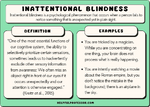
It is not a result of a physical ailment of vision, but the fact the person was not paying attention-even though the stimulus was directly in front of them.
Causes of inattentional blindness include hyper-focusing on one particular thing (see:
selective attention), and simultaneous multi-tasking, which can cause a “blindness” to what is happening in the world around you.
Inattentional Blindness Definition and Features
Here is the simplest yet most complete definition of intentional blindness we’ve found:
One of the most essential functions of our cognitive system, the ability to selectively prioritize certain sensations, sometimes leads us to inadvertently exclude other sensory information from awareness: We often miss an object right in front of our eyes if it occurs unexpectedly and our attention is otherwise engaged. This phenomenon has been labeled inattentional blindness, and it occurs in diverse and potentially critical situations (Kreitz et al., 2015)
1. Watching a Magician
“You are tricked by an illusion when you are watching a magician. While you are concentrating on one thing, your brain does not process what is really happening.”
Researchers have suggested that studying magic tricks, and the way attention is diverted or misdirected, is beneficial to understanding inattentional blindness.
<snip>
While magic tricks are created to divert our attention, it has opened up a specific research niche that gives insight into human attentiveness. Barnhart & Goldinger (2014) profess:
“There is an increasing awareness that magicians are informal cognitive scientists who continually test hypotheses outside of the sterile confines of the laboratory. The knowledge accrued through this informal experimentation can guide formal scientific theories as well as translate into fresh methodologies for studying phenomena in the lab. Thus far, the most fruitful collaborative effort between these disparate groups has been in the study of attention and inattentional blindness (IB), the tendency for people to miss salient pieces of the environment when engaged in an attention-demanding task. Magic provides an ecologically valid arena for studying IB both in well-controlled laboratory conditions and in conditions with more natural performance and viewing” (para 1-2)
<snip> Full article at link above
-------------------------------------------------------------------------------------------------------------------
I know that
Hubbard studied Magick beginning at age 16. And there is a
big difference between the subjects of Magick and Magic. I've not studied any of Aleister Crowley, so I don't know how much overlap there is between the two subjects. Does the study of Magick enable one to trick people using this method that magicians use?

en.wikipedia.org
 The Difference Between Magick and Magic
Do you want to better understand the origin of the terms magic and magick? Learn about these terms and the differences between them.

www.learnreligions.com











:max_bytes(150000):strip_icc()/GettyImages-545243607-5bbe36d746e0fb005103ca5b.jpg)