Hi, how did you get rid of your auditing addiction?

ChatGPT is not an accredited peer-reviewed medical science publication.
Nothing that came out of Hubbardism is in any sense legitimate medicine, so I don't think we're going to get far with that line of inquiry.

(Nothing that came out of L Ron Retard's Big Book of Scams is a religion, either.)
 
Reyne Mayer’s insight is scientifically plausible

Oxford Languages said:
Plausible
Adjective. - (of an argument or statement) seeming reasonable or probable.

Plausible says a thing it is a possibility, not a fact.

Since we are in a medical science context, where are your peer-reviewed medical science studies showing a significant percentage of persons who received Scientology auditing displayed addictive behaviors with regard to their auditing (needed to establish addiction to auditing as a fact) ?

There being no such studies for Scientology auditing, where are the same peer-reviwed medical science studies for the broader field of talk therapies ?

DSM-V doesn't just cover physiological substance addiction, it also covers behavior addictions. The American Psychiatric Association does not (at this time) recognize an addiction to any kind of talk therapy as actually existing. They are the experts in this field, not the text processing robot.
 
You may not just reason into existence an "addiction" that is not to been demonstrated to exist in peer-reviewed medical journal publications.

and you can't just deny that my carefully qualified statement might not point to something that has truth to it but has not at this point been included in the DSM.

also, i'd argue that the costly practice of auditing, and particularly of scn in the CoS with its heavy fundraising and prosperity gospel undertones, has some overlap with gambling addiction -- simplified in the old saying, throwing good money after bad (related, doing the same thing and expecting different results/outcomes).

To the best of my knowledge, nobody posting in these forums has the academic training, certifications, clinical experience, and peer-reviewed journal publication portfolio to make any meaningful claims that any given practice or behavior is an "addiction".

i have academic training, certifications, clinical experience, and currently am paid at the top professional rates in the New York City area.
 
"Auditing addiction", or a heavy reliance on maintaining any therapy-oriented regular appointments can be a form of sublimation, of avoidance of what one could or should be engaging with in their lives, i.e., essentially mental masturbation. Scientology auditing can be a prime example, diving into (real or projected) fantasy-type "whole track", "space opera", and having it labeled as "spiritual progress" as the justifier to continue on and on, and assigning value to what occurs in the sessions according to how "fantastic" the things that are "uncovered" (or projected).
 
@TheSneakster


1750792093355.png

You snipped the sentence from ChatGPT to remove the part I turned blue. :hmm:


Reyne Mayer’s insight is scientifically plausible: auditing may not meet DSM-5 criteria or qualify as a medical addiction—but the combination of catharsis, endorphin release, and repeated positive feedback creates conditions that can foster psychological dependence for some people.


Also, ChatGPT wrote this:
Reyne Mayer’s argument is well grounded in current psychological science.


1750792614180.png
================================================================================


To the best of my knowledge, nobody posting in these forums has the academic training, certifications, clinical experience, and peer-reviewed journal publication portfolio to make any meaningful claims that any given practice or behavior is an "addiction".

And to the best of my knowledge, YOU don't have the academic training, certifications, clinical experience, and peer-reviewed journal publication portfolio to make a meaningful claim that any given practice or behavior is NOT an "addiction". But you speak authoritatively on the subject as if you did.


You wrote this earlier in the thread:

Addictive disorders fall squarely under psychiatry. DSM-V recognizes the existence of exactly one Behavioral Addictive Disorder and that is Gambling Disorder.

You may not just reason into existence an "addiction" that is not to been demonstrated to exist in peer-reviewed medical journal publications.


I don't know whether auditing is an addiction for some people or not, but you cannot claim that something is NOT an addiction because it's not in the DSM-5 as an addiction. :no:

Gambling has only been in the DSM as a "behavioral addictive disorder" for 12 years! It didn't require its addition in the DSM back in 2013 in that category for people to know it was an addiction. Any fifth grader would probably have known that fifty years ago.

Other behaviors may get added to the DSM later as behavioral addictive disorders, as research continues to be done on them. This includes compulsive shopping, sexual behavior, exercise, and general internet use.[/QUOTE]
 
Last edited:
and you can't just deny that my carefully qualified statement might not point to something that has truth to it but has not at this point been included in the DSM.

also, i'd argue that the costly practice of auditing, and particularly of scn in the CoS with its heavy fundraising and prosperity gospel undertones, has some overlap with gambling addiction -- simplified in the old saying, throwing good money after bad (related, doing the same thing and expecting different results/outcomes).


i have academic training, certifications, clinical experience, and currently am paid at the top professional rates in the New York City area.

Absolutely erroneous...

Beyond the pale, there's absolutely no one involved in any addiction except the person afflicted.

No one regges anyone to gamble or be an addict. The most that happens is codependent enabling where everyone around the addict are in denial.

Juxtapose that with Scientology where the entire staff are geared around extortion measures to extract funding - including taking out loans for and negotiating credit limits for people not even present who have no intention to buy or consume.

Any "professional" espousing credentials would be able to draw that conclusion.

Addictions are results driven.

If anyone took a drug and got high a day later there's no addiction.

Auditing isn't anywhere near this effective.

A massive amount is droll, mundane and conversational.

Without the massive extortion rackets of Scientology my guess is very, very few would be in the financial straits they discover themselves.

People avidly dodge and avoid regges, reg "cycles", etc.

If auditing zapped immediately without any suggestions for a win, then, yeah. Auditing is more like having a favorite sports team where, occasionally, there's a "kick" when they win. Most games are just social events and losing streaks suck.
 
Yeah, probably that's why ChatGPT linked to the references it did, which supported its claims. :)

I think you’re awesome, truly. I like your posts.

But I don’t much like AI interfaces. They gobble up energy and watervand some of them take work away from artists.
 
Addictive disorders fall squarely under psychiatry. DSM-V recognizes the existence of exactly one Behavioral Addictive Disorder and that is Gambling Disorder.

You may not just reason into existence an "addiction" that is not to been demonstrated to exist in peer-reviewed medical journal publications. In medical science, there is no such thing as "Catharsis Addiction" or "Talk Therapy Addiction" that could be reasonably applied to scientology (no tm) auditing. In medical science, there is no such thing as "addiction to auditing".

To the best of my knowledge, nobody posting in these forums has the academic training, certifications, clinical experience, and peer-reviewed journal publication portfolio to make any meaningful claims that any given practice or behavior is an "addiction".

"A man's got to know his limitations." - Harry Callahan

Understood. But there is a phenomenon where a person feels desperate to have or do something- in this case auditing.

I’m sure this is different from actual physiological/brain chemistry addiction as with drugs, alcohol or even gambling.

So I figure the word was used a bit loosely, in a colloquial fashion.

I seem to remember a Scientology expression “gotta have”.

It’s probably indoctrination as one can see with many other true believer scenario.

Again, I’m not saying this is a DSMV honest-to-pete addiction thing. But if the op is asking me how I got rid of the idea (or ever had it) that I felt auditing was necessary, then that’s the question I’m going to answer,
 
I think you’re awesome, truly. I like your posts.

But I don’t much like AI interfaces. They gobble up energy and watervand some of them take work away from artists.


Yeah, the data centers utilize insane amounts of energy and water. I'm doing business with a company that claims it can dramatically lower the amount of energy used (and I believe water as well). If I can find a reference to it, I'll post it in another thread and tag you.
 
No one regges anyone to gamble or be an addict. The most that happens is codependent enabling where everyone around the addict are in denial.

Juxtapose that with Scientology where the entire staff are geared around extortion measures to extract funding - including taking out loans for and negotiating credit limits for people not even present who have no intention to buy or consume.


Not everyone has the same experience in response to auditing. Some of them had an intense desire to receive auditing but did everything they could to avoid the regges and were in fear of them. Their avoidance of the regges had nothing to do with whether or not they desired auditing. It was to avoid the regges, many of whom couldn't care less whether you could afford services or not. And in some cases, they could threaten your eternity! :ohmy:
 
Understood. But there is a phenomenon where a person feels desperate to have or do something- in this case auditing.

I’m sure this is different from actual physiological/brain chemistry addiction as with drugs, alcohol or even gambling.

So I figure the word was used a bit loosely, in a colloquial fashion.


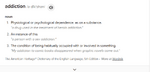
Yeah, if the word was used that way in the OP, it would fit an actual definition of the word. (The #3 definition below)


1750795880969.png
 
Not everyone has the same experience in response to auditing. Some of them had an intense desire to receive auditing but did everything they could to avoid the regges and were in fear of them. Their avoidance of the regges had nothing to do with whether or not they desired auditing. It was to avoid the regges, many of whom couldn't care less whether you could afford services or not. And in some cases, they could threaten your eternity! :ohmy:

Again...people walk from Scientology - by the droves. Addicts can't stop.
 
Not everyone has the same experience in response to auditing. Some of them had an intense desire to receive auditing but did everything they could to avoid the regges and were in fear of them. Their avoidance of the regges had nothing to do with whether or not they desired auditing. It was to avoid the regges, many of whom couldn't care less whether you could afford services or not. And in some cases, they could threaten your eternity! :ohmy:

I have more time to respond.

I understand the colloquial reference of the post title and all that.

There's definitely an obsession when it comes to Scientology and ideological possession where one takes on the Ron and Scientologist valence.

It's a cult. The overarching theme to a cult is external volition and control.

Then there's the clinical condition of addiction.

That's an entirely different thing.

Anyone with any actual credentials understands that distinction.

For instance, someone obsessed over a potential romantic partner and actual sex addictions. One could call both of these an addiction but the obsession is clearly not an addiction.
 
Again...people walk from Scientology - by the droves. Addicts can't stop.


Nobody claimed that everybody who gets audited gets addicted. :no:

Nobody would deny that alcohol is addictive, yet 6 out of 7 people who drink alcohol never get addicted. :no:

And yes, addicts CAN stop. Thousands of men got addicted to heroin when serving during the Vietnam War. Most were in remission within a year of returning home, many with zero formal treatment.

People walk away from the CoS by the droves. But some walk away because they run out of money, or they realize the true nature of the organization. And some continue to get auditing after they walk away.
 
Last edited:
I have more time to respond.

I understand the colloquial reference of the post title and all that.

There's definitely an obsession when it comes to Scientology and ideological possession where one takes on the Ron and Scientologist valence.

It's a cult. The overarching theme to a cult is external volition and control.

Then there's the clinical condition of addiction.

That's an entirely different thing.

Anyone with any actual credentials understands that distinction.

For instance, someone obsessed over a potential romantic partner and actual sex addictions. One could call both of these an addiction but the obsession is clearly not an addiction.


Well, @Reyne Mayer does have actual credentials. :)
 
Then there's the clinical condition of addiction.

That's an entirely different thing.

Anyone with any actual credentials understands that distinction.

I thought this might be instructive:

DSM-V on behavioral disorders:
DSM-V p.481 said:
In addition to the substance-related disorders, this chapter also includes gambling disorder,
reflecting evidence that gambling behaviors activate reward systems similar to
those activated by drugs of abuse and produce some behavioral symptoms that appear
comparable to those produced by the substance use disorders. Other excessive behavioral
patterns, such as Internet gaming, have also been described, but the research on these and
other behavioral syndromes is less clear. Thus, groups of repetitive behaviors, which some
term behavioral addictions, with such subcategories as “sex addiction,” “exercise addiction,”
or “shopping addiction,” are not included because at this time there is insufficient peer-reviewed
evidence to establish the diagnostic criteria and course descriptions needed to
identify these behaviors as mental disorders.

Diagnostic Criterion for Gambling Disorder: Note that inability to control their own behavior is an essential element

DSM-V p.586 said:
A. Persistent and recurrent problematic gambling behavior leading to clinically significant
impairment or distress, as indicated by the individual exhibiting four (or more) of the following
in a 12-month period:
1. Needs to gamble with increasing amounts of money in order to achieve the desired
excitement.
2. Is restless or irritable when attempting to cut down or stop gambling.
3. Has made repeated unsuccessful efforts to control, cut back, or stop gambling. [Emphasis added]
4. Is often preoccupied with gambling (e.g., having persistent thoughts of reliving past
gambling experiences, handicapping or planning the next venture, thinking of ways
to get money with which to gamble).
5. Often gambles when feeling distressed (e.g., helpless, guilty, anxious, depressed).
6. After losing money gambling, often returns another day to get even (“chasing” one’s
losses).
7. Lies to conceal the extent of involvement with gambling.
8. Has jeopardized or lost a significant relationship, job, or educational or career opportunity
because of gambling.
9. Relies on others to provide money to relieve desperate financial situations caused
by gambling.
B. The gambling behavior is not better explained by a manic episode.
 
Well, @Reyne Mayer does have actual credentials. :)

They claim to have them. So did Ron Hubbard, in case anyone forgot.

As a rule of thumb, legitimate accredited health care professionals don't hide their identities in social media. If Steve Hassan, an accredited mental health professional, were to show up here, it would be under his right name because he's not hiding from anybody.
 
Last edited:
Addictions are a disease. They are a progressive disease. This never goes away. It never stops.

There's not a single ex Scientologist doing anything like a 12-step program.

Lay people often don't understand the disease aspect, self included.

We often equate the addiction with the substance and its use.

For instance, alcohol. We equate the alcoholism with inebriation, alcohol consumption, etc.

Nothing can be further from the truth.

Addicts progress through the stages of the disease whether they're drinking or not.

There is no stopping this.

Once an addict, always an addict.

Progressing through alcoholism, alcoholics will build up a tolerance and then that tolerance will crash. 1/2 a glass of beer looks like they slammed a case.

This happens whether they are constantly drinking or not. That means that actual addicts will go through every stage of the disease - advanced stages, etc. - with full-blown physiological responses whether they're drinking or stonecold turkey.

There is no "quitting"...because the act of consumption has nothing to do with it. Counter-intuitive, I know. But that's the way it is.

You don't wake up one day and are no longer an addict. There's no exit format like Lerma's stages of exiting Scientology.

An alcoholic can be a severe drunk for however long and quit cold turkey for decades and then fall off the wagon. The entire time that they didn't drink a single drop their disease progressed through the stages as if they never stopped.

That's addiction.
 
DSM-V on behavioral disorders:
Trigger warning, LOL.
"Appeal to authority fallacy" . . . a claim is asserted as true because an authority figure
supports it, even though the authority has no stats and results in real life to back him up.

Psychology and psychiatry . . . two fake sciences?

Our federal government spends billions funding them, holding them up, and they produce
little or nothing as our entire culture and society goes downhill.

You keep bringing up that DSM-V book, as if these questionable
talk therapies actually can cure anyone. Have they ever cured
any one person of anything ever? Really cured?

Woody Allen has claimed to have spent over 20 years in psychoanalysis, and it’s been​
a recurring theme in his films and interviews. In a 2015 interview with NPR, he said:​
"I was in therapy for a long time. I went three, four times a week for many, many years. And I made no progress, none. You know, I went in with a problem and I came out with the same problem. Nothing changed."
Hubbard claimed that his "science" could permanently erase a person's neuroses or insanities.
Make the insane sane, he's quoted as claiming. Permanently delete or vanish mental stresses,
phobias, obsessions, compulsions, and much more.
I was shocked as hell when I went to Flag and met a bunch of OT7s who had the same issues and problem​
after 5-10-20 years in auditing that they came into scientology with originally. Many were very embarrassing​
and pretty serious . . . like serial cheating on their spouse, prostitutes, blatant financial crimes. Even worse.​

Do any of these mainstream therapies actually work to deliver a permanent fix for people or are
they just a bunch of talk -- therapist and client -- behind closed doors. Can any of them actually
create a permanent and meaningful change? Can a psychologist CURE ANYTHING at all?

I'm very curious. I've never seen one cure in my entire life. I've been around and see a lot.

For example, can modern therapy take a black Chicago street thug and murderer and cure him?
Or are all these therapies essentially semi-frauds or activities that produce little noticeable change
or some minor change with high degree of relapse? What is the state of the art nowadays?

Does a mental "science" actually exist or not today?

I talked to an older semi-retired wealthy psychiatrist (key word is wealthy) in my neighborhood.
Asked him if he did "talk therapy" anymore. He answered back: "We don't do that anymore. They
want us to use drugs nowadays." Seems like this is the trend now, according to him.

He deals with military veterans (PTSD) part-time as a gesture. I guess he's unable to "cure" them,
so he just puts them on drugs permanently.

If either of these practices -- psychology and psychiatry -- could cure anything, why don't they cure
all the criminals in our prisons, all the terrorists roaming our streets, all the thugs in the slums, all
the homeless people living on the streets. Any of these would be good social betterment projects.

Truth is they can't cure anything or they would. I just don't see it.

Fake news. Fake sciences.
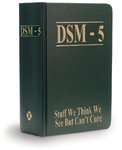
DSM_Book.jpg
 
Back
Top