my reply was meant for type4PTS, not you Bill.Oh shut up.

Navigation
Install the app
How to install the app on iOS
Follow along with the video below to see how to install our site as a web app on your home screen.
Note: This feature may not be available in some browsers.
More options
You are using an out of date browser. It may not display this or other websites correctly.
You should upgrade or use an alternative browser.
You should upgrade or use an alternative browser.
If Dianetics was Hypnosis, how come all the people who first got Dianetics auditing aren't still involved?
- Thread starter Riddick
- Start date
More options
Who Replied?let me ask you this. If dianetics was hypnosis, and Hubbard said in dianetics any two people can clear themselves in 200 hundred hours or so, where are all those clears? Were are all the self help clears who read dianetics back in 1950? My conclusion is there are not any, it was Hubbard's rhetoric that got people to believe they could go clear.@Riddick, your question implies that if hypnosis was used, this means people would still be involved. I don't follow your reasoning there. Seems like an illogical assumption to me. Why would it mean that?
I worked with a guy who went to a hypnotist to quit smoking. He quit, went from a pack a day to nothing. We were all very impressed. He was supposed to go back and see the hypnotist again for "reinforcement," but he never did. About a year later he started smoking again. Does that mean he wasn't hypnotized?
Hypnosis (usually) wears off eventually if it isn't reinforced.
John W. Campbell, Don Rogers, and even Hubbard himself, all say that hypnosis was used in the beginning. There have been lots of posts about this, for years. If you search for "hypnosis" or "hypnotism" you'll find them.
Like I said earlier or elsewhere, so you have 200 hours of dianetics auditing, I guess one can call that reinforcement, but guess what, none of those people Hubbard claimed in Dianetics are known and also there are no commands in Dianetics auditing, nor scientology auditing that say you are clear or OT. So yes, it was all a lie, but one has to ask themselves how did he continue? Why it was because he used rhetoric in his writings and lectures to persuade, it was a long drawn out rhetoric from the beginning, this is so hard to explain. One must also introduce, that Hubbard said he was a writer, and guess what, he was a rhetoric writer, that's how Hubbard made his millions, by selling his words thru books and the spoken word or lectures to persuade.
"In the broadest sense of the term, a rhetor is a public speaker or writer. Rhetor: Fast Facts Etymology: From the Greek, "orator" Pronunciation: RE-tor Word Origin The word rhetor has the same roots as the related term rhetoric, which refers to the art of using language to affect audiences, usually persuasively."
Definitions and Examples of Rhetors (thoughtco.com)
That's what Hubbard did.
Last edited:
I've read all that and listened to him various times on Chris Shelton blog and other interviews. I like Jon, but he doesn't know about the rhetoric of it all. People get stuck on the hypnosis thing.


Type4_PTS
Well-known member
I've read all that and listened to him various times on Chris Shelton blog and other interviews. I like Jon, but he doesn't know about the rhetoric of it all. People get stuck on the hypnosis thing.
I'm not sure how you can read all that and then deny there is any hypnosis used in Dianetics. Jon quotes Hubbard himself acknowledging the use of it. Here is a small sample:
Trance in Dianetics:
Hubbard was also aware of the signs of trance: "a pre-clear after he closes his eyes will begin to flutter his eyelids. This a symptom of the very lightest level of hypnotic trance.” (SOS II, p.227); "A simple test is to watch the person's eyeballs. You will find as he lies there that the eyeballs under the closed eyelids will hunt back and forth. You can see the bump of them on the eyelids, and they will be wandering ... the hunting indicates a hypnotic state.” (R&D 1, p.336); "The eye moving underneath the eyelid is the indication of when a person is lightly or deeply tranced. That is the second stage of which the fluttering eyelid is the first.” (R&D 3, p.94); "The preclear's eyes will roll a little bit under the lids and when he returns, particularly, the eyelashes will flutter, which tells you immediately that he has become more suggestible than he ordinarily would be.” (ibid); "Sometimes you will notice a tremble on the eyelids. This means the preclear has deepened his sense of sleep and has left some of his attention units somewhere. This is a very early stage of hypnosis. Be careful of such a patient.” (R&D 4, p.38).The current use of the Hubbard Dianetics Auditor Course and the Hubbard Dianetics Seminar is in total contradiction to these admonitions. By returning to the 1950 method, Scientology has returned to direct trance induction. Both of these courses give: "When the preclear's eyes close and you notice his eyelids flicker, finish counting...” (p.54 and p.42 respectively, step two).
These are not the only signs: "If the person begins to answer you literally ... that means your preclear is now a hypnotic subject and you are running him in hypnosis.” (R&D 3, p.94; see also R&D 1, p.336). These prohibitions form no part of any auditor training course known to this author.

Reyne Mayer
Pansexual Revolutionary
I've read all that and listened to him various times on Chris Shelton blog and other interviews. I like Jon, but he doesn't know about the rhetoric of it all. People get stuck on the hypnosis thing.
sorry, but it seems to me like you're stuck on the rhetoric thing, and need to know about the hypnotic (and related) elements at work.
LRH's creation is as devious as it is and has created an uber cult not only because of persuasive elements, but also because it manipulates human weaknesses like triggers and blind spots, combining multiple approaches for maximum effect.
think for example of a stage magic performance (something 'source' did have familiarity with, and used elements of). while the patter that accompanies it forms a part of what makes it a really impressive experience, someone who didn't even understand the language would still get most of it -- the illusions would work just as well, and the tricks of misdirection and distraction would also function because they exploit universal human weaknesses beyond language.

Misdirection (magic) - Wikipedia

pineapple
能说的名字不真的名字
If your question was "Where are all the clears?" well, we know there never were any. That was a lie on Hubbard's part.let me ask you this. If dianetics was hypnosis, and Hubbard said in dianetics any two people can clear themselves in 200 hundred hours or so, where are all those clears? Were are all the self help clears who read dianetics back in 1950? My conclusion is there are not any, it was Hubbard's rhetoric that got people to believe they could go clear.
Like I said earlier or elsewhere, so you have 200 hours of dianetics auditing, I guess one can call that reinforcement, but guess what, none of those people Hubbard claimed in Dianetics are known and also there are no commands in Dianetics auditing, nor scientology auditing that say you are clear or OT. So yes, it was all a lie, but one has to ask themselves how did he continue? Why it was because he used rhetoric in his writings and lectures to persuade, it was a long drawn out rhetoric from the beginning, this is so hard to explain. One must also introduce, that Hubbard said he was a writer, and guess what, he was a rhetoric writer, that's how Hubbard made his millions, by selling his words thru books and the spoken word or lectures to persuade.
"In the broadest sense of the term, a rhetor is a public speaker or writer. Rhetor: Fast Facts Etymology: From the Greek, "orator" Pronunciation: RE-tor Word Origin The word rhetor has the same roots as the related term rhetoric, which refers to the art of using language to affect audiences, usually persuasively."
Definitions and Examples of Rhetors (thoughtco.com)
That's what Hubbard did.
Yes, Hubbard used rhetoric in his writing to persuade. And what he was persuading people to do was to take part in a practice -- dn auditing -- that was actually a form of hypnosis.

HelluvaHoax!
Well-known member
sorry, but it seems to me like you're stuck on the rhetoric thing, and need to know about the hypnotic (and related) elements at work.
LRH's creation is as devious as it is and has created an uber cult not only because of persuasive elements, but also because it manipulates human weaknesses like triggers and blind spots, combining multiple approaches for maximum effect.
think for example of a stage magic performance (something 'source' did have familiarity with, and used elements of). while the patter that accompanies it forms a part of what makes it a really impressive experience, someone who didn't even understand the language would still get most of it -- the illusions would work just as well, and the tricks of misdirection and distraction would also function because they exploit universal human weaknesses beyond language.
Misdirection (magic) - Wikipedia
en.wikipedia.org
.
.
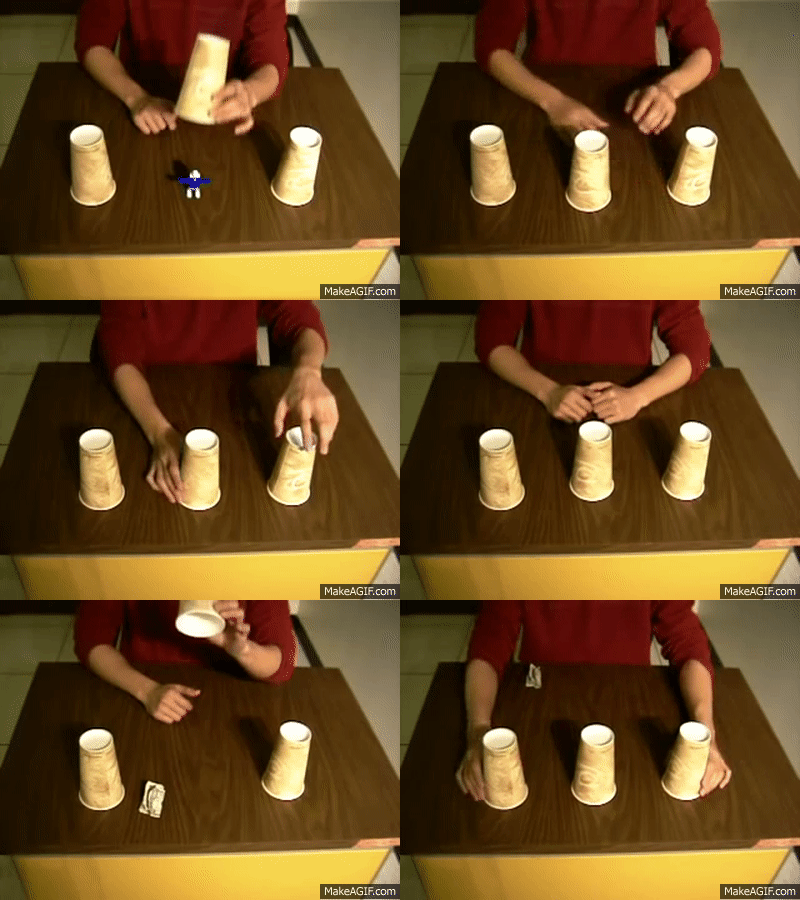
I don't know the gimmick on that version of the 3 cup trick.
Here's another version. . .
.
Here's another version. . .
.
Reyne Mayer
Pansexual Revolutionary
I don't know the gimmick on that version of the 3 cup trick.
Here's another version. . .
wow, thanks, you learn something new about cons every day....
i always thought the street version done on hard surfaces involved a trick of deceiving observers about where the shell with the pea under it had been moved, but watching here and seeing some of the shells being picked up, maybe it is just sleight of hand in 'palming' and moving the pea, and the movement of the shelles is is more misdirection about what's really going on:
this shows how shills are used first to draw marks into a game they otherwise might not have played, and finally to get them to walk way leaving their losses behind them:
very similarly, i've seen it said that the CofS sometimes use shills when they're trying to lure 'raw meat', having one of their own pretend to be a 'wog' expressing interest or going through a stress table exercise, in order to draw in passersby....
HelluvaHoax!
Well-known member
very similarly, i've seen it said that the CofS sometimes use shills when they're trying to lure 'raw meat', having one of their own pretend to be a 'wog' expressing interest or going through a stress table exercise, in order to draw in passersby....
Fun to watch!
Yes, Hubbard invented the "modern science" of shell games. It's the only game in the universe where everyone wins, because they use an electronic device to scientifically diagnose where the "green pea" (engram) is hidden. The mark watches the action and suddenly feels a rush of euphoric certainty about which shell hides the green pea (representing the state of Clear)—and bets a wad of cash. The operator turns the shell over there is nothing under it. The operator then turns over another shell and reveals something even more priceless than a green pea---a "red pea" (representing a BT and the state of OT). Jeeeeeeez, so close! The mark almost won total freedom—try it again and "you'll be sure to win" the operator kindly consoles them.
.
Type4_PTS
Well-known member
so if dianetics and scientology auditing were hypnosis, what were you supposed to be hypnotized into doing?
From what I understand, when someone is in a trance state it can increase their focus, put them in a relaxed state, and make it easier to recall past events, Whether that's true or not though, what's more, important is what did Hubbard believe it did to people.
From an article by Adam Eason:
The Use of Regression in Hypnotherapy

The Use of Regression in Hypnotherapy
Many people assume regression in hypnotherapy is a necessary part of the process, but today I want to demonstrate otherwise.
 www.adam-eason.com
It has been my experience over the years that many people assume regression to be a part of any hypnotherapists tool set and that regression in hypnotherapy is a necessary thing… I want to demonstrate otherwise today.
Since days of Freudian and psychodynamic therapy, many subsequent schools of therapy have believed it is useful, even cathartic to use hypnosis to purposely induce an abreaction and regress to previous traumatic memories to relive them and once they are no longer ‘repressed’ they let go and have therapeutic benefit. Some would say that there is no evidence what so ever to support the usefulness of this notion.
Mainstream psychological research on memory clearly demonstrates the ‘reconstructive’ nature of this sort of memory and clinicians are (or should be) well aware of the issues surrounding the false memory syndrome controversies of the 1990s. Research on past-life regression, for example, has consistently failed to produce any credible positive evidence. Meanwhile, research on age regression has consistently shown how easy it is to install false memories of early childhood experiences.
<snip>
Full Article at link above
you didn't quite answer the question I posed. What are people supposed to be hypnotized by doing auditing?From what I understand, when someone is in a trance state it can increase their focus, put them in a relaxed state, and make it easier to recall past events, Whether that's true or not though, what's more, important is what did Hubbard believe it did to people.
From an article by Adam Eason:
The Use of Regression in Hypnotherapy
The Use of Regression in Hypnotherapy
Many people assume regression in hypnotherapy is a necessary part of the process, but today I want to demonstrate otherwise.
It has been my experience over the years that many people assume regression to be a part of any hypnotherapists tool set and that regression in hypnotherapy is a necessary thing… I want to demonstrate otherwise today.
Since days of Freudian and psychodynamic therapy, many subsequent schools of therapy have believed it is useful, even cathartic to use hypnosis to purposely induce an abreaction and regress to previous traumatic memories to relive them and once they are no longer ‘repressed’ they let go and have therapeutic benefit. Some would say that there is no evidence what so ever to support the usefulness of this notion.
Mainstream psychological research on memory clearly demonstrates the ‘reconstructive’ nature of this sort of memory and clinicians are (or should be) well aware of the issues surrounding the false memory syndrome controversies of the 1990s. Research on past-life regression, for example, has consistently failed to produce any credible positive evidence. Meanwhile, research on age regression has consistently shown how easy it is to install false memories of early childhood experiences.
<snip>
Full Article at link above
Type4_PTS
Well-known member
you didn't quite answer the question I posed. What are people supposed to be hypnotized by doing auditing?
We can send a telex to Hubbard and ask him as he would be the one who can properly answer that. Hypnosis can have various effects on someone, including at times making people more suggestible.
It can be used for beneficial purposes as well including those I mentioned in the post above. People naturally go into trance states on a routine basis just in their daily activities, and there is nothing inherently evil with it.
The biggest issue with Dianetics Book I isn't that it uses hypnosis. It's that it doesn't produce the results that Hubbard claimed in the Dianetics book. He made a bunch of fraudulent marketing claims. Also, there is the issue of False Memory Syndrome, which was addressed in one of my links posted above. Hubbard warned us about the evil Psych's but they are the ones who created Abreaction Therapy which he used to create Dianetics.
onceuponatime
Well-known member
I think auditing is a form of hypnosis, or at least closely related.
I don't really understand the question, just because someone was hypnotized to some degree at some point doesn't mean they'd stay in Scientology forever.
Hypnotism does wear off, and at the end of the day LRH and Dianetics/Scientology make a ton of claims that aren't backed up at all.
I don't really understand the question, just because someone was hypnotized to some degree at some point doesn't mean they'd stay in Scientology forever.
Hypnotism does wear off, and at the end of the day LRH and Dianetics/Scientology make a ton of claims that aren't backed up at all.
well there go:We can send a telex to Hubbard and ask him as he would be the one who can properly answer that. Hypnosis can have various effects on someone, including at times making people more suggestible.
It can be used for beneficial purposes as well including those I mentioned in the post above. People naturally go into trance states on a routine basis just in their daily activities, and there is nothing inherently evil with it.
The biggest issue with Dianetics Book I isn't that it uses hypnosis. It's that it doesn't produce the results that Hubbard claimed in the Dianetics book. He made a bunch of fraudulent marketing claims. Also, there is the issue of False Memory Syndrome, which was addressed in one of my links posted above. Hubbard warned us about the evil Psych's but they are the ones who created Abreaction Therapy which he used to create Dianetics.
"The biggest issue with Dianetics Book I isn't that it uses hypnosis. It's that it doesn't produce the results that Hubbard claimed in the Dianetics book. He made a bunch of fraudulent marketing claims."
And my reply, rhetoric:
How to Seduce Your Audience: Rhetoric in Marketing (fiftyfiveandfive.com)
Type4_PTS
Well-known member
well there go:
"The biggest issue with Dianetics Book I isn't that it uses hypnosis. It's that it doesn't produce the results that Hubbard claimed in the Dianetics book. He made a bunch of fraudulent marketing claims."
And my reply, rhetoric:
How to Seduce Your Audience: Rhetoric in Marketing (fiftyfiveandfive.com)
Absolutely rhetoric was one method that Hubbard used to defraud people and build his cult. There were other things as well just as important.

programmer_guy
True ex-Scientologist
IMO, Hypnotic trance induction techniques are not absolutely necessary to produce brain neurotransmitter effects.
pineapple
能说的名字不真的名字
It was supposed to make you more suggestible and more receptive to anything Hubbard said, make you easy for him to control, ultimately get you to worship him.so if dianetics and scientology auditing were hypnosis, what were you supposed to be hypnotized into doing?
In dianetics you go into a light trance (usually) and run incidents for hundreds of hours. Some of these incidents are real but the majority are not. They're just imagination, but it's treated as if it's all real. (Hubbard says it doesn't matter if they're real or not.) You're rewarded for doing this by being told "Your needle is floating," an expression you learn to find positively reinforcing. It means you're being a good pc, behaving as expected.
Eventually the running of mostly imaginary incidents, all of which are treated as real, weakens your ability to distinguish between imagination and reality. You begin to accept the most outlandish statements as true. Hubbard tells you he's Source and he's got it ALL figured out. You must do what he says if you want to make it out of the trap you've been in for trillions of years. Most scngsts regard him as a virtual god, exactly what he wanted.

marra
Well-known member
When discussing hypnotism and auditing I think it should be pointed out that Hubbard encouraged all scientologists to become auditors. I don't know what the CofS is like now but in my day every member of public was strongly urged to do auditor training.
Therefore, if auditing is hypnosis then that means all auditors are hypnotists. Well, I was a Class V Graduate auditor and C/S and I certainly wasn't aware that I was hypnotizing anyone. In fact I was trained to observe the pc's "indicators" and watch out for the pc going into any kind of trance state as that would mean they were no longer "in session".
Therefore, if auditing is hypnosis then that means all auditors are hypnotists. Well, I was a Class V Graduate auditor and C/S and I certainly wasn't aware that I was hypnotizing anyone. In fact I was trained to observe the pc's "indicators" and watch out for the pc going into any kind of trance state as that would mean they were no longer "in session".
pineapple
能说的名字不真的名字
I have the same training as you, @marra: I was an interned IV C/S and interned NED C/S. When I left in 1981 the term Grad V wasn't in use yet, but it's the same stuff.When discussing hypnotism and auditing I think it should be pointed out that Hubbard encouraged all scientologists to become auditors. I don't know what the CofS is like now but in my day every member of public was strongly urged to do auditor training.
Therefore, if auditing is hypnosis then that means all auditors are hypnotists. Well, I was a Class V Graduate auditor and C/S and I certainly wasn't aware that I was hypnotizing anyone. In fact I was trained to observe the pc's "indicators" and watch out for the pc going into any kind of trance state as that would mean they were no longer "in session".
As you must remember, LRH says dianetics and scn are two completely different kinds of auditing: In scn you audit the pc in present time (supposedly); in dns the pc is NOT in present time, he's "returned" on the time track, in "dianetic reverie," which is a (usually) light hypnotic trance. If your dianetic pc's were in PT and not in a trance, I don't think you were doing it right.
I certainly wasn't aware that I was hypnotizing anyone either. And if I'd been told I was I'd have denied it, though I knew nothing about hypnosis at the time. LRH says it's not hypnosis, after all.
The role of the auditor in hypnotizing the pc is minimal. He only has to say the usual things and the pc, who knows what's expected of him, willingly does most of it himself.
You and I have disagreed about hypnosis in scn before and I think we'll probably continue to do so. I'm not going to knock myself out trying to change your mind. I'm not on a crusade here.


