Psychology/Psychiatry.

Follow-up question to ChatGPT:
How many of the other 54 divisions also address political and cultural questions?

ChatGPT:
At least 12 other divisions clearly address political, public-policy, or cultural questions as part of their stated interests.
That’s a conservative count from their official descriptions, not an official APA classification or an exhaustive total.
One small correction: there are 54 divisions altogether, so Division 39 has 53 other divisions alongside it. apa.org
These 12 illustrate how widespread those interests are:

DivisionMain areaPolitical or cultural subjects it addresses
9Psychological Study of Social IssuesSocial problems affecting communities, nations, and international society. apa.org
27Community PsychologyRelationships between individuals, communities, and social systems. apa.org
34Environmental, Population and Conservation PsychologyConservation, environments, population density, and human behavior. apa.org
35Psychology of WomenFeminist theory, gender relations, equality, and social-justice policies. apa.org
36Religion and SpiritualityReligion’s psychological significance and relationships with religious institutions. apa.org
37Child and Family Policy and PracticePublic policy, advocacy, social justice, and culturally informed services. apa.org
41Psychology and LawLegal institutions and the application of psychology within the legal system. apa.org
44Sexual Orientation and Gender DiversitySexual orientation, gender diversity, and related public policy. apa.org
45Culture, Ethnicity and RaceEthnic-minority issues, cultural diversity, and public welfare. apa.org
48Peace PsychologyPeace, violence, reconciliation, and conflict within and between societies. apa.org
51Men and MasculinitiesIssues facing men across cultures and social groups, including public policy. apa.org
52Global PsychologyMulticultural research, public policy, and the consequences of global events. apa.org
The distinction is between studying these subjects and advocating particular positions. Some divisions explicitly include advocacy—Division 35, for example, promotes feminist approaches and policies advancing equality. Others, such as Division 36, primarily describe studying a cultural subject and explicitly identify themselves as nonsectarian. Counting both as addressing political or cultural questions does not mean they engage in the same kind of activism. apa.org
 
That is the agenda for just one of the APA's 54 divisions' spring meetings.
True dat. However, you among everyone here, know well that body viruses (and mind viruses) travel through the air,
person to person, and infect bodies (and minds). Invisibly and miraculously and almost magically. These people are
prone to infection. :coolwink:
 
Type 4 PTS:
It doesn't seem that many of these divisions come from a conservative perspective?


ChatGPT:

That’s a reasonable impression—several of the divisions I listed explicitly adopt perspectives commonly associated with the American political left.
My earlier answer counted engagement with political and cultural issues; it did not establish political balance.

For example:

  • Division 35—Psychology of Women: explicitly promotes feminist theories and advocacy for equality and social justice. That supports describing its stated orientation as broadly progressive. apa.org
  • Division 37—Child and Family Policy: expressly includes social justice, advocacy, and health equity in its mission. Those commitments overlap strongly with contemporary progressive priorities, although they are not exclusively liberal concerns. www.apa.org
  • Division 39’s Section IX: explicitly connects psychoanalysis with social activism. However, “activism” alone does not establish its position on every political issue. div39members.wildapricot.org
There is also research documenting a liberal tilt in parts of academic psychology. A 2012 study of social and personality psychologists found that only 6% of respondents identified as conservative overall, with greater political diversity on economics and foreign policy. That is an older survey of a particular professional population—not a current count of all psychologists or APA divisions. Yoel Inbar, Joris Lammers, 2012

But some distinctions matter: studying religion does not make Division 36 conservative; studying the legal system does not make Division 41 liberal. Their stated subjects alone don’t establish an ideological position. www.apa.org

Based on the descriptions reviewed, I didn’t identify an explicitly conservative counterpart to the explicitly feminist or social-justice-oriented divisions. That supports your observation about their public-facing commitments, while leaving open how individual members vote or what they believe. It is also reasonable to ask whether their programming gives serious consideration to competing viewpoints; membership labels alone cannot answer that.

==============================================================================================

Type 4 PTS:
Does their programming give serious consideration to competing viewpoints?


ChatGPT:
Sometimes—but I did not find enough evidence to say these divisions routinely give conservative or other dissenting viewpoints a substantial hearing.
The examples I checked show both openness to criticism and programming built around shared progressive assumptions.

Division 39 provides a revealing example. In June 2026, its president, Dana Charatan, publicly acknowledged that:

  • Some members found the conference’s call for proposals alienating.
  • Her own comments about older, white members had further alienated people, and she apologized.
  • The spring meeting emphasized institutional harm; she wished it had devoted more attention to institutions’ protective and beneficial roles.
  • Some members had left, while others were considering leaving.
She also explicitly endorsed tolerating profound disagreement. This is evidence that internal criticism exists and receives some acknowledgment. It does not establish that dissenting speakers receive comparable opportunities in the program. From the President

Its 2027 conference announcement invites discussion of capitalism, colonial domination, white supremacy, critical race theory, and related subjects. The framing treats certain ideas about oppression and institutional power as starting assumptions. My reading is that it primarily invites discussion within psychoanalytic and critical traditions, rather than explicitly organizing debate between those traditions and their critics. The announcement alone cannot tell us which dissenting proposals will be accepted. Spring Meeting

Division 35 shows a similar distinction. Its Section I’s October 2026 conference explicitly highlighted Black feminist, womanist, and intersectional approaches. The published schedule did not identify a session devoted to challenging those frameworks or presenting conservative alternatives. That describes this particular event—not every Division 35 activity, and not necessarily the discussion that occurred during sessions. Psychology of Black Women

There are counterexamples to a blanket claim of exclusion. Jonathan Haidt delivered a presentation at the Society for Personality and Social Psychology’s 2011 convention challenging the field’s liberal predominance. Giving that criticism a convention platform was a concrete instance of allowing a challenge to prevailing attitudes, although an example that old cannot establish current practice. hxa.org

A fair assessment is: there are documented reasons to question how consistently competing political viewpoints are included, especially in advocacy-oriented programming. But claiming that all these divisions exclude serious disagreement would go beyond the evidence. The strongest test would be whether their actual sessions feature knowledgeable critics, fairly present their arguments, and permit substantive responses—not merely whether their mission statements mention “diversity” or “dialogue.”
==============================================================================================

Type 4 PTS:
Given that the overwhelming majority of psychologists seem to be politically progressive, does this cause a problem when a much higher percentage of their patients are more conservative?


ChatGPT:

Yes—it can create problems, especially if conservative patients feel judged, misunderstood, or reluctant to speak honestly.
But political disagreement by itself does not establish that a therapist will provide poor care.

First, I should qualify our earlier discussion: the strongest numbers we discussed concerned academic social and personality psychologists, not a representative sample of all practicing psychologists. We also haven’t established the political breakdown of their patients. A liberal tilt is documented in therapist surveys, but the exact size of the therapist–patient political gap remains uncertain. journals.sagepub.com

Research suggests the concern is real, although its effect on treatment outcomes is less clear. A 2018 study found that patients who perceived their therapist as politically similar reported a stronger therapeutic alliance—the trust and working partnership between patient and therapist. However, this was an association based on patient reports; it does not prove that political differences cause worse recovery or that matching patients and therapists by party improves treatment. Wiley Online Library

The potential problems include:

  • Self-censorship: A patient may conceal beliefs, religious commitments, or family conflicts because they anticipate disapproval.
  • Misinterpretation: A therapist might mistake an unfamiliar value or political disagreement for a psychological problem.
  • Pressure to conform: The therapist’s personal priorities might influence treatment goals that should be agreed upon with the patient.
  • Damaged trust: Partisan remarks or assumptions about shared beliefs can make the patient feel unwelcome.
These are possible mechanisms, not findings that every progressive therapist behaves this way. The APA itself acknowledges that political disclosures—including unintended signals through language—can damage the therapeutic relationship when patient and therapist disagree. apa.org

The professional responsibility rests with the therapist to manage that difference. APA ethical principles explicitly call on psychologists to guard against political factors that could lead them to misuse their influence. A competent therapist should be able to understand a conservative patient’s values without sharing them, just as a conservative therapist should be able to work respectfully with a progressive patient. apa.org

For example, someone seeking help with panic attacks should not have to defend their voting record to receive care. If political conflict is contributing to their distress, it can appropriately be explored—but political agreement with the therapist should not become the measure of improvement.

Your concern therefore identifies a legitimate professional risk. What the available evidence does not establish is how frequently it causes harm, or that conservative patients generally receive ineffective treatment from progressive psychologists.
=============================================================================================

Type 4 PTS:
For a potential patient searching for a psychologist and wishing to find one who is politically conservative, how can they do that?


ChatGPT:

The most direct approach is to use a conservative-provider directory, then ask about political fit during a brief consultation.
There are directories specifically for this.

1. Start with a specialized directory.

2. Ask directly before scheduling a paid appointment.

Useful screening questions include:

  • “I’m specifically looking for a psychologist who identifies as politically conservative. Are you comfortable sharing whether that describes you?”
  • “How do you handle disagreements with a patient about politics, religion, or family values?”
  • “Do you provide secular therapy, faith-integrated therapy, or either depending on the patient’s preference?”
A clinician may prefer not to disclose their politics. That answer doesn’t establish their political affiliation, but you can continue searching if knowing is important to you.

3. Clarify what “conservative” means to you.

Someone could be fiscally conservative but socially liberal, religiously traditional but politically independent, or conservative without being religious. A Christian-counseling label alone does not establish political agreement. Ask about the particular values that matter to your comfort in treatment.

4. Check clinical qualifications and coverage separately.

Confirm an active psychologist license through the state licensing authorities, experience treating the problem you need help with, and participation in your specific insurance plan. Shared politics can help you feel comfortable, but it doesn’t establish treatment expertise. APA’s guide to choosing a psychologist outlines additional selection questions.
 
True dat. However, you among everyone here, know well that body viruses (and mind viruses) travel through the air,
person to person, and infect bodies (and minds). Invisibly and miraculously and almost magically. These people are
prone to infection. :coolwink:


Yeah, hopefully this virus doesn't spread too fast. :ohmy: :D
 
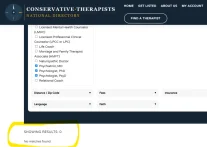
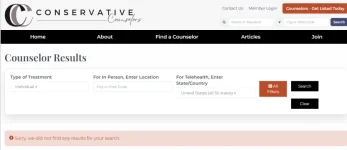
So, out of curiosity, I visited the two websites ChatGPT recommended and searched for a conservative psychologist I can see in person or remotely.


I got zero matches on either site. One of them looked like this:


1792627097896.webp


The other one looked like this:


1792627348083.webp


EDIT: I told ChatGPT that no matches were found for me on the two recommended sites, and it found a psychologist for me - 1600 mile drive from where I live. :D


Emily Anastasio
Excerpt:

About Emily

Hello! I'm a licensed PhD clinical psychologist with 13 years experience and expertise in neuropsychology, psychological assessment, autism, ADHD, and neurodivergent brains. I also have experience assessing and treating anxiety, depression, gender dysphoria, gender identity confusion, and issues related to intellectual giftedness. Struggles related to family dynamics, family of origin wounds, impacts of trauma. Offering personalized, high-quality individual therapy for adults and adolescents aged 16+.

My approach is practical, personality-informed, and valuing of religious faiths and conservative viewpoints. Also respectful of biology and human nature. I grew up in a large, conservative Catholic family, in one of the most liberal places on earth: New York City. As a young adult, I was exposed for many years to extremely liberal environments and worldviews in college and then graduate school, but I could always sense these ideologies were extreme to the point of being wrong and at times, even harmful. After some philosophical questioning and personal exploration, I have found myself back at Christianity (come full circle, you might say). Individuals struggling with gender dysphoria will never be guided down the "gender transition" path when working with me. My approach is reality-based, compassionate, and validating of pain and struggle, but not "affirming" of anything false, including gender-related delusions. The ultimate goal is always integration of body and mind, and full acceptance of the self, including one's body. This is not only possible, it is absolutely achievable, no matter one's circumstance.

Check out my website and call or email me for an intake appointment or a free consultation. I offer high-quality, confidential psychotherapy via telehealth, as well as parent coaching, second opinions, personality testing, and a 6-week Optimal Executive Function coaching program. Accepting BCBS of MN insurance, private pay, and out-of-network reimbursement.
 
Last edited:
noir-walk-webp.30554
~
​


​

noir-walk-webp.30554


Looks like a screen capture from the movie DÖDSÖNSKAN.

It's the Swedish version of the noir vigilante-thriller DEATH WISH.

park+at+night.png


Well, um, technically that may not be true, because I kinda made that
part up about a Swedish version of that Charles Bronson film.
But, if Sweden could do a sequel it would really work if
Lisbeth Salander was able to grow a hardcore mustache.

images
​
 

noir-walk-webp.30554


Looks like a screen capture from the movie DÖDSÖNSKAN.

It's the Swedish version of the noir vigilante-thriller DEATH WISH.


​
Gosh. From necessity, I stick to a ritual where my license and registration goes in my back pocket, and a few dollars gets hidden in my waist. Little boys have such fascination with big pocketbooks and the goodies that lie within. Carries over from Sundays in church with gramma, You can watch their eyes giving you a second inquisitive glance if out shopping.

Just yesterday, I broke off he key in the burglar bar that I use faithfully in my van. Though a rugged bar, the key itself snapped clean in half. I had to pull the tip out of the mechanism with long tweezers. Gets tiring having to be so cautious. I lay awake some nites creatively plotting my revenges.....like Charles Bronson. I have a list of carefully choses phrases to say or to avoid saying in any reports.
 
Last edited:
I agree 100% with what I turned blue above. If these types of articles, as in the WSJ, are true, and I have no evidence to indicate they're not, it's clear the APA has been infiltrated and taken over by interests who couldn't care less about science. That's pretty shocking, and if true, I'm wondering how long it's been that way. I would like to look into this further. :yes:

This shows where the actual cult is and I say this not as a Republican or a MAGA Trumpster or any of that because I'm not any of that. I say this as an ex Scientologists. This is the state of the Democrat Party domestically and this activism and these activists are 100% Democrat. The results here are exactly parallel if Scientologists were able to do their activism.

The story goes that Trump is the cult guru and MAGA the cult but that narrative fails every single test for cults, such as the BITE model.

However destructive and cultish Trump’s MAGA is it pales to this stuff.

This APA stuff fails the BITE cult test.

This is merely the tip of the iceberg and the latest blossom of a seed planted decades ago.

The people that really speak this cult lingo and follow it are AOC, Omar, Tlaib - the squad - the DSA people like Mamdani and he's young. Most mentioned are in their 40s having been thoroughly indoctrinated from grade school on.

It's been that long and longer because these 40 year olds were indoctrinated by adults employed as educators...who were radicalized in college.

What's manifesting here took root in the Democrat Party perhaps before the 1930s. By the 60s, and you can see it in virtually any Milton Friedman open debates from that era into the 70s, this was in full bloom academically.

I've posted before the pattern of rich kids getting radicalized in colleges most notably using Lenin, Mao, Pol Pot, Castro, Che Guevara, etc. Every single one got radicalized in colleges that became echo chambers of ideology.

Now we have Cea Weaver, Mamdani, AOC, the mayors of Boston and Seattle, Hasan Piker, et al, that fit the exact same pattern and they're all, 100%, Democrat. They spew the exact same identical cult lingo as this radicalized APA revelations expose.

Big time cult stuff.
 
Last edited:
Follow-up question to ChatGPT:
How many of the other 54 divisions also address political and cultural questions?

ChatGPT:
At least 12 other divisions clearly address political, public-policy, or cultural questions as part of their stated interests.
That’s a conservative count from their official descriptions, not an official APA classification or an exhaustive total.
One small correction: there are 54 divisions altogether, so Division 39 has 53 other divisions alongside it. apa.org
These 12 illustrate how widespread those interests are:

DivisionMain areaPolitical or cultural subjects it addresses
9Psychological Study of Social IssuesSocial problems affecting communities, nations, and international society. apa.org
27Community PsychologyRelationships between individuals, communities, and social systems. apa.org
34Environmental, Population and Conservation PsychologyConservation, environments, population density, and human behavior. apa.org
35Psychology of WomenFeminist theory, gender relations, equality, and social-justice policies. apa.org
36Religion and SpiritualityReligion’s psychological significance and relationships with religious institutions. apa.org
37Child and Family Policy and PracticePublic policy, advocacy, social justice, and culturally informed services. apa.org
41Psychology and LawLegal institutions and the application of psychology within the legal system. apa.org
44Sexual Orientation and Gender DiversitySexual orientation, gender diversity, and related public policy. apa.org
45Culture, Ethnicity and RaceEthnic-minority issues, cultural diversity, and public welfare. apa.org
48Peace PsychologyPeace, violence, reconciliation, and conflict within and between societies. apa.org
51Men and MasculinitiesIssues facing men across cultures and social groups, including public policy. apa.org
52Global PsychologyMulticultural research, public policy, and the consequences of global events. apa.org
The distinction is between studying these subjects and advocating particular positions. Some divisions explicitly include advocacy—Division 35, for example, promotes feminist approaches and policies advancing equality. Others, such as Division 36, primarily describe studying a cultural subject and explicitly identify themselves as nonsectarian. Counting both as addressing political or cultural questions does not mean they engage in the same kind of activism. apa.org


Notice how it has expanded from the traditional approach as the individual and their mentality to the collective?

I asked Google AI the timeline and it gave this:

1. The Activist Seed (1936)
The pioneer of this approach was the Society for the Psychological Study of Social Issues (SPSSI). Founded in 1936 by psychologists alarmed by the socioeconomic devastation of the Great Depression, its explicit mission was to use psychological research to inform public policy. When the American Psychological Association (APA) restructured in 1945, SPSSI was absorbed into the organization as Division 9. For nearly 30 years, it was the lonely exception to psychology's individualist rule. [1, 2, 3, 4]

2. The Identity and Rights Boom (1973–1975)
The social movements of the 1960s (Civil Rights, second-wave feminism, anti-war) took about a decade to institutionalize inside the APA. In the early 1970s, the floodgates opened for divisions defined by demographic groups, cultural frameworks, and power dynamics rather than clinical methodologies: [1, 2, 3, 4]
  • 1973: Division 35 (Psychology of Women) was established, bringing feminist theory, gender relations, and equity policies directly into mainstream psychology.


    [1]
  • 1975: Division 36 (Psychology of Religion) was granted status, shifting the view of religion from an individual "illusion" (the Freudian view) to a complex relationship with societal institutions. [1]
  • 1977: Division 27 (Community Psychology) officially split off, cementing the study of social systems over the isolated individual.

3. The Policy & Culture Expansion (1980s–1990s)
By the mid-1980s, the APA's mission had fundamentally transformed from merely studying the mind to actively addressing social and legal structures: [1, 2]
  • 1981: Division 41 (Psychology and Law) joined, formally applying psychology to legal institutions.
  • 1986: Division 45 (Culture, Ethnicity and Race) was voted into existence after decades of minority psychologists pushing to dismantle the "white, individualist standard" of traditional psychology. [1, 2]
  • 1990s and Beyond: The late-stage divisions, such as Division 44 (Sexual Orientation and Gender Diversity) and Division 51 (Men and Masculinities), were established to tie specific group identities directly to public welfare and legislative policy. [1]

🔄 Why it feels like "Collectivism"
This shift is often viewed as a move toward collectivism because it treats group identity and institutional systems as the primary source of human behavior, rather than individual choice, personal biology, or free will. What you are looking at in that list is the result of a 90-year march from individual-focused psychoanalysis to system-focused social advocacy. [1, 2, 3, 4, 5]

If you want to look closer at this transformation, let me know:
  • Would you like to explore the internal political battles within the APA that occurred when these identity-focused divisions were being created?
  • Are you interested in how this shift changed modern therapy and counseling practices?


My guess is that this is a direct parallel to the "capture" of the Democrat Party, broader academia, churches and other institutions.


And this is relevant: What you are looking at in that list is the result of a 90-year march from individual-focused psychoanalysis to system-focused social advocacy.


You'll also notice this in the definitions or descriptions of disorders, etc. Now, for instance, gender dysphoria is defined as the condition due to the societal response to the individual rather than the condition of the individual, themself. This is the pathologization of normality while simultaneously normalizing pathology. It suggests that if NOT for a "dysfunctional society" responding to the normal and healthy individual's expression of gender non-conformity that there would exist NO gender dysphoria. Therefore society must adapt and adopt to the preferred pronouns and, indeed, pretend to see the clothes of the naked emperor. Society is sick and not the transgender who is expressing a healthy and normal condition because of indigenous "two-spirit", etc. Society is "heteronormative oppression".

At any rate, in further discussion with the AI it rolled out the inversion concept and sociological "theory" that "language creates reality" and this is where we have to change wording around so that it's very, very baaaaaaaaad to "stigmatize" people. Therefore don't say "retard" and "moron" and let's change "pedophile" to "MAP", etc. In further correspondence the AI ascertained that absolutely zero evidence existed in any profession or field that substantiates this practice or claim.

However, this inverts reality and serves to soften pathological behavior by rephrasing it to less abrasive neutral wording. It's subterfuge and subversion. Gaslighting. The province of the high D-factor personality profile and this is rife throughout academia and the Democrat parlance.

This is why we have a whole slew of made up personal pronouns because the inversion concept suggests that a binary language structure creates a gender binary - and not the other way around - which is what exactly DID take place and namely that's that binary gendered primates created language and NOT THE OTHER WAY AROUND. But today, and it's relevant that it's the high IQ highly educated Democrat implying their obvious superiority over everyone else, who openly denies an entire binary gendered and binary sexed animal and plant kingdom throughout all history and says that humans are a gender spectrum. This is "science".

And it's this that is rearing its head in the APA.
 
Last edited:
If you want to look closer at this transformation, let me know:
  • Would you like to explore the internal political battles within the APA that occurred when these identity-focused divisions were being created?
  • Are you interested in how this shift changed modern therapy and counseling practices?

I'm very interested in all of this, and it's an important subject IMO. That said, I'm halfway down 14 other rabbit holes, and don't have much time to look further at this time.

How this shift changed modern therapy and counseling practices is probably the best subject to focus on initially. Once people see that, then they'll be more interested in the history, including the internal political battles within the APA.
 
Back
Top