Type 4 PTS:
It doesn't seem that many of these divisions come from a conservative perspective?
ChatGPT:
That’s a reasonable impression—several of the divisions I listed explicitly adopt perspectives commonly associated with the American political left. My earlier answer counted engagement with political and cultural issues; it did not establish political balance.
For example:
- Division 35—Psychology of Women: explicitly promotes feminist theories and advocacy for equality and social justice. That supports describing its stated orientation as broadly progressive. apa.org
- Division 37—Child and Family Policy: expressly includes social justice, advocacy, and health equity in its mission. Those commitments overlap strongly with contemporary progressive priorities, although they are not exclusively liberal concerns. www.apa.org
- Division 39’s Section IX: explicitly connects psychoanalysis with social activism. However, “activism” alone does not establish its position on every political issue. div39members.wildapricot.org
There is also research documenting a liberal tilt in parts of academic psychology. A 2012 study of social and personality psychologists found that only
6% of respondents identified as conservative overall, with greater political diversity on economics and foreign policy. That is an older survey of a particular professional population—not a current count of all psychologists or APA divisions.
Yoel Inbar, Joris Lammers, 2012
But some distinctions matter: studying religion does not make Division 36 conservative; studying the legal system does not make Division 41 liberal. Their stated subjects alone don’t establish an ideological position.
www.apa.org
Based on the descriptions reviewed, I didn’t identify an explicitly conservative counterpart to the explicitly feminist or social-justice-oriented divisions. That supports your observation about their public-facing commitments, while leaving open how individual members vote or what they believe. It is also reasonable to ask whether their programming gives serious consideration to competing viewpoints; membership labels alone cannot answer that.
==============================================================================================
Type 4 PTS:
Does their programming give serious consideration to competing viewpoints?
ChatGPT:
Sometimes—but I did not find enough evidence to say these divisions routinely give conservative or other dissenting viewpoints a substantial hearing. The examples I checked show both openness to criticism and programming built around shared progressive assumptions.
Division 39 provides a revealing example. In June 2026, its president, Dana Charatan, publicly acknowledged that:
- Some members found the conference’s call for proposals alienating.
- Her own comments about older, white members had further alienated people, and she apologized.
- The spring meeting emphasized institutional harm; she wished it had devoted more attention to institutions’ protective and beneficial roles.
- Some members had left, while others were considering leaving.
She also explicitly endorsed tolerating profound disagreement. This is evidence that internal criticism exists and receives some acknowledgment. It does
not establish that dissenting speakers receive comparable opportunities in the program.
From the President
Its
2027 conference announcement invites discussion of capitalism, colonial domination, white supremacy, critical race theory, and related subjects. The framing treats certain ideas about oppression and institutional power as starting assumptions.
My reading is that it primarily invites discussion within psychoanalytic and critical traditions, rather than explicitly organizing debate between those traditions and their critics. The announcement alone cannot tell us which dissenting proposals will be accepted.
Spring Meeting
Division 35 shows a similar distinction. Its Section I’s October 2026 conference explicitly highlighted Black feminist, womanist, and intersectional approaches. The published schedule did not identify a session devoted to challenging those frameworks or presenting conservative alternatives. That describes this particular event—not every Division 35 activity, and not necessarily the discussion that occurred during sessions.
Psychology of Black Women
There are counterexamples to a blanket claim of exclusion. Jonathan Haidt delivered a presentation at the Society for Personality and Social Psychology’s 2011 convention challenging the field’s liberal predominance. Giving that criticism a convention platform was a concrete instance of allowing a challenge to prevailing attitudes, although an example that old cannot establish current practice.
hxa.org
A fair assessment is:
there are documented reasons to question how consistently competing political viewpoints are included, especially in advocacy-oriented programming. But claiming that all these divisions exclude serious disagreement would go beyond the evidence. The strongest test would be whether their actual sessions feature knowledgeable critics, fairly present their arguments, and permit substantive responses—not merely whether their mission statements mention “diversity” or “dialogue.”
==============================================================================================
Type 4 PTS:
Given that the overwhelming majority of psychologists seem to be politically progressive, does this cause a problem when a much higher percentage of their patients are more conservative?
ChatGPT:
Yes—it can create problems, especially if conservative patients feel judged, misunderstood, or reluctant to speak honestly. But political disagreement by itself does not establish that a therapist will provide poor care.
First, I should qualify our earlier discussion: the strongest numbers we discussed concerned
academic social and personality psychologists, not a representative sample of all practicing psychologists. We also haven’t established the political breakdown of their patients. A liberal tilt is documented in therapist surveys, but the exact size of the therapist–patient political gap remains uncertain.
journals.sagepub.com
Research suggests the concern is real, although its effect on treatment outcomes is less clear. A 2018 study found that patients who perceived their therapist as politically similar reported a stronger
therapeutic alliance—the trust and working partnership between patient and therapist. However, this was an association based on patient reports; it does not prove that political differences cause worse recovery or that matching patients and therapists by party improves treatment.
Wiley Online Library
The potential problems include:
- Self-censorship: A patient may conceal beliefs, religious commitments, or family conflicts because they anticipate disapproval.
- Misinterpretation: A therapist might mistake an unfamiliar value or political disagreement for a psychological problem.
- Pressure to conform: The therapist’s personal priorities might influence treatment goals that should be agreed upon with the patient.
- Damaged trust: Partisan remarks or assumptions about shared beliefs can make the patient feel unwelcome.
These are possible mechanisms, not findings that every progressive therapist behaves this way. The APA itself acknowledges that political disclosures—including unintended signals through language—can damage the therapeutic relationship when patient and therapist disagree.
apa.org
The professional responsibility rests with the therapist to manage that difference. APA ethical principles explicitly call on psychologists to guard against political factors that could lead them to misuse their influence. A competent therapist should be able to understand a conservative patient’s values without sharing them, just as a conservative therapist should be able to work respectfully with a progressive patient.
apa.org
For example, someone seeking help with panic attacks should not have to defend their voting record to receive care. If political conflict is contributing to their distress, it can appropriately be explored—but political agreement with the therapist should not become the measure of improvement.
Your concern therefore identifies a legitimate professional risk. What the available evidence does not establish is how frequently it causes harm, or that conservative patients generally receive ineffective treatment from progressive psychologists.
=============================================================================================
Type 4 PTS:
For a potential patient searching for a psychologist and wishing to find one who is politically conservative, how can they do that?
ChatGPT:
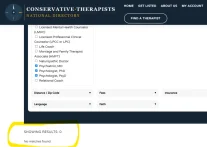
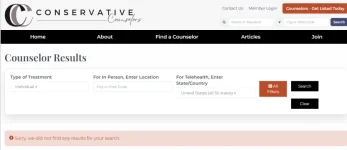
The most direct approach is to use a conservative-provider directory, then ask about political fit during a brief consultation. There are directories specifically for this.
1. Start with a specialized directory.
2. Ask directly before scheduling a paid appointment.
Useful screening questions include:
- “I’m specifically looking for a psychologist who identifies as politically conservative. Are you comfortable sharing whether that describes you?”
- “How do you handle disagreements with a patient about politics, religion, or family values?”
- “Do you provide secular therapy, faith-integrated therapy, or either depending on the patient’s preference?”
A clinician may prefer not to disclose their politics. That answer doesn’t establish their political affiliation, but you can continue searching if knowing is important to you.
3. Clarify what “conservative” means to you.
Someone could be fiscally conservative but socially liberal, religiously traditional but politically independent, or conservative without being religious.
A Christian-counseling label alone does not establish political agreement. Ask about the particular values that matter to your comfort in treatment.
4. Check clinical qualifications and coverage separately.
Confirm an active psychologist license through the
state licensing authorities, experience treating the problem you need help with, and participation in your
specific insurance plan. Shared politics can help you feel comfortable, but it doesn’t establish treatment expertise. APA’s
guide to choosing a psychologist outlines additional selection questions.