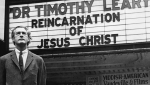
If Dianetics was Hypnosis, how come all the people who first got Dianetics auditing aren't still involved?

Oh, I don't know Gibby, was it really rhetoric or was it his mellifluous voice? Could have been his red hair was mightily influencing the minions.

It was Hubbard's deep baritone voice that got them.


"You are a master. You are as sexy and sensitive as Pan. Lord help women when you begin to fondle them.
You are master of their bodies, master of their souls as you may consciously wish.
You have no karma to pay for these acts.
You cannot now accumulate karma because you are a master adept.
Your voice is low and compelling to them. Singing to them, for you sing like a master, destroys their will to resist..."


From L. Ron Hubbard's Affirmations
 
This latest interview by Chris Shelton of somebody who recently left, guess what she didn't read dianetics but yet still somehow got involved, her mom did and read dianetics and SOS, it's at the beginning of the video, 3:30 mark and even Chris says he didn't read dianetics.

Chris Shelton interviews Katherine Olson, who only escaped Scientology’s Sea Org last year | The Underground Bunker (tonyortega.org)

Question to ask oneself, and like I said earlier and elsewhere lots of staff never got auditing. So the hypnosis theory doesn't sit right with me. What was it to get people involved?

unless i'm mistaken, she says that she did eventually read Dianetics, but only much later. which i think actually goes to the point, that it's not necessarily the rhetoric that gets people into scientology....

and i actually prefer to refer to suggestion (or suggestive techniques) and hypnosis, because i think that better captures the range of phenomenon at work -- it's more than the stereotypical, overt hypnotic session. did you watch those Darren Brown videos, where he's using more subtle techniques to get people to believe in pseudoscience, and give him their valuables?

as others have already pointed out very well, it's not that it's all hypnosis (and related techniques) -- just as it's not all rhetoric.
 
That was my experience with Dianetics. It certainly wasn't hypnosis - I got some Dianetics after a bunch of Grades, so it was the later version of Dianetics. It was boring but not hypnosis.
If my understanding of hypnosis is correct, there are several gradients of hypnosis - and one version that is frequently used by Hubbard, has to do with difference in altitude. A form of low grade hypnosis is a one way flow from a person of higher altitude to a person of lower altitude.

So, if you consider LRH to be a person of higher knowledge etc. than yourself, and the flow of information from him is one way (such as in taped lectures) you can become hypnotized to an extent in accepting what he says is true.

You wouldn't recognize that you have been hypnotized, but to the extent you adopted his ideas, you would be.

You see that in the died in the wool Scientologists - they, despite evidence to the contrary, follow his dictates, concepts without examining them. Once examined, they cease to have a hypnotic effect

When I first read Jeff Hawkins' article on entheta, where he says essentially, it's just bad news redefined, his example of saying the academy stats have crashed is entheta, when in reality it's true, and only bad news, I broke from that particular hypnotic command or mental outlook. It was quite revelatory for me at the time. A milestone on my road out of the cult.

Bill, I would bet, that originally you believed in the e-meter, and it's veracity, IE: that you were hypnotized on a low gradient to accept it worked and was invaluable, but at some point you examined in in depth, and realized it read on belief, and no longer took meter reads as gospel, and were freed from that particular hypnotic command. And thus freed, you wrote your articles in your Just Bill web site.

This mass formation psychosis we see associated with the pandemic, is just that - it is a one way flow from a higher authority telling you to wear a mask, despite there being no evidence they have any value whatsoever. That explains why you see people alone in cars, outside etc. wearing masks when there is zero need to wear them.

Mimsey
 
Last edited:
If my understanding of hypnosis is correct, there are several gradients of hypnosis - and one version that is frequently used by Hubbard, has to do with difference in altitude. A form of low grade hypnosis is a one way flow from a person of higher altitude to a person of lower altitude.

So, if you consider LRH to be a person of higher knowledge etc. than yourself, and the flow of information from him is one way (such as in taped lectures) you can become hypnotized to an extent in accepting what he says is true.

You wouldn't recognize that you have been hypnotized, but to the extent you adopted his ideas, you would be.

You see that in the died in the wool Scientologists - they, despite evidence to the contrary, follow his dictates, concepts without examining them. Once examined, they cease to have a hypnotic effect

When I first read Jeff Hawkins' article on entheta, where he says essentially, it's just bad news redefined, his example of saying the academy stats have crashed is entheta, when in reality it's true, and only bad news, I broke from that particular hypnotic command or mental outlook. It was quite revelatory for me at the time. A milestone on my road out of the cult.

Bill, I would bet, that originally you believed in the e-meter, and it's veracity, IE: that you were hypnotized on a low gradient to accept it worked and was invaluable, but at some point you examined in in depth, and realized it read on belief, and no longer took meter reads as gospel, and were freed from that particular hypnotic command. And thus freed, you wrote your articles in your Just Bill web site.

This mass formation psychosis we see associated with the pandemic, is just that - it is a one way flow from a higher authority telling you to wear a mask, despite there being no evidence they have any value whatsoever. That explains why you see people alone in cars, outside etc. wearing masks when there is zero need to wear them.

Mimsey
Note: It's "dyed in the wool". [pedantic]

I don't agree with your ideas about my being hypnotized. Believing much of what Hubbard said certainly was gullible, foolish and stupid, but I don't see how that has anything to do with hypnosis, technically.

In the beginning, I did believe Hubbard's claims -- but that was due to my being young and inexperienced in life, not because Hubbard dropped by and put me in a trance.

It is odd that there is such a fuzzy concept for "hypnosis". Using some definition I'm not yet aware of, I'm sure one could say that I was hypnotized, but from what I know about hypnosis, I wasn't. Just stupid.
 
Note: It's "dyed in the wool". [pedantic]

I don't agree with your ideas about my being hypnotized. Believing much of what Hubbard said certainly was gullible, foolish and stupid, but I don't see how that has anything to do with hypnosis, technically.

In the beginning, I did believe Hubbard's claims -- but that was due to my being young and inexperienced in life, not because Hubbard dropped by and put me in a trance.

It is odd that there is such a fuzzy concept for "hypnosis". Using some definition I'm not yet aware of, I'm sure one could say that I was hypnotized, but from what I know about hypnosis, I wasn't. Just stupid.


I think that even within a group of professional hypnotists there is often some disagreement about the distinction between hypnosis and trance. I'm going to post a few things about the distinction between hypnosis and trance, and there will in all likelihood be differences between the various posts.

I believe that some of what was done in Scientology made it very easy to go into a trance state, including TR 0, possibly while studying in the academy as well. And being in a trance can make one more suggestible. If anyone went into a trance state during the time they were studying Hubbard's writings then this point can be important. While I don't believe that hypnosis was necessary in order to recruit or maintain members I wouldn't be surprised if he used his extensive knowledge of hypnosis and trance states to accomplish that purpose. Of course, Hubbard had so many other ways in which this was done as well.

Here's a post from John Kreiter: (emphasis added by me)

The Difference Between Hypnosis and Trance

Hypnosis is defined as; an artificially induced trance state resembling sleep, characterized by a heightened susceptibility to suggestion.

Hypnosis then is one way to go into trance. It is good to be clear on the fact that hypnosis is not trance but just one way to attain trance. Why this is important is because, in personal change, trance is very important while hypnosis is just one method of attaining this most important state.

Hypnosis essentially requires a hypnotist. The hypnotist basically becomes a guiding force for the patient and becomes an authoritative figure that leads to patient’s consciousness into a desired state. This is a very powerful way to achieve a trance state but it does have some flaws.

First of all, hypnosis takes it for granted that in order to hypnotize someone you need to have them go into a lethargic sleep like state. Now if the ultimate outcome of hypnosis is attaining a trance state, then you must realize that you do not need to going to a sleep like state to get there. a trance state can also be achieved through great excitation, this can be seen when you witness an athlete performing a difficult physical task or when you see people achieve ecstatic states while dancing.

Hypnosis also tends to function much better with a hypnotist. It is possible to get yourself into a self hypnosis state, but these states are usually weaker than anything that can be achieved with the hypnotist. Now this is the case because you are following hypnotic procedure in order to try and achieve a trance. You can though achieve a trance by yourself that is far stronger than anything that you can achieve through self hypnosis. Trance states therefore are far easier to achieve than self hypnosis.

There is great contention as to who can be hypnotized. Many experts believe that only highly suggestible people can become hypnotized, that there is a large number of people out there that cannot be hypnotized or that some people cannot be put into a hypnotic trance that is very strong. While this might or might not be true, it is fact that anyone can go into a trance state. A trance state can best be defined as a complete focus of the consciousness on one object or subject. So any time that you are completely focused on one thing, and you are ignoring or not aware of everything else around you, you are in a trance state.


Why are trance states so important? They are important because they are the best way possible to implant a belief into your subconscious. In order to do this you focus your mind completely on your desired belief or thought. The trance is achieved when you are able to focus your mind completely on this thought or belief to the exclusion of everything else. Another way to say this is that any thought or belief that you are able to maintain in your mind while in a state of complete mental silence, becomes a command to your subconscious. In this way you are able to consciously program yourself by correctly affecting your subconscious beliefs and actions.

There are two major ways to achieve trance. The first that we have mentioned is the one taken by the hypnotist; this is achieved by getting yourself into a very relaxed, almost sleep like state, where through complete body relaxation you are able to focus your conscious mind on a single goal. The other method which I briefly mentioned is through excitation; this trance state is achieved by getting yourself in an incredibly excited state. A trance state achieved through excitation can be achieved through great physical stress for example. Native people of the world can be seen attaining these types of trances through drumming, dancing, and wild agitation.

The fact of the matter is though that there is no need to go into either extremes to create a trance like state that is most useful. You can for example create the perfect trance state while being completely awake and not gyrating to the drumbeats of jungle rhythms. In order to do this all you have to do is train yourself to focus completely on one thought or desire. In order to develop the kind of concentration that you need, I suggest you read the article Learn The Power of Concentration.

By knowing that the active ingredient of hypnosis is trance, and by knowing that a trance can be achieved through many varied methods, which do not need to involve hypnosis, you can begin to create your own methods to achieve trance states that are far simpler and far more powerful. Remember that a trance state is your full and complete mental concentration on one object or idea. As such then you are constantly in different states of trance as you go about your day. Personal trance states are natural to all of us and they can be used by us at any time to help us achieve our goals.
 
What’s The Difference Between Hypnosis & Trance?
by
Kevin Cole
( trained with Dr. Richard Bandler, a Master Hypnotist)


This is a question that I get asked a lot, and frankly, because there has never been an agreeable definition of exactly what “Hypnosis” is and exactly what “Trance” is, I can only share my opinions.
So, what are my opinions?

Well, I believe that “Trance” is simply an altered state of consciousness that can be reached through many different experiences in many different forms. The terms we give to the two most common forms of trance include, “Downtime Trance” and “Up-time Trance” (sometimes known as “Waking Trance”).

In order to better understand, here are some examples of the two generic kinds of trance.

Some of the most common examples of a “Downtime Trance” include;

Meditating
Driving long distances
Missing your off ramp while driving
Just before falling asleep
Getting caught up in a good book
Enjoying a good movie
Experiencing portions of a live hypnosis training
Daydreaming
Becoming absorbed in a project of task
Listening to an instructor speak
Watching television, browsing the internet, listening to the radio while driving(advertisers take HUGE advantage of all of these by the way)
And of course much more
Some of the most common examples of an “Uptime Trance” include;

Practicing martial arts
Being on a nature hike
Experiencing portions of a live NLP Training
Being involved in an extreme sport like skydiving
Playing chess
Public speaking
Driving fast while weaving in/out of lanes (not that we recommend it!)
Sculpting
Wilderness tracking
Photography
Being the conductor of an orchestra
And of course much more
When you are experiencing a “Downtime Trance”, your brainwave activity has most likely altered from what we call a “Beta Brainwave” (Which simply means that you are experiencing a standard waking consciousness), and has transitioned into either an “Alpha Brainwave” (which is basically a light to medium trance) or a “Theta Brainwave” (which is basically a medium to deep form of trance) which allows you to more easily recognize and focus on what’s happening *inside* yourself.

And when you are experiencing an “Up-time trance” your brainwave activity has most likely altered from a standard “Beta Brainwave” to either a “High Beta Brainwave” or a “Gamma Brainwave” which allows you to more easily focus on what’s happening *outside* yourself.

I know some of these terms might seem a little jargonistic, but hang in there. It’ll all make sense very soon.

Very simply put, the answer to the question, “What’s The Difference Between Hypnosis And Trance?”, is…

Hypnosis is simply the intentional usage of these different kinds of trance as a tool for helping ourselves and or others achieve our goals in life.

<snip>
 
Here's a video on Hypnosis vs Trance by Brian David Phillips. From his Bio: Brian is a Certified Focused Trance Guide Instructor Trainer, and Board Certified Hypnotist (Certified Hypnotherapist and Certified Hypnosis Instructor Trainer) with broad experience in trance modalities of various types. In addition to my work as a focused trance guide, hypnotherapist, a trance-based performance hypnosis specialist, and a trance modality trainer,

 
Oh, I don't know Gibby, was it really rhetoric or was it his mellifluous voice? Could have been his red hair was mightily influencing the minions.


A quote from Michael Harris, Ph.D., a Board Certified Hypnotherapist:

The Classic Definition of Suggestibility.
“People are typically more suggestible in a trance state than in a waking state. The other factors affecting this are tonality, pacing, rhythm, and choice of language patterns”.
 
You took 75 LSD trips? Wow. I only took about a dozen but I can still relate.

It probably didn't alter my DNA but my Genetic Entity probably didn't know what was coming at it.
.
.
(joke)
Yeah. But it's about quality, not quantity. Some of it was fun, but a lot was mostly just a waste of time. I certainly don't recommend it, especially not nowadays.

All you kids out there, stay in school!

 
Yeah. But it's about quality, not quantity. Some of it was fun, but a lot was mostly just a waste of time. I certainly don't recommend it, especially not nowadays.

All you kids out there, stay in school!


Any idea as to what Hubbard's real reason was for disqualifying people for the Sea Org if they've taken LSD?
 
Any idea as to what Hubbard's real reason was for disqualifying people for the Sea Org if they've taken LSD?
1) I think Hubbard saw the drug culture as competition. If people could have mystical experiences on drugs, they wouldn't need scientology. No doubt Hubbard had had many "mystical experiences" on drugs himself.

In the beginning, LSD seemed almost like a new religion. The drug culture had some charismatic leaders.

1653952843440.png

2) People who took acid tended to be rebels and not easily cowed by authority. Not the kind of people you want in a quasi-military organization like the Sea Org.
.
I remember hearing about S.O. early in my scn experience and thinking, "Not for me, never!" Even at my most gung-ho, I never even considered it. (Of course, they wouldn't have taken me anyway, which was fine with me.)

Edit: I spent my entire scn career at two missions and one Cl IV org, and most of it in Hawaii. There were no S.O. in any of these places, so I had virtually no contact. Two S.O. recruiting missions came through Hawaii in my time; I was not tempted at all.
 
Last edited:
Those of you who don't think you were hypnotized in scn: Okay, maybe you weren't. I wasn't there and I don't know what was happening in your universe. I do not insist that you, personally, were hypnotized.

But I do think Hubbard was trying like hell to hypnotize you. In most cases he succeeded, but this time maybe he had his mojo workin', but it just didn't work on you. :confused:
 
.

If Dianetics was Hypnosis, how come all the people
who first got Dianetics auditing aren't still involved?


ANSWER: Because hypnosis is like the rain. It doesn't always rain 24 hours a day 365 days a year. And when it does rain you only get "soaked" if you intentionally stand in the rain without a raincoat, umbrella and/or other protective gear.


soak
intransitive verb
1: to lie immersed in liquid (such as water) : become saturated by or as if by immersion
2a: to enter or pass through something by or as if by pores or interstices : PERMEATE
b: to penetrate or affect the mind or feelings —usually used with in or into
3: to drink alcoholic beverages intemperately
transitive verb
1: to permeate so as to wet, soften, or fill thoroughly
2: to place in a surrounding element (such as liquid) to wet or permeate thoroughly
3: to extract by or as if by steeping - soak the dirt out
4a: to draw or take in by or as if by suction or absorption - soaked up the sunshine
b: to intoxicate (oneself) by drinking alcoholic beverages

5: to cause to pay an exorbitant amount

.
 
Those of you who don't think you were hypnotized in scn: Okay, maybe you weren't. I wasn't there and I don't know what was happening in your universe. I do not insist that you, personally, were hypnotized.

But I do think Hubbard was trying like hell to hypnotize you. In most cases he succeeded, but this time maybe he had his mojo workin', but it just didn't work on you. :confused:
Yeah, no. Inever met him, never talked to him. Not a problem.
 
Like I said in my above post, if John Campbell was Hubbard's first auditor, and Hubbard audited him, why didn't Campbell continue to follow hubbard? How come? Was Campbell hypnotized? I think not. Think about it. Hubbard thru his rhetoric convinced Campbell he had solved world problems and the answer was dianetics which Campbell fell for but later rejected. Think about it. Campbell was Hubbard's first dianetics auditor but never produced a clear. Think about that..
 
I am very happy everybody is discussing this topic in a civil manner, it's actually old time rhetoric and civil. There is the camp hypnosis, there is the camp not hypnosis, and there is the camp of rhetoric, and there is the camp of Veda, and there is the camp of indies and scientologists.

One could never do this why when Hubbard introduced his KSW when involved, keeping scientology working, only he was right, there was no discussion, no civil discourse.

Rhetoric: how its definition has changed over time | Akanksha Bhusari's RCL Blog (psu.edu)

"Looking at the evolution of rhetoric, it stands to show how society has changed. In the ancient times, rhetoric acknowledged that disagreement was natural and it offered a means to deal with disagreement in a civil and civic way. Today however, rhetoric is given a bad reputation due to its association with disagreement, which has a negative connotation in society. In ancient times, rhetoric was used to agree to disagree (Hawee, 1994) while today it is used as a means to go against disagreement. Personally, being civic is more a mentality and a set of values than it is a sequence of actions and ancient rhetoric aligns with that. "

What Hubbard did was twist the natural rhetoric equation, to he was only right

.
 
Any idea as to what Hubbard's real reason was for disqualifying people for the Sea Org if they've taken LSD?


According to Ron Jr. (Nibs), Hubbard had a bad LSD trip during the mid 1950s.

Hubbard had audited Aldous Huxley on Dianetics in 1950.

Huxley was a proponent of psychoactive substances, and wrote a book about his experiences on Mescaline, which Hubbard praised as a "good book" in a 1956 Professional Auditors Bulletin.

It's possible that Hubbard, who had experimented with peyote while in Arizona in 1954, obtained his LSD from Huxley.

Huxley had his wife inject him with LSD on his deathbed in 1963:

 
Note: It's "dyed in the wool". [pedantic]

I don't agree with your ideas about my being hypnotized. Believing much of what Hubbard said certainly was gullible, foolish and stupid, but I don't see how that has anything to do with hypnosis, technically.

In the beginning, I did believe Hubbard's claims -- but that was due to my being young and inexperienced in life, not because Hubbard dropped by and put me in a trance.

It is odd that there is such a fuzzy concept for "hypnosis". Using some definition I'm not yet aware of, I'm sure one could say that I was hypnotized, but from what I know about hypnosis, I wasn't. Just stupid.

Ericksonian Hypnosis
Ericksonian Hypnosis – named after Milton Erickson (the father of modern hypnotherapy) – is a type of hypnosis that uses metaphors, storytelling, and indirect suggestions instead of direct suggestions or commands. The theory behind this technique is that you are less likely to resist indirect suggestions, which can help you absorb and internalize them better. It relies greatly on your unconscious mind and offers a more organic approach to suggesting change. This type of hypnosis is particularly useful for those who are skeptical of traditional hypnosis.

GuanoLoco wrote some stuff about the altitude difference hypnosis on the old ESMB, and this Ericksonian Hypnosis is similar. I didn't spend a bunch of time trying to find the data. BTW, I fixed the died in the wool - thanks. Mimsey
 
Ericksonian Hypnosis

that then spawned NLP, which though i think is a bit hokey in its own way, is on the mark as far as trying to leverage mechanisms of influence, manipulation and even control that do actually exist and 'work' to at least some extent, including suggestive techniques, and conversational or covert hypnosis.

interestingly, Erickson was based in Phoenix for a long time, and i discovered that LRH was working out of a location not far away. there almost had to have been some indirect connections due to both attracting people with the same sort of interests, and the possibility of 'source' more directly getting things from Erickson's 'work' can't be ruled out. it's certainly a reminder that LRH was just one of many people in that era with such interests, from amateurs to people trying to pursue the subject rather professionally.

i like Darren Brown as a go to because while he's doing things for show, he's obviously a master of these techniques who is interested in how they work and how far they can be pushed, and in not just entertaining but also educating people.

this is sort of a follow on to reports several years ago from Europe (and the US) that robbers were using hypnotic techniques to get store clerks to hand over money from the cash register. these videos are only a minute and a half each and well worth watching and pondering.


ETA: notice that how in both videos, early on when he's engaging with them about other things he inserts the suggestion/command 'you're happy to give that to me', and then continues with at least an attempt to shake their hands and hold their wrists, before on to getting them to hold his water bottle as some sort of distraction/diversion, after which they give him their wallets (and in the second case, other items) when asked/told to.

it's interesting that he says this technique worked on about 2/3 of people (though that may be figuring in only the ones he got to stop and engage to begin with). that would fit with research showing that about a quarter of people aren't hypnotizable at all and the rest have varying degrees of susceptibility, with only less than a quarter being in the most highly susceptible category -- so his techniques apparently work on all but the invulnerable.

ETA2: i decided to do a quick check for an explanation and found this -- it is in fact Ericksonian techniques at work

The Handshake Induction
Confusion is the basis of Erickson's famous hypnotic handshake. Many actions are learned and operate as a single "chunk" of behavior: shaking hands and tying shoelaces being two classic examples. If the behavior is diverted or frozen midway, the person literally has no mental space for this - he is stopped in the middle of unconsciously executing a behavior that hasn't got a "middle". The mind responds by suspending itself in trance until either something happens to give a new direction, or it "snaps out". A skilled hypnotist can often use that momentary confusion and suspension of normal processes to induce trance quickly and easily.

By interrupting the pattern of a 'normal' handshake in some way, the hypnotist causes the subject to wonder what is going on. If the handshake continues to develop in a way which is out-of-keeping with expectations, a simple, non-verbal trance is created, which may then be reinforced or utilized by the hypnotist. All these responses happen naturally and automatically without telling the subject to consciously focus on an idea.

The various descriptions of Erickson's hypnotic handshake, including his own very detailed accounts, indicate that a certain amount of improvisation is involved, and that watching and acting upon the subject's responses is key to a successful outcome. The most important thing is that the 'normal' handshake is subverted in such a way to cause puzzlement, which may then be built upon.

Richard Bandler was a keen proponent of the handshake induction, and developed his own variant, which is commonly taught in NLP workshops.

Any habitual pattern which is interrupted unexpectedly will cause sudden and light trance. The handshake is a particularly good pattern to interrupt because the formality of a handshake is a widely understood set of social rules. Since everyone knows that it would be impolite to comment on the quality of a handshake, regardless of how strange it may be, the subject is obliged to embark on an inner search (known as a transderivational search, a universal and compelling type of trance) to identify the meaning or purpose of the subverted pattern.

further and more detailed explanation at link:

 
Last edited:
that then spawned NLP, which though i think is a bit hokey in its own way, is on the mark as far as trying to leverage mechanisms of influence, manipulation and even control that do actually exist and 'work' to at least some extent, including suggestive techniques, and conversational or covert hypnosis.

interestingly, Erickson was based in Phoenix for a long time, and i discovered that LRH was working out of a location not far away. there almost had to have been some indirect connections due to both attracting people with the same sort of interests, and the possibility of 'source' more directly getting things from Erickson's 'work' can't be ruled out. it's certainly a reminder that LRH was just one of many people in that era with such interests, from amateurs to people trying to pursue the subject rather professionally.

i like Darren Brown as a go to because while he's doing things for show, he's obviously a master of these techniques who is interested in how they work and how far they can be pushed, and in not just entertaining but also educating people.

this is sort of a follow on to reports several years ago from Europe (and the US) that robbers were using hypnotic techniques to get store clerks to hand over money from the cash register. these videos are only a minute and a half each and well worth watching and pondering.


I think Hubbard would attempt to use any covert means of influence he possibly could. And given his many years of experience as a hypnotist, it would shock me if he didn't at least attempt to use some of it against cult followers. Here is a quote from Mankind's Greatest Friend himself (from his affirmations/admissions):

"Material things are yours for the asking. Men are your slaves. Elemental spirits are your slaves. You are power among powers, light in the darkness, beauty in all."

Last night I watched a video from part of a course called Redesigning Your Destiny which is taught by Dr Joe Dispenza. Amongst other things he shows students how to intentionally put themselves into a trance state and reprogram their subconscious. This is a quote from his video:

"Suggestibility is your ability to accept, believe, and surrender to information without analyzing it. When you're in a trance you're more suggestible..." The critic is in the back seat and you can program the subconscious mind, creating your future."

From what I understand, people naturally go into trance states on a regular basis. IF it is true that one is more suggestible in a trance state then I wonder if I was ever in such a state during one of the 10 or 20 times I was studying KSW Series 1. :unsure: :ohmy:
 
Last edited:
Back
Top