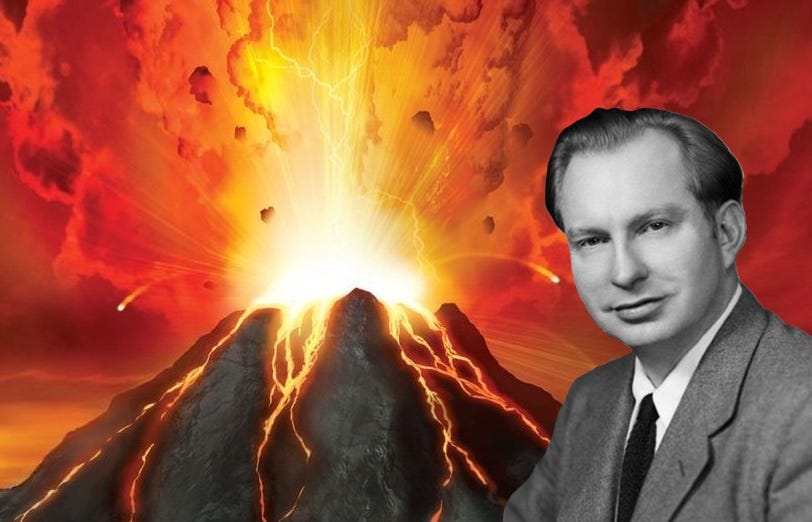
Dianetics at 75: Scientology’s bible, endorsing child molestation since 1950

Karen#1

Well-known member
TONY ORTEGA
Excerpt:

Seventy-five years ago today, L. Ron Hubbard published the book that changed his life and sparked a movement, Dianetics: The Modern Science of Mental Health.

Two years later, after the brief Dianetics boom had gone bust (along with his second marriage), Hubbard regrouped in Phoenix and, with the name “Dianetics” stuck in bankruptcy, called his new idea “Scientology,” replacing a focus on recovering memories in the womb (a central part of Dianetics) with recovering memories from past lives.

But even as Scientology grew and went in many strange directions, Hubbard’s 1950 bestseller Dianetics has remained, even today, “Book One” for Scientologists, and the bedrock text that the movement rests on.

READ MORE

 
The seven-year-old girl who shudders because a man kisses her is not computing; she is reacting to an engram since at seven she should see nothing wrong in a kiss, not even a passionate one

I’ve always wondered about LRH surrounding himself with pubescent Messengers in hot pants.

I was thinking he may have thought it a cure for his impotence.
 
I wonder how many times the average Scientologist has read something by Hubbard and felt he had to tell himself, "He doesn't mean it the way it sounds". When I was in the fold, there were a handful of times I was irked by some self-serving Hubbard statement. For me probably the most aggravating was his stating that the purpose of an auditor was "to help LRH clear the planet". So, I was supposed to have the PC in front of me and maintain the attitude that I had to help Hubbard? That pissed me off no end. Believing in what I was doing there, I was there to help the PC, not Hubbard, and had anyone asked, I would have made that painfully clear. To willfully guide a PC through a session to forward the purpose of somebody else would be a betrayal of the PC's trust in me. Perhaps equally aggravating to me was the peer pressure to applaud and cheer "Hip hip hoorah!" for Hubbard. I never could stomach doing that, so I'd stand silently, bristling at the sheep around me, and the jerk leading the cheering. There was a lot that I did willingly swallow, but not that stuff.
How about the tripe in "Keeping Scientology Working", specifically, "A girl died of cancer from a beating from a mis-audited PC"? Literally everyone had to find a way to get past that without outwardly calling Hubbard out for demanding that we all go along with insulting our intelligence to force intellectual submission to anything that came from him (and wasn't that the entire point of "KSW").
 
Yes. There's a thread on the old board which references a passage from the Philadelphia Doctorate Course in which LRH basically declaies calculus to be worthless. Don't read it unless you're willing to risk getting a headache;;

"Rate of change is this mathematics known as Calculus. Calculus, it's a very interesting thing, is divided into two classes -- there's Differential Calculus and Integral Calculus. The Differential Calculus is in the first part of the textbook on Calculus, and Integral Calculus is in the second part of the textbook on Calculus. As you look through the book, you'll find in the early part of the book on Calculus, "dx" over "dy", a little "dx", and a little "dy" -- and one's above the other on a line -- predominates in the front part of the book, but as you get to the end of the book you find these "dx" and "dy"s preceded by a summation sign, or are equating to a summation sign, and the presence of this shows that we are in the field of Integral Calculus. Now I hope you understand this, because I've never been able to make head nor tail of it. It must be some sort of a Black Magic operation, started out by the Luce cult -- some immoral people who are operating up in New York City, Rockefeller Plaza -- been thoroughly condemned by the whole society.

Anyway, their rate-of-change theory -- I've never seen any use for that mathematics, by the way -- I love that mathematics, because it -- I asked an engineer, one time, who was in his 6th year of engineering, if he'd ever used Calculus, and he told me yeah, once, once I did, he said. When did you use it? And he said I used it once. Let me see, what did you use it on? Oh yeah. Something on the rate-of-change of steam particles in boilers. And then we went out and tested it and found the answer was wrong.

Calculus -- if you want to know -- there is room there for a mathematics which is a good mathematics. And it would be the rate of co-change, or the rate of change when something else was changing, so that you could establish existing rates of change in relationship to each other, and for lack of that mathematics, nobody has been able to understand present time -- you just can't sum it up easily -- or let us say, for lack of an understanding of what present time was, nobody could formulate that mathematics. So, actually there's a big hole there that could be filled -- a thing called calculus is trying to fill that hole, right now, and it can't.

But the rates of change -- it comes closest to it. I think it was one of Newton's practical jokes. Here we have Calculus, and it's trying to measure a rate of change. Well, if we had something that was really workable and simple, it would be formed on this basis. The present time, and gradients of time were gradients of havingness, and as one havingness changed, you could establish a constancy of change for other related havingnesses.

But because the basic unit of the universe is two, you would have to have a rate of change known and measured for every rate of change then estimated. The mathematics won't operate in this universe unless it has simultaneous equations. If you have two variables, you must have two equations with which to solve those two variables. In other words you have to compare one to the other simultaneously. Otherwise you just get another variable. Of course, people laughingly do this. They take an equation with two variables, and then they solve it. And then you say "What have you got?" And the fellow says "K". And you say now just a minute -- you got "K", huh? Well, what is "K"? Well "K", we have established arbitrarily as being -- well, say, why did you work the equation out in the first place? You had "K", didn't you?""


Now, a lot of people in Scn (especially Scn public) were very *maths literate - the subject attracted a lot of engineers, especially in the early days. Imagine all the problems they must have had with students coming upon the section and thinking to themselves (putting it politely), "This makes no sense at all", or (the less heavily conditioned ones) "Hubbard's talking out of his arse here", and yet knowing full well that they can't tell the Course Sup that or they'll end up in Ethics.

* The 's' on the end is because I'm British. Americans of course will leave it off.
 
Last edited:
Yes. There's a thread on the old board which references a passage from the Philadelphia Doctorate Course in which LRH basically declaies calculus to be worthless. Don't read it unless you're willing to risk getting a headache;;

"Rate of change is this mathematics known as Calculus. Calculus, it's a very interesting thing, is divided into two classes -- there's Differential Calculus and Integral Calculus. The Differential Calculus is in the first part of the textbook on Calculus, and Integral Calculus is in the second part of the textbook on Calculus. As you look through the book, you'll find in the early part of the book on Calculus, "dx" over "dy", a little "dx", and a little "dy" -- and one's above the other on a line -- predominates in the front part of the book, but as you get to the end of the book you find these "dx" and "dy"s preceded by a summation sign, or are equating to a summation sign, and the presence of this shows that we are in the field of Integral Calculus. Now I hope you understand this, because I've never been able to make head nor tail of it. It must be some sort of a Black Magic operation, started out by the Luce cult -- some immoral people who are operating up in New York City, Rockefeller Plaza -- been thoroughly condemned by the whole society.

Anyway, their rate-of-change theory -- I've never seen any use for that mathematics, by the way -- I love that mathematics, because it -- I asked an engineer, one time, who was in his 6th year of engineering, if he'd ever used Calculus, and he told me yeah, once, once I did, he said. When did you use it? And he said I used it once. Let me see, what did you use it on? Oh yeah. Something on the rate-of-change of steam particles in boilers. And then we went out and tested it and found the answer was wrong.

Calculus -- if you want to know -- there is room there for a mathematics which is a good mathematics. And it would be the rate of co-change, or the rate of change when something else was changing, so that you could establish existing rates of change in relationship to each other, and for lack of that mathematics, nobody has been able to understand present time -- you just can't sum it up easily -- or let us say, for lack of an understanding of what present time was, nobody could formulate that mathematics. So, actually there's a big hole there that could be filled -- a thing called calculus is trying to fill that hole, right now, and it can't.

But the rates of change -- it comes closest to it. I think it was one of Newton's practical jokes. Here we have Calculus, and it's trying to measure a rate of change. Well, if we had something that was really workable and simple, it would be formed on this basis. The present time, and gradients of time were gradients of havingness, and as one havingness changed, you could establish a constancy of change for other related havingnesses.

But because the basic unit of the universe is two, you would have to have a rate of change known and measured for every rate of change then estimated. The mathematics won't operate in this universe unless it has simultaneous equations. If you have two variables, you must have two equations with which to solve those two variables. In other words you have to compare one to the other simultaneously. Otherwise you just get another variable. Of course, people laughingly do this. They take an equation with two variables, and then they solve it. And then you say "What have you got?" And the fellow says "K". And you say now just a minute -- you got "K", huh? Well, what is "K"? Well "K", we have established arbitrarily as being -- well, say, why did you work the equation out in the first place? You had "K", didn't you?""


Now, a lot of people in Scn (especially Scn public) were very *maths literate - the subject attracted a lot of engineers, especially in the early days. Imagine all the problems they must have had with students coming upon the section and thinking to themselves (putting it politely), "This makes no sense at all", or (the less heavily conditioned ones) "Hubbard's talking out of his arse here", and yet knowing full well that they can't tell the Course Sup that or they'll end up in Ethics.

* The 's' on the end is because I'm British. Americans of course will leave it off.

So Hubbard had Kamala beat by light-years in ability to compose word salads.

I forget what his grades were in math at GW Univ. D's I think. He was not that bright. Oh, that reminds me of KSW #1, talking about the not quite bright people. Oh, well. At least he was a super-being at word salading. Word-salad OT in fact. Now how much would you pay to have that ability?
 
Back
Top