Hubbard became an "implanter" in September 1963.

.


Really? I never heard that one.

It sounds very odd and unlikely. Is there any link to who said it?

Removing dictionaries from a Scientology course room would be comparable to removing the terms "God" and "Jesus" from the Bible. Unless the new courses in the cult each included their own comprehensive glossary of terms.

.
Somebody on Rinder's blog said when they were at Flag they went into a course room and the tech dictionaries were missing and I think someone else said the same thing about an org. There were a few back and forth comments about it. For now it's just something someone said on the internet. Lol
Next time I comment there I'll make an inquiry.
 
A good experiment would be to take someone with zero exposure and then run Scientology stuff on them without doing much, if any, PC hatting and finding out what happens.
I have considered that many times. What would happen in an auditing session if the PC were not first oriented & indoctrinated with a "CS-1" that taught them exactly "what is needed and wanted" from them as a new preclear.
Been there, done that fellas. :LOL::LOL::LOL:

My story is here and here. :whistle:

I'll be interested in hearing what someone who is a never-in and rigorously trained
in other mental studies, like @Reyne Mayer, has to say about all this. Seems to me
looking back, the processes themselves produce a certain suggestibility when
done by a somewhat competent, caring, and commanding person, like I apparently
must have been at that time.

So then to summarize my experiences, I'll point to my previous post on this thread.
All I can ever write about is my personal anecdotes of what happened.

I did have a couple "incredible moments" in my processing over the years, things I
can't explain and were wonderful and snared me tightly into continuing on. I'll pass
on writing about those for another day. Don't know how much I want to say really. ¯\_(ツ)_/¯
 
....

A good experiment would be to take someone with zero exposure and then run Scientology stuff on them without doing much, if any, PC hatting and finding out what happens.

....

I've done this on a number of occasions. No preparation. No explanation. No e-meter.

I first did it before becoming seriously involved, having only read some of Hubbard's books plus Ruth Minshull's Miracles for Breakfast, and was impressed when the person I was "processing" came "up tone," going from being grumpy and introverted to being cheerful and extroverted.

Another time I cured a person's hiccups by using a process from the book Creation of Human Ability. In fact I've used the same process, informally, a couple of time, and it always "worked."

Little things.

For example, seeing a person who's constantly being interrupted - or ignored - and is becoming quietly upset, then allowing the person to express himself without being interrupted - or appropriately acknowledging the person - much to the person's relief. Of course, as a result, the person "rises in tone."

All of this was "applying the tech." It was very convincing to me.

The other person had no idea that he was being "processed" or "handled."

I never used these instances to attempt to disseminate Scientology, but the experiences did make me particularly unreceptive to those who insisted that Scientology was nonsense.

Of course, at the time, at the distant periphery of Scientology, I really had no idea what Scientology actually was.

I assumed, erroneously, that it was an honest subject, and that these experiences were representative of the subject as a whole.

This type of "processing" is in contrast to the usual Scientology "preclear" who enters the trance of being "in session," and follows the familiar pattern in which he has been trained.
 
Somebody on Rinder's blog said when they were at Flag they went into a course room and the tech dictionaries were missing and I think someone else said the same thing about an org. There were a few back and forth comments about it. For now it's just something someone said on the internet. Lol
Next time I comment there I'll make an inquiry.
I remember reading (probably here) that the Tech Volumes -- the red books with all the HCOB's -- had been removed from courserooms. That is much more believable than no Tech dictionaries.

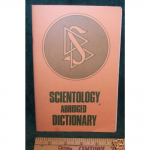
Although, @Zertel, if you were in scn roughly the same time as me, you may remember when there was no Tech dictionary. There was only a little booklet called the "Scn Abridged Dictionary." This was the case when I started out in '75. The actual Tech Dictionary came along a little later, probably on my first iteration of HSDC. So scngsts did somehow get along without it, for at least 25 years! o_O

1654572290304.png

ETA picture of scn abridged dict.
 
Last edited:
Thanks but my question is more about the timing. Expecting a newbie scientologist to work their way through several scientology books at the beginning without getting bogged down seems impossible. As a guess maybe it's just another stupidity introduced by DM. Buy the books, read the books and then write a Success Story? Somebody said they don't even keep "Tech Dictionaries" in the course room anymore. Figure it out by context or go ask the Supervisor?

@ILove2Lurk said she read some scn books before getting in so as with any books on any subject it's possible to get an overview. Good enough is good enough might be the current expectation but I still havent seen an exact description of how it works these days.
.


Really? I never heard that one.

It sounds very odd and unlikely. Is there any link to who said it?

Removing dictionaries from a Scientology course room would be comparable to removing the terms "God" and "Jesus" from the Bible. Unless the new courses in the cult each included their own comprehensive glossary of terms.

.
Somebody on Rinder's blog said when they were at Flag they went into a course room and the tech dictionaries were missing and I think someone else said the same thing about an org. There were a few back and forth comments about it. For now it's just something someone said on the internet. Lol
Next time I comment there I'll make an inquiry.

I can confirm they removed them from course rooms. A little after GAT II an issue came out that listed the approved dictionaries. If a dictionary wasn't on the list it was verboten. I'm pretty sure the tech dictionary was removed at or around that time. This was around the time they got rid of the tech Vols. The org was only supposed to have GAT II materials and only the approved dictionaries. Tech dictionary and tech Vols aren't GAT II so they got the axe. There is an unofficial "pilot" dictionary that most orgs have, it replaced the tech dictionary and the admin dictionary.

I remember reading (probably here) that the Tech Volumes -- the red books with all the HCOB's -- had been removed from courserooms. That is much more believable than no Tech dictionaries.

Although, @Zertel, if you were in scn roughly the same time as me, you may remember when there was no Tech dictionary. There was only a little pamphlet called the "Scn Abridged Dictionary." This was the case when I started out in '75. The actual Tech Dictionary came along a little later, probably on my first iteration of HSDC. So scngsts did somehow get along without it, for at least 25 years! o_O

There was a crackdown on all non GAT II material, tech dictionary got taken out along with the vols. It's been awhile but I think I remember hearing of it all happening at the same time.
 
For example, seeing a person who's constantly being interrupted - or ignored - and is becoming quietly upset, then allowing the person to express himself without being interrupted - or appropriately acknowledging the person - much to the person's relief. Of course, as a result, the person "rises in tone."

All of this was "applying the tech." It was very convincing to me.

The other person had no idea that he was being "processed" or "handled."

that sounds like basic empathic listening, which is inherently therapeutic regardless of setting or modality, or whether it's even done in a formal setting rather than just in the course of going about life and relationships.

i think i once completely transformed a young mother's relationship with her child (not present) during the course of a long-ish bus ride, just by listening, asking some open ended questions, and affirming the beauty i heard underlying her struggles.
 
.


.


Based on your limited theory, if an individual studied the subject of "RHETORIC" they could not be persuaded or tricked.

One could claim the same fallacious argument just by substituting another word instead of "RHETORIC".

examples:


If one studied the subject of "CON GAMES" they could not be conned. (Obviously not true)​
​
If one studied the subject of "CULTS" they could not tricked into joining a religious cult and/or remaining in a religious cult they were born into. (see any mainstream religion with manifestly absurd/superstitious beliefs such as LDS founder and notorious fraudster Joseph Smith peering into a hat with "seer stones" in order to discover answers to all the mysteries of life). ​
​
If one studied the subject of "LYING" they could not be persuaded with lies. ​
​
Each of the fraud victims in the above scenarios (despite their scholarly knowledge of "con games", "cults" and "lying") could still be tricked if the professors teaching them those subjects simply and solemnly informed them at the beginning of the semester that the course they were about to take would make them immune from con artists, cult gurus and liars. Consider Hubbard. He "r-factored" his disciples that they were loaded with "false data" and "implants" and he had the "tech" to undo all the trillions of years of being tricked with lies. So, naturally, new Scientologists believed they were getting rid of harmful rhetoric, while at the very same time they were being implanted with more of it.

Any skilled liar could rather easily trick a person who has only studied the subject of rhetoric. One good and believable lie can render a rhetorical scholar into a fraud victim within minutes if not seconds. If anyone thinks this is not true, I invite you to begin interviewing world renowned experts on the subject of rhetoric and have them fill out a detailed biographical questionnaire which discretely asks them about their religion. And you will find the group populated with devout worshippers of Jesus, Joseph Smith, Mohammad, L. Ron Hubbard and a long list of other miraculous messiahs.

And how many "experts" on finance lost their money to financial gurus such as Bernie Madoff, Reid Slatkin and other skilled liars such as Charles Ponzi?

Sure, it's true that a person can be defrauded/tricked with rhetoric. But anyone thinking that is the ONLY way they can be persuaded has been conned just as badly as any victim of "Dr" Hubbard's goofy lies.

SUMMARY: Claiming that rhetoric is the only way one can be tricked is identical to the useless generic claim that the only way one can be tricked is with tricks.


.
you have not researched rhetoric.
 
I'll be interested in hearing what someone who is a never-in and rigorously trained
in other mental studies, like @Reyne Mayer, has to say about all this. Seems to me
looking back, the processes themselves produce a certain suggestibility when
done by a somewhat competent, caring, and commanding person, like I apparently
must have been at that time.

it depends on exactly what sort of processes you're talking about.

there's a sort of standard repertoire of things like relaxation and guided visualization exercises, that has long existed and that LRH among many others of his era adapted and used. any time you have one person doing the leading or being the sort of authority, and the other person relaxing (including closing their eyes), you start to get into suggestion and at least light trance.

if you're just talking about simple 'book one' auditing, then it may come under what i just responded to Veda about, above.

an example that effectively incorporates a body scan starting at the feet/toes and working up, without being too explicit about it:

6178b2cb4ad35c2a66dcaaa61a26a1f9.png


explained explicitly:

image


also used in self hypnosis:

 
I've done this on a number of occasions. No preparation. No explanation. No e-meter.

I first did it before becoming seriously involved, having only read some of Hubbard's books plus Ruth Minshull's Miracles for Breakfast, and was impressed when the person I was "processing" came "up tone," going from being grumpy and introverted to being cheerful and extroverted.

Another time I cured a person's hiccups by using a process from the book Creation of Human Ability. In fact I've used the same process, informally, a couple of time, and it always "worked."

Little things.

For example, seeing a person who's constantly being interrupted - or ignored - and is becoming quietly upset, then allowing the person to express himself without being interrupted - or appropriately acknowledging the person - much to the person's relief. Of course, as a result, the person "rises in tone."

All of this was "applying the tech." It was very convincing to me.

The other person had no idea that he was being "processed" or "handled."

I never used these instances to attempt to disseminate Scientology, but the experiences did make me particularly unreceptive to those who insisted that Scientology was nonsense.

Of course, at the time, at the distant periphery of Scientology, I really had no idea what Scientology actually was.

I assumed, erroneously, that it was an honest subject, and that these experiences were representative of the subject as a whole.

This type of "processing" is in contrast to the usual Scientology "preclear" who enters the trance of being "in session," and follows the familiar pattern in which he has been trained.
that's great, the question to ask yourself, is did the person continue? Why and or why not?
 
you have not researched rhetoric.
Alright, when I count to three and snap my fingers, the time track will move to the first availablle incident containing the word "rhetoric" ....
 
it depends on exactly what sort of processes you're talking about.
Just as a footnote, I ran people on a selection of processes from the book Creation of Human Ability,
not any dianetics or track-running ones. They seemed more mind-expanding and creative and would
be easier for me at the time, an untrained novice and from-the-book beginner all alone in fly-over country.

Hubbard had written in the 1955 book that any person of moderate to high intelligence could run the
processes straight out of the book. I did, LOL, on four people. This was a long, long time ago, when I
was very young and in college. :innocent:
 
didn't you buy a OT9 package, how come? Were you persuaded? If you did know rhetoric at the time you bought the package, wouldn't you have known you were being persuaded or not? And you did sort of, but yet you bought the package.
@Riddick, with all due respect, I'm gonna save you some future grief. Maybe permanently change your life.

I think you're missing the boat on one thing about your fascination with rhetoric -- as everybody's "item" or "thing" or "main explanation" for their lives. In auditing, it's called a "wrong item" being pushed down someone's throat. Apart from scientology, there's some validity to it, IMO.

In real life, an example of a "wrong item" or "wrong indication" would be something like a president standing at a podium and calling out all hard-working, tax-paying, honest white people "white supremacists" or "racists." People will be in a huge apoplectic rage about this. It's a patently a false accusation.

In auditing, we'd call off a list and look for meter reads for a wrong item.

Let me assess one on myself here real quick to show you how it's done.

evaluation . . . . . x​
invalidation . . . . . x​
wrong item . . . . . sf​
not your item . . . . . x​
given a wrong why . . . . . x​
given a wrong item . . . . . sf​
given a wrong indication . . . . . sf​
false item forced on you . . . . . LFBD FN ---> dial wide FN​
​
[ Ind item to PC ]​

"Oh, hell yeah! That's all wrong. It's that fricking rhetoric thing. It's just​
all wrong. It has nothing to do with me. I'm tired of hearing about it. Every​
week, he tells me it's rhetoric. I feel so much better now after spotting that."​
:happydance::happydance::happydance::happydance:​

Show my "worksheet post" to your OT8 wife and ask her about this. She'll know. :coolwink:
That's life. :LOL:
 
Last edited:
I remember reading (probably here) that the Tech Volumes -- the red books with all the HCOB's -- had been removed from courserooms. That is much more believable than no Tech dictionaries.

Although, @Zertel, if you were in scn roughly the same time as me, you may remember when there was no Tech dictionary. There was only a little booklet called the "Scn Abridged Dictionary." This was the case when I started out in '75. The actual Tech Dictionary came along a little later, probably on my first iteration of HSDC. So scngsts did somehow get along without it, for at least 25 years! o_O

View attachment 18275

ETA picture of scn abridged dict.
I think I bought my first edition unabridged Tech Dictionary when it first came out while I was doing the Hubbard Standard Dianetics Course maybe a year or two past 1975 but that's a guess since I don't know the original copyright date. It was a beauty and I loved it. It had a red hardcover, was almost two inches thick and had lots of illustrations. I was well on my way to becoming a top notch auditor!
 
Last edited:
you have not researched rhetoric.


Jeez, the rhetoric scholar has now been reduced to hurling insults? LOL

Is guessing what other people have researched what rhetoric experts like yourself are trained to do?

You have repeated seemingly over 100 times on different threads your theory that the only persuasive gimmick Hubbard used was rhetoric. You give no proof for that. And every time someone mentions OTHER methods of persuasion you get all bent out of shape and angrily dismiss and insult them for not agreeing with you.

Honestly, if you further studied and understood rhetoric, YOU might one day be able to persuade others to agree with you. However, the simple fact that so many frequently disagree with you is sui evidentiam probationem (self evident proof) that you are a novice in the subject of rhetoric.

.
 
Last edited:
Jeez, the rhetoric scholar has now been reduced to hurling insults? LOL

Is guessing what other people have researched what rhetoric experts like yourself are trained to do?

You have repeated seemingly over 100 times on different threads your theory that the only persuasive gimmick Hubbard used was rhetoric. You give no proof for that. And every time someone mentions OTHER methods of persuasion you get all bent out of shape and angrily dismiss and insult them for not agreeing with you.

Honestly, if you further studied and understood rhetoric, YOU might one day be able to persuade others to agree with you. However, the simple fact that so many frequently disagree with you is sui evidentiam probationem (self evident proof) that you are a novice in the subject of rhetoric.

.
Some people have a hobbyhorse and refuse to dismount so I just leave it at that. Some guy who has a blog called "Mockingbird's Nest" says everything in scn from start to finish is hypnosis or hypnotic techniques and goes into extensive detail to prove his point. He and Riddick should have a debate.
 
Last edited:
Some people have a hobbyhorse and refuse to dismount so I just leave it at that. Some guy who has a blog called "Mockingbird's Nest" says everything in scn from start to finish is hypnosis or hypnotic techniques and goes into extensive detail to prove his point. He and Riddick should have a debate.

My view is slightly different. I think a lot - though not all - of scn is hypnosis and that's not necessarily a bad thing in itself (I've had friends who have trained as hypnotherapists, and who I believe had done some good).

It all depends on what purpose it is put to, and it's that in Scn that is wrong - Scn uses hypnosis and the induction of hypnotic states in people in order to control them and get them to do what Scn wants them to do.
 
that sounds like basic empathic listening, which is inherently therapeutic regardless of setting or modality, or whether it's even done in a formal setting rather than just in the course of going about life and relationships.

It was, but it was more than that. I guess you had to be there.

i think i once completely transformed a young mother's relationship with her child (not present) during the course of a long-ish bus ride, just by listening, asking some open ended questions, and affirming the beauty i heard underlying her struggles.


that's great, the question to ask yourself, is did the person continue? Why and or why not?

Continue what? Continue living?

I think I made it plain in the post to which you're responding that I wasn't disseminating Scientology.

Scientology wasn't mentioned.


Just as a footnote, I ran people on a selection of processes from the book Creation of Human Ability,
not any dianetics or track-running ones. They seemed more mind-expanding and creative and would
be easier for me at the time, an untrained novice and from-the-book beginner all alone in fly-over country.

Hubbard had written in the 1955 book that any person of moderate to high intelligence could run the
processes straight out of the book. I did, LOL, on four people. This was a long, long time ago, when I
was very young and in college. :innocent:


Long ago and far away, after I quit Scientology Inc. and was commencing my review - re-examination - of its various processes and levels, unencumbered by the nosiness, meddling, and red tape of the "Organization," it was tempting to begin with COHA.

I was going to begin the "pc" with Route 2 and progress to Route 1. By then, I had thoroughly studied the (other than poetry and channeled woo) parts of Crowley and thought I might slip in Crowley's 1911 Batra, which is the antecedent of Hubbard's 1954 Grand Tour.

Link to Batra. (Note: the word "Nuit" means infinity.)

Quoting John Symonds and Kenneth Grant, who were editors of some of Crowley's writings:

"It [the above linked collection of 111 year old processes] deals with the magical practice of expanding consciousness to the stars and planets... Consciousness - so the theory goes - is exalted to infinity by this method."


Shades of "LSD will set you free."
64a22a267f2473609fef86189be0f83b772a381a.jpg

​
Aldous Huxley's Doors of Perception, which described a Mescaline trip he took in 1953, was praised by Hubbard as a "good book," in 1956, in a Professional Auditors Bulletin. Huxley and his wife had been audited by Hubbard on Dianetics in 1950.

Huxley was also a proponent of LSD. Hubbard and his then wife, Sara, socialized with Huxley and his wife, and Huxley and Hubbard may have maintained contact, of some sort.

During the early 1960s, Huxley was still in touch with the break-away group California Association of Dianetic Auditors. Was Huxley a source of at least some of Hubbard's psychedelic substances during the time, in Phoenix Arizona, when Hubbard was allegedly using psychedelics?

Recording of Huxley on LSD

​
Aleister Crowley, in his Magick in Theory and Practice, included Alice's Adventures in Wonderland on his list of recommended reading. Hubbard recommended Magick in Theory and Practice in a lecture in Philadelphia during late 1952.

It all seems to be intertwined in some odd way.​

In any event, using COHA seemed like a cool idea at the time - for about ten minutes - until I decided on the less adventurous option of beginning my willing and eager, and curious, volunteer "pc" at the bottom of the conventional Grade Chart, and auditing him up the Chart, at least to the point where the "next step" was moving into a furnished room inside Hubbard's head - that being somewhere around R6-End Words or OT 1. (Depending on whether one was using the pre or post second-Hubbard-nervous-breakdown Grade Chart).


From Van Morrison's Inarticulate Speech of the Heart album of 1983:

During the early 1980s Van Morrison was briefly "on lines,"
and received "Life Repair" auditing.
Morrison apparently liked the auditing,
but did not wish to become further involved.


Three years later he released another album titled
No Guru, No Method, No Teacher.

​
 
Aleister Crowley, in his Magick in Theory and Practice, included Alice's Adventures in Wonderland on his list of recommended reading. Hubbard recommended Magick in Theory and Practice in a lecture in Philadelphia during late 1952.

didn't he also recommend Alice, or the reading of parts of it?

i find this, for example:

 
Back
Top