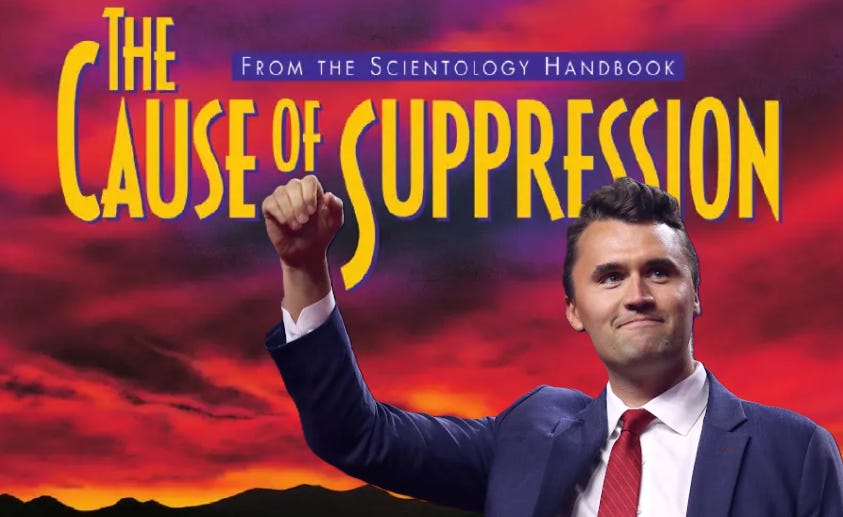
The Scientology booklet Charlie Kirk reportedly said 'saved his life'

Karen#1

Well-known member
TONY ORTEGA
Excerpt:

​
We’re grateful that Joy Villa shared quite a bombshell with us this week.

In regards to a claim by political commentator Candace Owens that one of the “bigger donors” of Charlie Kirk’s Turning Point USA was a Scientologist, Joy told us that she believed Owens was referring to major Scientology donor Craig Jensen.

“I think it’s important to be known that Charlie Kirk — what Candace probably means is one of Charlie’s early big funders was Craig Jensen,” Joy told us. “Craig was heavy into trying to get Charlie into Scientology.”

To back up her assertion, Joy shared with us an email she received from Jensen in 2017. That was the year that Joy’s own notoriety exploded after she wore a “MAGA” dress to the Grammys in February. That November, Jensen was encouraging Joy to get involved with Kirk and his Turning Point USA speaking events.

When Joy asked Jensen if Kirk knew he was a Scientologist, Jensen sent this response…
I was introduced to Charlie by a good friend from Palm Beach. I then put on an event for Charlie at my home in CW and gave him an OSA-escorted tour of the Flag building. He was blown away! I gave him a copy of the “Causes of Suppression” booklet and he said later that it saved his life. So, yes, he knows full well I am a Scientologist and he is supportive.

I am on the Turning Point USA Advisory Board.
Love, Craig
We explained last time that “CW” was a reference to Clearwater, Florida, Scientology’s spiritual headquarters, and the location of the Flag Building, home of the “Super Power Rundown.” And that “OSA” meant the Office of Special Affairs, Scientology’s secret police.

READ MORE

 
I feel for the kid's family, and some people close to me knew and loved him, but he was tailor made for the dumpster fire that os Scientology, preaching that "empathy is a bad thing".
 

John Mappin allegedly helped Charlie Kirk expand his donor network and introduced Candace Owens to George Farmer. Now, he’s claiming Charlie appreciated Scientology, raising questions about Charlie’s Christian faith and John Mappin’s alleged connections. What’s really going on?
 
I feel for the kid's family, and some people close to me knew and loved him, but he was tailor made for the dumpster fire that os Scientology, preaching that "empathy is a bad thing".


I've only seen a very tiny percentage of his videos, but never saw him preaching "empathy is a bad thing. I did hear him say he didn't like the use of the word "empathy". He preferred the word "sympathy". And he didn't like the use of "empathy as a communication strategy in politics." In the video I saw, the context was a discussion of political messaging, including Bill Clinton’s practice of expressing identification with people’s pain, such as in this 3-second video below:


Scientology is all about "helping the able become more able", and Kirk has expressed sympathy and compassion for homeless people and mentally ill people, so I don't know that he was tailor-made for Scientology.
 
Descriptions of anti social people in psychological and psychiatric terms like sociopath or psychopath is nothing new and the Hubbard/Scn descriptions of the mentality and actions of the "Suppressive Person" is accurate IMO. No doubt Kirk would have such people attempting to sabotage his organization and he may have found the shorthand descriptions of the activities of "SPs" useful.
 
Tony does a pretty good summary of the "SP, PTS Tech" in his article. Quote:

"A PTS Type III person is being negatively influenced by everyone and everything, and even things that don’t exist. “The Type III PTS is mostly found in mental institutions,” Hubbard said, and in Scientology, “Type III” is generally shorthand for “insane."
...................................................................................................................................
I guess a @Type4_PTS has escaped the mental institution and has become clever at hiding his maledictions. :bravo:


A malediction is a curse, a spoken or written expression that calls down evil, harm, or bad luck upon someone. [1, 2, 3]
 

John Mappin allegedly helped Charlie Kirk expand his donor network and introduced Candace Owens to George Farmer. Now, he’s claiming Charlie appreciated Scientology, raising questions about Charlie’s Christian faith and John Mappin’s alleged connections. What’s really going on?
That was interesting. She makes a good attempt at defining scn and posts some supposed interaction between Kirk and Mappin with Mappin claiming Charlie knew "a lot" about scn and found it useful. [at about 8:00 in the video]
Trivia - Mappin was in a 1996 movie and there are a couple movie clips of him in her video.
 
Last edited:
Descriptions of anti social people in psychological and psychiatric terms like sociopath or psychopath is nothing new and the Hubbard/Scn descriptions of the mentality and actions of the "Suppressive Person" is accurate IMO. No doubt Kirk would have such people attempting to sabotage his organization and he may have found the shorthand descriptions of the activities of "SPs" useful.
Here is an update or correction I came across some time ago.
...............................................................................................................

AI Overview

No, psychologists do not use "sociopath" as a formal clinical diagnosis. [1, 2]

Key Facts About the Term
    • Not in Diagnostic Manuals: The word "sociopath" does not appear in the Diagnostic and Statistical Manual of Mental Disorders (
      Webroot Classification: green
      DSM-5-TR
      ) or the International Classification of Diseases (ICD-11). [1]
    • The Official Diagnosis: Mental health professionals use the diagnosis of Antisocial Personality Disorder (ASPD) instead. ASPD focuses on observable behaviors, such as a long-term pattern of disregarding or violating the rights of others. [1, 2, 3]
    • Informal Usage: While the term is common in popular culture and everyday language, most clinical researchers and psychologists consider "sociopath" an outdated or non-clinical label. [1, 2, 3]
    • Popular vs. Clinical Distinctions: In informal discussions, people sometimes use "sociopath" to describe someone whose antisocial traits are shaped by environmental factors and trauma (resulting in impulsive or erratic behavior), whereas "psychopath" is often used to describe traits thought to be more innate or biological (resulting in cold and calculated behavior). However, clinicians generally avoid using either label in official evaluations, grouping these behaviors under ASPD or assessing specific psychopathic traits using tools like the Hare Psychopathy Checklist-Revised (PCL-R). [1, 2, 3, 4]
.............................................................................................................................................

 
Last edited:
Back
Top