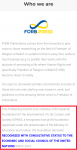
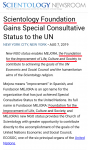
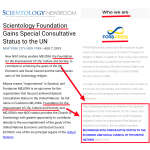
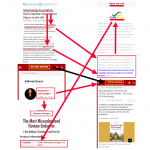
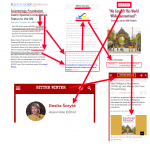
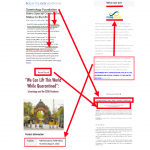
Here we consider the incestuous ecosystem of the Church of Scientology, FORB Press (aka FORB Publishing), the "academic" journal CESNUR, and author Rosita Šorytė.
Šorytė, an author published by Church of Scientology owned FORB, herself published an "academic" paper in CESNUR defending Scientology: "Labeling Scientology: “Cult,” “Fringe,” “Extremist,” or Mainstream?"
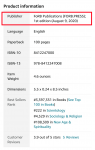
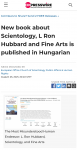
The Church of Scientology owns FORB. See:
https://exscn2.net/threads/the-chur...-house-forb-publications-aka-forb-press.3904/
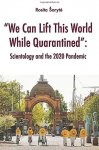
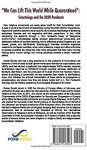
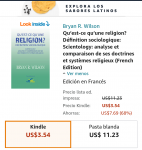
FORB published Šorytė's book “We Can Lift This World While Quarantined”: Scientology and the 2020 Pandemic. See:
https://exscn2.net/threads/the-chur...-publications-aka-forb-press.3904/post-108157
In an obvious conflict of interest, Šorytė published the "academic" paper defending Scientology: "Labeling Scientology: “Cult,” “Fringe,” “Extremist,” or Mainstream?" in CESNUR. See:
https://cesnur.net/wp-content/uploads/2021/07/tjoc_5_4_2_soryte.pdf
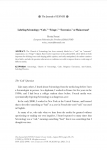
Defending the Church of Scientology in her paper, Šorytė "suggests" that five different forces are behind the hostility to the church:
* * * * * BEGIN EXCERPT * * * * *'
Only conspiracy theories posit that behind certain cultural campaigns there is only one “Big Brother.” I would suggest that behind the hostility to Scientology there are at least five different forces.*
First, new religions enter a crowded market, and they are rarely welcomed by old religions. Nobody likes a new competitor. In Russia, it is pretty much obvious that the Russian Orthodox Church is behind the strongest attacks against Scientology (USCIRF 2020). Nor would it deny it. In other countries, some Catholics and Protestants are not exactly happy that some of their devotees spend a part of their time with Scientology (even if, as I mentioned earlier, Scientology does not ask anybody to abandon their religion). However, their power and influence are rarely as pervasive as the Russian Orthodox Church’s in Russia. And their opinions are divided. Two well-known Italian scholars who have written books and articles emphasizing the positive aspects of Scientology, Aldo Natale Terrin and Luigi Berzano, are both Catholic priests (see Terrin 2017; Berzano 2018).
Second, there are governments and forces in governments, with a problematic relation to democracy, which do not like those who are fiercely independent, insist on thinking with their own head, and live apart from the lifestyle dictated by the official propaganda. Russia, again, is an egregious example of how these independently-minded people, including Scientologists, are treated, and the fact that the headquarters of their religion are in the United States make their predicament worse, because the politicians in power use as a propaganda tool a primitive anti-Americanism. Nor should we dismiss the greed of politicians and bureaucrats who, in “liquidating” religious movements, are also eager to take control of their bank accounts and real estate.
Third, there are secular humanists who had predicted the demise of religion in the 20th or 21st century. While they may have been right in anticipating that mainline churches would lose members (although not everywhere), they were taken by surprise by the emergence of new religions such as Scientology. Hence their strange obsession with the theory that groups such as Scientology are not really growing and are in fact shrinking, or are about to disappear, a theory that is not supported by any reliable statistics (Rigal-Cellard 2019, 107). Although they sometimes ally with religionists trying to protect themselves against competition, secular humanists are widely present in Western anti-cult groups and in the media and cultural establishment, which explains the hostile coverage of Scientology and other new religious movements.
Fourth, there is a growing influx of libertarians and proponents of “new rights” who do not tolerate that people in their right mind may voluntarily decide to join high-demand groups, knowing that they should respect certain rules. These powerful cultural and social movements do not like religion in general, but they become particularly incensed when a religion disciplines those in its ranks who have breached its rules.
While these four groups harass and persecute a number of different religions, Scientology incurred the hostility of a fifth group, which is among the most powerful lobbies on the planet. The financial resources at its disposal are virtually limitless. It is the pharmaceutical lobby. Scientologists likes to mention psychiatry as the source of their troubles, and certainly Scientology’s criticism of psychiatrists in general created powerful enemies. However, I would respectfully suggest that, as much as some of them may have tried to prevent the growth of Scientology in its early years, today psychiatrists are rarely a united front, have different opinions on many subjects, and have both less power and less to lose from Scientology’s campaigns than some pharmaceutical companies.
Consider that Scientology is opposed to the use of psychiatric drugs, and that the corresponding market was evaluated at more than $27 billion in 2020. Since prescriptions of psychiatric drugs boomed during the COVID-19 pandemic, and many became addicted to them, some expect that their sales will reach $40 billion by 2025 (GlobalData 2020).
We should perhaps pause and read these figures again. Everybody who becomes a Scientologist will opt out of this market. And will try to persuade others that psychiatric drugs are harmful. Everybody who ever enters a Scientology building or attends a Scientology event will be exposed to the argument that psychiatric drugs are bad for him, her, and the world in general. Worse, from the point of view of those who sell these products, Scientologists such as Tom Cruise are opinion leaders, and when interviewed they often speak out against psychiatric drugs. As one columnist argued, trying to dismiss Cruise’s arguments by just offending Scientology did not really work out (Navarrete 2005).
* * * * * END EXCERPT * * * * *'
Then, employing the logical fallacies of
ad hominem and
appeal to motive, avoiding any consideration of the merits -- or her own conflict of interest -- Šorytė concludes that this "is the best proof that [Scientology] is not a “fringe” religion":
* * * * * BEGIN EXCERPT * * * * *'
We can suspect that these companies are not attacking Scientology because they have been persuaded by some journalists, or to protect the rights of exmembers “disconnected” from their former friends and relatives. What they are protecting is a $27-billion market, not to mention the fact that Scientology suggests moderation in consuming both prescription and over-the-counter drugs in general. And, since the COVID may almost double the psychiatric drugs market, perhaps we can guess that they are currently increasing their support for anti-Scientology efforts as well.
More generally, what Scientology does is to offer alternative techniques to solve problems normally our medicalized society tries to address with drugs. When these techniques succeed, there is no further need to buy drugs. This does not endear Scientology to pharmaceutical companies.
Indeed, the coalition of those opposing Scientology is so impressive that the fact that it managed to survive is the best evidence that it is a stable organization, in which many have found a new, meaningful way of living they are prepared to defend at the cost of significant sacrifice. It is the best proof that it is not a “fringe” religion.
* * * * * END EXCERPT * * * * *'
In summary, Rosita Šorytė has an obvious conflict of interest in publishing an "academic" paper on an entity, the Church of Scientology, that published her book and pays her through it's subsidiary FORB Press. Šorytė also utilizes both
ad hominem and an improper
appeal to motive to defend the church.
For these reasons, Šorytė's CESNUR paper "Labeling Scientology: “Cult,” “Fringe,” “Extremist,” or Mainstream?" should be considered for
what it is -- i.e., paid propaganda with no academic or other merit.
---------------
*While according to Šorytė "[o]nly conspiracy theories posit that behind certain cultural campaigns there is only one “Big Brother," apparently those who, like Šorytė, posit that five forces are "behind certain cultural campaigns" cannot possibly be conspiracy theorists. Seriously?
---------------
The incestuous ecosystem in graphical form:
/


 forbpress.mejorandolasociedad.es