

Karen#1
Well-known member
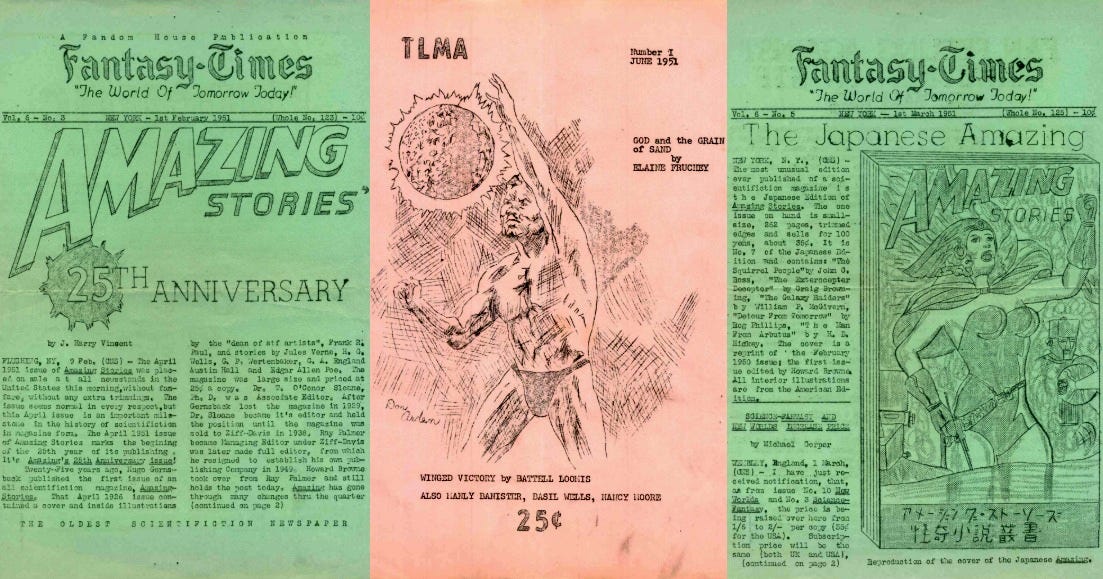
On Thursday, we told you that one of our helpers had a brainstorm and looked for what science fiction fanzines might have said about L. Ron Hubbard and his book Dianetics: The Modern Science of Mental Health in the months after it was published in May 1950.
We excerpted a fascinating report from a zine called Western Star as it reported in September 1950 about a convention in Portland, Oregon where it was impossible not to have a discussion about Dianetics on the program. “It would have been quite impossible to keep down the one subject that is the hottest thing in fandom, and a warm enough subject even in the mundane world,” editor Jim Kepner reported.
But Kepner also pointed out that the dianeticists came off as dogmatic and annoying, and he gave the impression that many fans were pushing back.
We found some other very interesting reports in zines which also reported that as the months went by, resistance to Hubbard and his “science of the mind” was growing.
We thought you’d enjoy seeing those reports as well…
Fantasy Times, 1 Feb 1951
“Number one fraud of the year — Dianetics,” says “Liberty”
In a four-page article authored by Elaine C. Stewart, LIBERTY Magazine this month took Dianetics — termed by them as a “science of mental healing” — Astounding Science Fiction, John W. Campbell, and science-fiction in general, lumped them all together, and then battered that lump into a bloody mess.
To quote a sample of the strong language used in the article, the blurb under a picture of the cover of the May 1950 issue of “ASF” (the one which carried the first article on Dianetics) says: “Dianetics made its debut as an article in Astounding Science Fiction, a pulp magazine devoted to weird tales of time ships and moon men.”
Stressing the fees collected by the Hubbard Dianetics Training School and its graduate “auditors” ($500 and $25 per hour respectively), the article quoted opinions from three apparent authorities on psychology, who condemned Dianetics as “a symptom of a dangerous trend,” as having “no respect for the complexities of personality,” and as a “mixture of oversimplified truths, half truths and plain absurdities.”
Basis for the article was an investigation by the author, in which she interviewed John W. Campbell, Jr., L. Ron Hubbard, and top auditors and other personnel at the Dianetics Institute.
The one person she did not meet, says Miss Stewart, was a “clear.”
On this point, one of the Institute’s officers told her, she reported: “It’s the funniest thing in the world. Everyone wants to see a clear. But we hide them away. After all, this isn’t a side-show. You might just as well ask me for a two-headed man to gape at!”
In answer to a query regarding proof for Dianetics, Mr. Campbell is said to have answered impatiently: “The trouble is, everyone wants proof. In engineering, you can take an old breadboard, rig up a rough circuit and fiddle around with it. So it doesn’t work. So you try some more. You’ve got this idea, see, and you keep trying until it works. You don’t have any proof. But you know it works. That’s the way it is with Hubbard and dianetics. He doesn’t have any proof but he knows it works.”
Unfortunate from the science-fiction fan’s viewpoint, scientifiction in general is made to stand on the same spot as Dianetics in this attack, and is further specifically characterized as “weird stories...which, using some scattered scientific facts, creates fantastic wars on the moon, time ships which travel to the past or future and horrible monstrosities who will some day rule the earth.”
A strange twist in the situation is that not very long ago, Astounding Science Fiction was practically the only scientifiction mag to which fans could point with pride, and now it has been made the springboard for the launching of one of the strongest attacks to which science-fiction has ever been subjected.
Read more :
More early sci-fi fanzines dunking on L. Ron Hubbard and 'Dianetics'
On Thursday, we told you that one of our helpers had a brainstorm and looked for what science fiction fanzines might have said about L.
 tonyortega.substack.com


