Golden age of Admin - Program announced at Flag

yeah, that all fits with what i've picked up on, trying to keep an eye on numbers. i'm not sure what the peak was supposed to have been -- maybe around 4,500? -- but a couple of estimates have it closer to 3,000 in recent years, and i've seen at least one report that they offloaded a lot of older ones during the pandemic, i'm guessing those who had family to take them in.

<snip>
In Marc Headley's book Blown For Good Marty Rathbun wrote a foreword in which he stated that in 2004 there were 8,500 Sea Org members.
 
i'm sure some must be starting to notice -- particularly in Austin where we know there have been multiple re-schedulings of the date, and also in Chicago where they apparently had the org close to opening 3 years ago before they mothballed it again, and where i assume they have probably had re-schedulings over the last few months as well. i'm hoping we'll hear from some insider, but it seems like the orgs are kind of Schrödinger's boxes now, where what goes on inside is unknowable.

and yeah, i'd figured they'd have been practically frantic to at least get one or two 'ideal' buildings opened in the first quarter as promised, to show they're fully back in business. i was actually surprised that didn't happen by the end of last year, and would expect it's got to happen by late this fall unless they're somehow in far worse trouble -- whether it's just numbers, or management dysfunction/paralysis -- than we thought.

the other thing i keep wondering about -- and wanting to hear more about -- is that report that over half the orgs in WUS were insolvent and requiring bailouts, some monthly. so now i'm thinking, could at least part of it be that they're trying to figure out how to get orgs back to mostly being self-supporting post-reopening, before opening big new ones? though of course that could be a bridge too far at this point in their decline....

Agreed, I really thought they'd make an effort to show that things were fine, Scientology still expanding, etc. But that's looking at things logically in real world terms, Scientology doesn't operate that way. They have their own twisted reasons for doing what they do that are usually disconnected from reality.

I haven't been able to confirm that there are large numbers of orgs getting regular bailouts, it doesn't match the data I have. I'm not saying this to try and say Scientology is doing fine, I don't think it is. Orgs generally have super low operating costs and that's the only way they stay in business at all.

This assumes an unlimited supply of Sea Org. My thought is that they don't have enough left. I wonder what the blow rate is now?

Sure, they don't have an unlimited supply, but they should still have enough to handle things to open an org. Trainee going slow? Assign 10 SO members to do nothing but one-way flow him and blast him through, including blasting any other barriers out of the way that might come up. Not enough staff? Put 50 SO members on missions to recruit worldwide for Austin. They still have enough for things like that, especially when it's supposed to just be a short period of time.

It must be super bad times for all. The ones still in that I know of have zero enthusiasm. Even the few that I know still on staff aren't happy at all. I know several on the ot levels, haven't spoken in some time but they are so deep in the bubble a nuclear war would not register.

Yes, I have noticed this too. The enthusiasm seems to have gone down a few notches. It isn't to the point where people are openly saying things but you get the feeling doubts are starting to form. The ones who are still "everything is great" have an almost manic feel to them.

Another reason for the delay on these execs firing might be worry about what happens when it all falls flat. SMP was a massive failure that some public had to notice. They were promised floods of new div 6 people flowing into orgs, the reality was quite different. What happens when exec teams fire and the orgs still suck?

thanks, you seem like a pretty experienced observer so at least that gives us some impression....

and do you have any particular explanation for why we seem to be getting relatively little information at moment, and not for example hearing much from UTRs like i think we once did?

As Scientology shrinks there are less people left to leave and also those who remain will be the most dedicated. I also think most of them want to stay anonymous so they don't share all the information threy have.

In Marc Headley's book Blown For Good Marty Rathbun wrote a foreword in which he stated that in 2004 there were 8,500 Sea Org members.

Thanks, that gives us a good starting point. I'm sure it's nowhere near 8500 today but I also think estimates of 2-3K are probably too low, that would be an over 50% drop which doesn't match my observations.
 
Agreed, I really thought they'd make an effort to show that things were fine, Scientology still expanding, etc. But that's looking at things logically in real world terms, Scientology doesn't operate that way. They have their own twisted reasons for doing what they do that are usually disconnected from reality.

I haven't been able to confirm that there are large numbers of orgs getting regular bailouts, it doesn't match the data I have. I'm not saying this to try and say Scientology is doing fine, I don't think it is. Orgs generally have super low operating costs and that's the only way they stay in business at all.

yeah -- i'm wondering just how dysfunctional what's going on is, and what either their strange calculations or simply paralyzing levels of organizational chaos are.

for starters, we know that orgs have had to be periodically bailed out. for example Birmingham was 250k in debt and being sued by their landlord when Haydn James took over about 2 decades ago, Quebec City ended up a million in debt in the last decade, Montreal was reported to be having to get $7-10k per month from whales at one point, and Lily has written about even Santa Barbara requiring small bailouts from time to time in the late '80s or early '90s. so i think the orgs may have been trending towards insolvency for a long time, and finally got pushed over the edge during the pandemic -- from which they may never have fully recovered, setting a new normal that's more on the side of non-viable. maybe it's not as bad as that one report -- or only was during the worst of the pandemic, when the orgs were virtually closed -- but still doesn't it make sense that a fair number of orgs that were on the edge must have been pushed over it?

plus i think we have to keep in mind that the 'Chase wave', which had kept a lot of orgs going, crashed and left them with tapped out fields (and staff) right before the pandemic -- which resulted in membership (and staff) losses i don't think we've much information about, but which we can see for example has left some orgs no longer keeping full hours. so it may have been a sort of perfect storm.

also, when i've checked into it, it looks like orgs such as Boston and Chicago could easily be having to spend $250k per year or possibly even much more on rent and utilities, and even little Long Island was somewhere around $60-80k -- no toilet paper in the bathrooms may make it seem like expenses are super low, but it may be that public only see the tip of the iceberg. the co$ certainly seems to have a bizarre, schizophrenic habit of throwing almost unlimited funds at some things as if money doesn't matter (even in high-cost cities like Chicago and Boston, it looks like the orgs still have to rent the standard 15k sq ft even when lease rates run around $20 sf/yr), and then acting like other things such as $1 rolls of toilet paper would break the bank and doom the planet. and even when they move into 'ideal' buildings and if they don't have to pay rent (but are they supposed to still be paying rent to the int landlord?) costs may be as high for a building 3.5 times as large as what they had before, particularly if it's in a cold weather area with high utility expenses like Chicago.

are you aware at all of those sorts of financial issues? or is that something the orgs keep pretty well compartmentalized and hidden?
 
In Marc Headley's book Blown For Good Marty Rathbun wrote a foreword in which he stated that in 2004 there were 8,500 Sea Org members.

i thought i'd see numbers maybe around 6,500, but those seemed high to me, at least for recent times.

checking again i find a number of sources that put it around that as a past max c. 2000 -- but not higher. Mike Rinder for example says about that in the 1990s -- but probably more like half now:

 
Yes, I have noticed this too. The enthusiasm seems to have gone down a few notches. It isn't to the point where people are openly saying things but you get the feeling doubts are starting to form. The ones who are still "everything is great" have an almost manic feel to them.

The "born in" second generation (and even third generation) people are not necessarily going to be as enthusiastic. As an example, in the Orthodox Jewish community, lots of children leave Orthodoxy, being unwilling to live with the strict lifestyle (the high Orthodox birthrate makes up for this).

The dynamics are also different for the 2nd generation. First generation guy leaves but wife stays in, he might never see his kids again, which is a reason to stay in (or at least pretend to). If a 2nd gen leaves, he can tell his still-in parents "I'd like to stay in touch with you. If you disconnect from me you lose contact with your grandkids. And by the way, who is going to take care of you when you are too old to be useful to the org?"
 
and if they don't have to pay rent (but are they supposed to still be paying rent to the int landlord?) costs may be as high for a building 3.5 times as large as what they had before, particularly if it's in a cold weather area with high utility expenses like Chicago.
Good point. Regardless of anything, they have to pay to keep the place heated and lit and keep the phone service on.
 
Good point. Regardless of anything, they have to pay to keep the place heated and lit and keep the phone service on.

yeah -- and i forgot, but overseas there was this in SA:


oh, and that reminds me -- i remember that during the pandemic the New York org had something like a $180k overdue utility bill, though this shows 'just' $114k as of late 2021:


i can't remember if i've heard of any others -- but there have got to be quite a few more.

also, from what i've found the average utility costs for commercial space are usually pegged around $2 sf/yr, which would mean $100k for a standard sized idea org. i'm sure they try to skimp on that -- but it can be 3 times that rate in a cold high-cost environment, meaning some orgs must pay probably at least 50% over that.
 
yeah -- i'm wondering just how dysfunctional what's going on is, and what either their strange calculations or simply paralyzing levels of organizational chaos are.

for starters, we know that orgs have had to be periodically bailed out. for example Birmingham was 250k in debt and being sued by their landlord when Haydn James took over about 2 decades ago, Quebec City ended up a million in debt in the last decade, Montreal was reported to be having to get $7-10k per month from whales at one point, and Lily has written about even Santa Barbara requiring small bailouts from time to time in the late '80s or early '90s. so i think the orgs may have been trending towards insolvency for a long time, and finally got pushed over the edge during the pandemic -- from which they may never have fully recovered, setting a new normal that's more on the side of non-viable. maybe it's not as bad as that one report -- or only was during the worst of the pandemic, when the orgs were virtually closed -- but still doesn't it make sense that a fair number of orgs that were on the edge must have been pushed over it?

plus i think we have to keep in mind that the 'Chase wave', which had kept a lot of orgs going, crashed and left them with tapped out fields (and staff) right before the pandemic -- which resulted in membership (and staff) losses i don't think we've much information about, but which we can see for example has left some orgs no longer keeping full hours. so it may have been a sort of perfect storm.

also, when i've checked into it, it looks like orgs such as Boston and Chicago could easily be having to spend $250k per year or possibly even much more on rent and utilities, and even little Long Island was somewhere around $60-80k -- no toilet paper in the bathrooms may make it seem like expenses are super low, but it may be that public only see the tip of the iceberg. the co$ certainly seems to have a bizarre, schizophrenic habit of throwing almost unlimited funds at some things as if money doesn't matter (even in high-cost cities like Chicago and Boston, it looks like the orgs still have to rent the standard 15k sq ft even when lease rates run around $20 sf/yr), and then acting like other things such as $1 rolls of toilet paper would break the bank and doom the planet. and even when they move into 'ideal' buildings and if they don't have to pay rent (but are they supposed to still be paying rent to the int landlord?) costs may be as high for a building 3.5 times as large as what they had before, particularly if it's in a cold weather area with high utility expenses like Chicago.

are you aware at all of those sorts of financial issues? or is that something the orgs keep pretty well compartmentalized and hidden?

Orgs have financial issues all the time, and management exerts massive pressure for them to handle it locally. Orgs being behind on bills is the norm. When I talk about bailouts I'm talking about from scientology management at the cont or int level. I still haven't seen anything that confirms bailouts like this are the norm or common. They happen for sure I just don't know how often.

The "born in" second generation (and even third generation) people are not necessarily going to be as enthusiastic. As an example, in the Orthodox Jewish community, lots of children leave Orthodoxy, being unwilling to live with the strict lifestyle (the high Orthodox birthrate makes up for this).

The dynamics are also different for the 2nd generation. First generation guy leaves but wife stays in, he might never see his kids again, which is a reason to stay in (or at least pretend to). If a 2nd gen leaves, he can tell his still-in parents "I'd like to stay in touch with you. If you disconnect from me you lose contact with your grandkids. And by the way, who is going to take care of you when you are too old to be useful to the org?"

Yes, the 2nd generation is never going to be as dedicated. This is going to be a big issue for them and I think it's actually one of the main reasons for this whole exec evolution. The older members are starting to leave staff for whatever reason and they're worried about having replacements. This evolution ensures they'll have at least some members for the next however many years. They pushed heavily on getting younger trainees. I don't think all the trainees duplicated that when they signed up for this evolution they signed up for the rest of their lives.
 
..
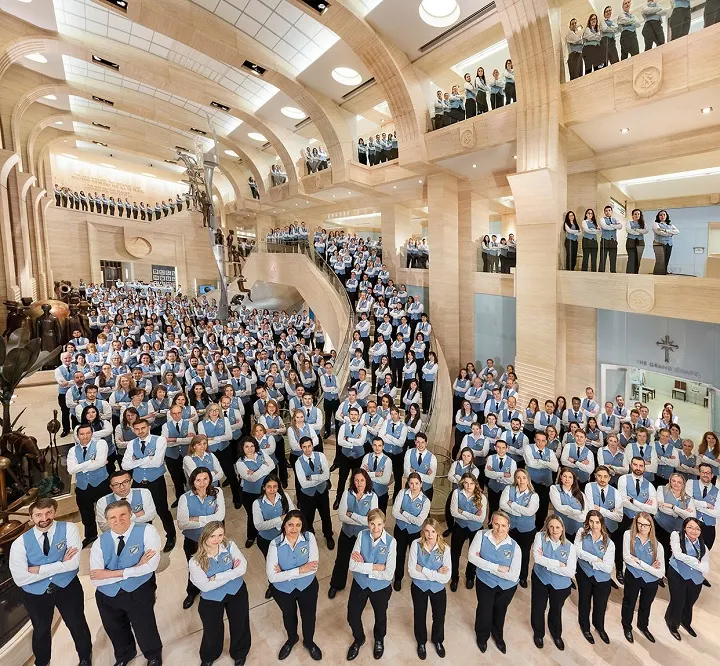
here's a CoS promo picture they recently used, showing trainees.
https%3A%2F%2Fsubstack-post-media.s3.amazonaws.com%2Fpublic%2Fimages%2F2a3c97b4-9dd5-43bd-bd9d-48295ad93ced_720x666.jpeg


The number of Salvation Army Navy members in that photograph is under 300. It's easy to quickly estimate it if you just count the number of people in the front row and then roughly count the number of rows--and add some more for the multi-tiered stragglers above.

What is missing from that still-life photo is a CAPTION on what is happening in real time. What they are doing is an ADMIN TRAINING DRILL based on a recently recovered piece of technology from a highly confidential LRH Advice Letter.

TR-WOW
https%3A%2F%2Fsubstack-post-media.s3.amazonaws.com%2Fpublic%2Fimages%2F2a3c97b4-9dd5-43bd-bd9d-48295ad93ced_720x666.jpeg

Three (3) times a day, outer-org trainees muster for roll-call and then
drill 2 hours on the most vital administrative skill that will BOOM their
orgs when they fire back to their home cities. Ron states that:

"TR-WOW is the missing key to all orgs booming well
beyond
the size of Old Saint Hill and into unimaginably
higher realms of financial prosperity and stellar stats
than even those of Ideal Orgs!" —L. Ron Hubbard


​

..

* TR-WOW: Training Routine WOW ("Waiting On Whales"). The administrative trainee is to mock up an annoyed tone level, by impatiently crossing their arms at the indignity of having to wait for a local whale to come into their struggling org to make a jumbo donation. Coaching emphasis is on ensuring that the student is actually in the tone level of 'waiting', not just pretending. Flunks are also given for failing to keep outflowing a tone-40 postulate that a whale will soon arrive. The drill is best practiced near a window so that the student can stay extroverted by staring longingly outside until a whale shows up. (NOTE: I was temporarily not able to find the GIF version of that photo where you can clearly see the 300 folded-arm trainees drilling on how to impatiently tap one foot).


...
 
Last edited:
Orgs have financial issues all the time, and management exerts massive pressure for them to handle it locally. Orgs being behind on bills is the norm. When I talk about bailouts I'm talking about from scientology management at the cont or int level. I still haven't seen anything that confirms bailouts like this are the norm or common. They happen for sure I just don't know how often.

i'm aware local orgs were pretty much set up to always be barely making it. the cases i mentioned often did involve bailouts from upper management. and doesn't the pandemic have to have resulted in a lot of orgs not having enough income to pay essential bills like rent and utilities?

plus mustn't the couple of orgs like Plymouth (reported to have as few as 6 active members left) and Winnipeg that we know never went back to being open anywhere near full hours after the pandemic -- but still are in relatively large spaces with steep rent -- now be on permanent financial life support? i wonder if the secret of how bad things like that are is now so compartmentalized and locked down, that it can hardly be known.

and it's an interesting idea that GAA -- and maybe the problem with getting finished 'ideal' buildings opened -- could be tied to 2nd gen staff, and their shortcomings*. plus if born-ins are not willing to sacrifice to work for decades or a lifetime at local orgs much more than they are to stay in the sea org, that kind of breaks the staffing model that has relied on the core of diehards they're now losing.

* ETA: it could also be seen as at least in part, their being less accepting of exploitation and abuse -- perhaps having learned from the mistakes of their parents.
 
Last edited:
I am so in favor of Miscavige's Golden Age of Admin. The sooner the better.

First, you had Hubbard's "Admin Tech". It was totally unworkable. Hubbard's saving grace was that if you were successful in running an org, if you made him money, he'd leave you mostly alone. He didn't care how you did it, so you could skip the "on-policy" shit. And, so, some success happened. Individuals who understood this made things work despite Hubbard's silly Admin Tech.

Miscavige has "improved" on Hubbard's Admin Tech by getting rid of anyone or anything that comes close to being successful. His "Golden Age of Admin" doubles down on that. Micro-management, crushing administration rules, endless planning, meetings, reporting, inspection, verification, correction, re-inspection, etc., etc.

Guaranteed faster failure. I love it.

The Church of Scientology's worst enemy is Miscavige. Hip-hip ....
 
..
What we will be seeing are the few, the proud, the Belief Perseverance poster people.

..
LOL

Yeah, let's give another standing ovation to the cult's elite Scientists, Sailors & Stragglers!

..
 
i'm aware local orgs were pretty much set up to always be barely making it. the cases i mentioned often did involve bailouts from upper management. and doesn't the pandemic have to have resulted in a lot of orgs not having enough income to pay essential bills like rent and utilities?

plus mustn't the couple of orgs like Plymouth (reported to have as few as 6 active members left) and Winnipeg that we know never went back to being open anywhere near full hours after the pandemic -- but still are in relatively large spaces with steep rent -- now be on permanent financial life support? i wonder if the secret of how bad things like that are is now so compartmentalized and locked down, that it can hardly be known.

and it's an interesting idea that GAA -- and maybe the problem with getting finished 'ideal' buildings opened -- could be tied to 2nd gen staff, and their shortcomings*. plus if born-ins are not willing to sacrifice to work for decades or a lifetime at local orgs much more than they are to stay in the sea org, that kind of breaks the staffing model that has relied on the core of diehards they're now losing.

* ETA: it could also be seen as at least in part, their being less accepting of exploitation and abuse -- perhaps having learned from the mistakes of their parents.

Things are definitely tough for them. Even previously "good" orgs are going through rough patches with a combination of the pandemic, chase wave ending, losing staff and being unable to replace them.

I'm not going to say things are at a breaking point just yet, and this admin evolution might patch things together for a little bit, but 5-10 years down the line? Looks extremely bleak in my opinion.

I still think most orgs, especially ideal orgs, can keep the lights on. But this is because they have essentially zero operating costs, all the money that comes in can go to bills. We've seen even that isn't enough in some cases, hard to say how widespread that is without more data though.

Are we at the tipping point? I don't think so, not quite yet. Let's see how it's doing in a year or two though.
 
I still think most orgs, especially ideal orgs, can keep the lights on. But this is because they have essentially zero operating costs, all the money that comes in can go to bills.

not sure what you mean by operating costs, so here is a list i picked up off a Quicken blog as what should be a common way to look at it:
  • rent -- n/a for 'ideal' orgs, but the standard utilities for a 50k sq ft are about $100k per year, and even if they skimp it could well be 1.5 to 2 times that regardless in extreme climates. for regular orgs it's still probably $100k - $250k for rent and utilities.
  • inventory costs -- minimal except when new editions mean throwing out unsold stock
  • equipment -- computers, copiers etc.
  • insurance -- presumably n/a
  • payroll -- negligible
  • marketing -- sending out flyers must cost each org a lot
  • other overhead costs -- property maintenance is my guess for the largest. but there must be unique payments to CoS entities.
it still looks to me like there are probably $100k+ base operating costs for any org -- the utilities costs of a huge 'ideal' building will more or less wipe out the savings of not paying commercial lease rates for the previous modest types of space just about 30% the size.

the orgs that can no longer keep regular hours have got to be the canary in the coal mine, but i wonder how many others still can't make expenses all the time.

if figure that DM will keep them all open regardless of the cost, lest his myth of 'expansion' be proven incontrovertibly to be a lie. if they reduced operations to skeleton staffs just using a small part of the 'ideal' buildings and turned utilities down to uninhabitable levels in the rest, they could probably significantly pare costs.

we'd of course know a lot more if we got a recent defector from management at a high enough level and with a good enough head for figures, to provide some really solid info about what's going on. though even one or two people with good numbers for presumably average orgs would still give us some insight.
Roughest of estimates here, (I'm an accountant with some accessories) might be around 50k/year for a "bought the building" ideal org scenario. But 50k - 100k, pretty close. This money can be raised from several donors over a year of regging incidents, as needed. I've seen this exact sort of regging happen over the years. Local "financial flaps" are kept off lines as much as possible.
 
I still think most orgs, especially ideal orgs, can keep the lights on. But this is because they have essentially zero operating costs, all the money that comes in can go to bills. We've seen even that isn't enough in some cases, hard to say how widespread that is without more data though.
Orgs always operated short of money, even when income was decent. Most of the money then went "uplines" to pay for lawyers, PIs etc.

That "uplines" cash flow no longer exists.

DM no longer can afford the kind of OSA infrastructure needed to intimidate critics and "fair game" apostates and squirrels.
 
That "uplines" cash flow no longer exists.

DM no longer can afford the kind of OSA infrastructure needed to intimidate critics and "fair game" apostates and squirrels.

except that direct regging of whales by int management for IAS statuses became a substitute source for that cash flow, didn't it?

still, i have my suspicions that is also starting to dry up -- though just one mega whale like Trish Duggan could probably make up for it if squeezed extra hard. (and i've wondered what would happen if TC retires from making moves and turns scn into his hobby, reaching into his very deep pockets)

i'd say signs are OSA is still doing plenty, now more focused on those bringing suits against the CoS, and at the Aftermath Foundation. do you think that's not really comparable?

still, like with keeping open orgs that are showing increasing signs of insolvency, i suspect that either they're at least no longer able to continue to build up reserves like they have for decades (internal accounting can make DM's 'stat' appear to continue to rise by increasing the book value of properties), or even have had to start spending them down under 'emergency' justifications (the pandemic could well have triggered and justified that, at a point of decline where it was going to be inevitable before long anyway).

i'm genuinely interested in what's going on, and asking questions regarding things i'd be happy to be better informed about by those with relevant experience or better information.
 
Back
Top