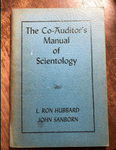
There were some who were at home in the atmosphere of the mid 1960s and the 1970s. It was their time.
We were all naive about the secretive subject of Scientology.
People who influenced me about Scientology, early on (late 1960s/early 1970s) were John McMaster ("first real Clear"), the Incredible String Band (psychedelic folk music), Rick Alexander (original OT 6, the highest released level at the time. The 1960s OT 6s were regarded as real OTs, who could leave their bodies at will and travel around the universe, exploring, and enjoying, every detail, and the vast spaces, with full perception.) Rick Alexander was an upbeat and intelligent fellow and that impressed me. And, of course, there was Ingo Swann who I didn't meet and talk with until early 1973. It was all very impressive to my young mind, and more exciting than the books on consciousness, LSD, Zen, mysticism, Yoga, and, of course, Alan Watts whose every book I owned and had devoured. I finally met and talked with Watts in 1969 and showed him my copy of the book,
Master Game, by De Ropp. I could see, as he stood there in his black Zen robe, being a Zen Master, that he regarded De Ropp as a rival of some kind. Mmmm... Rivalry among the enlightened? How could that be? In any event, on that same evening, I first visited the Scientology Org in the Martinique Hotel in New York City. It was 1969 and McMaster had recently been Declared a Suppressive Person. The photograph of his smiling face was ubiquitous in Scientology promotional literature, and hadn't been removed yet. He had not yet been erased.
De Ropp's Master Game was the perfect lead in to Scientology which, to me, at the time, seemed to be a real life, functioning, "master game," as in spiritual mastery.
As I discovers more about the enlightenment game, over a period of years, and about Scientology, I came to realize that there was a dark side.
*
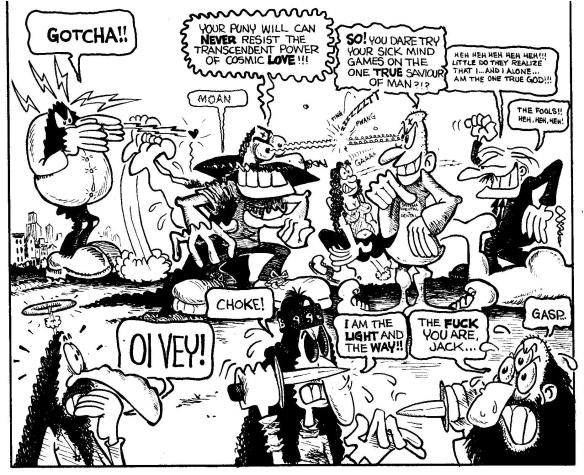
The image below is from the cover of a counter culture comix of the early 1970s
depicting the scene in San Francisco during the Summer of Love in 1967,
when Jesus returned to Earth only to find himself talked into joining staff at the San Francisco Scientology "Org."
Jesus is at the lower left.
*
For a little perspective...
During the late 1960s, Leonard Cohen was "on lines" at the New York Org.
After having moved on from Scientology, he wrote this song about a friend of his who was "going Clear."
Exploitation of Abreaction, cinematic depiction:
A cult leader encounters a poor soul and addresses (partly telepathically?) his loss or "key in ," and the poor souls is revived and given a new purpose in life.
And the cult leader has a willing slave, at least for a while.
Segment ends at 4:50ish
*
During the period of Scientology's greatest expansion, the top of "Bridge" Grade Chart was the ability to be TOTALLY FREE AND AT TOTAL CAUSE.
TOTAL POWER. This, combined with the idea that each Scientologist is an Infinite Mind, was a tremendous ego rush for Scientologists.
In his book
Magick in Theory and Practice, Aleister Crowley wrote:
"The whole and sole object of all true Magickal training is to become free of every kind of limitation."
During late 1952, Hubbard gave a series of lectures where he referred to Aleister Crowley:
"Our whole activity tends to make an individual completely independent of any limitation... Old Aleister Crowley had some interesting things to say about this..."
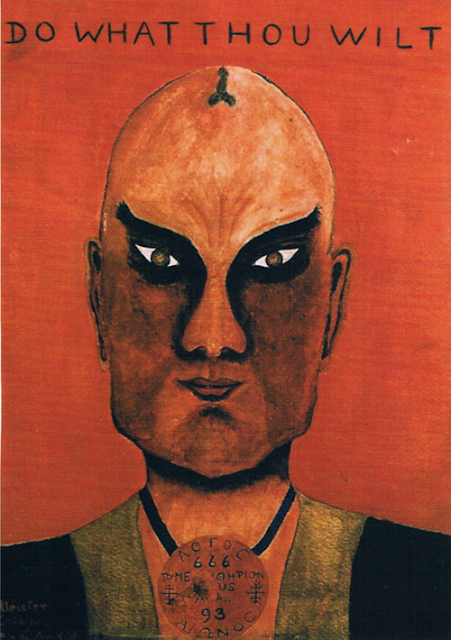
Aleister Crowley self portrait
Crowley wrote, "The Great Work is the raising of the whole man... to the power of infinity."
The ultimate ego trip and also, if it were possible, great fun.
The title of Hubbard's book
Scientology 8-8008 means just that.
The "whole man," of course, includes the ego.
Crowley wrote that there was a multiplicity of infinite minds. Hubbard echoed this idea.
From
Scientology 8-8008:
"Infinite mind is individualistic. All mankind does not depend upon or share a portion of the infinite mind. On the contrary, the highest individualism attainable is the individualism of the infinite mind. It was beyond the power and grasp of the intellect applying itself to the field of philosophy, to conceive of a multiplicity of infinite minds..."
Hubbard must have known that there would be disappointment, and confusion, when original (mysterious, but never actually existed, 1960s era) OT 8 disappeared and was replaced with
New OT 8.
Awkward.
Scientologists like to chant that "the tech works," and parts of "the tech"
do "work" sometimes, to varying extent.
The lonely old lady
does feel better after being acknowledged.
But it's a long way from feeling better, once a messy room has been tidied, to TOTAL POWER.
There are thousands of pieces of "tech."
One piece of "tech working," once, can be enough to hook someone.
Letting a person know that the one piece of "tech," that sold them on Scientology, is not representative of the rest of the subject, can loosen the glue.










 ? I had always wondered what that meant on the Scn book jacket of 8-08.