E-Meters

Hi Sneakster,

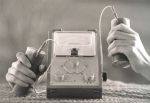
Being an electronics tech I researched all that years ago. Frankly, until I used the Quantum the old Mk V was as good as any other meter I've used, the VI and VII only adding convenience with their inbuilt timekeeper and digital TA counter. Interestingly I've paid the same price, more or less, for each of my meters. The Mk VI has devalued the most since it has a reputation for insensitivity when doing upper OT material, but it's a fine meter up to OT III.

I certainly should have bought a few more VII's when they were going off on eBay. Currently bidding on a sad British Mk V from the UK but the price is getting silly as usual. They have become collector's items and/or status symbols.
 
Last edited:
If anyone knows where I can find one of the following Allen Wright E-Meters, please let me know:

Excalibur Clearing Biofeedback Meter, or
Alphametrics Clearing Biofeedback Meter

Both made in the late 80's and early 90's and look identical except for the name on the meter faceplate. Hank Levin (USA) advertised them in Free Spirit and claimed they were developed and produced by Rowland Barkley, although I seriously doubt that is correct.
( ref: https://www.clearing.org/cgi/archive.cgi?/homer/sci39.memo )

Case is taller than it is wide, the meter movement is at the top and it takes up the full case width. There are three knobs below: TA (centre), Off-On-Test-Charge (left) and Sensitivity (right). The cans lead plugs into the righthand side.

Edit: Here's a photo of the Excalibur version with round knobs. They usually have the standard Mk V style "chicken head" knobs.CB Meter.png
Photo: Stephanie Relfe B.Sc. "Clearing with a Biofeedback Meter" (c) 2002
 
Last edited:
I was a good friend of Allen Wright and know much about the Meter he designed. Rowland Barkley commissioned Allen to design a meter that was more sensitive than the Mark VI that was in vogue at the time. Two of the findings Allen made on examining the Mark IV was that the meter movement was a cheap piece of crap without any bearings in the movement (in an attempt to make it more sensitive by removing bearing friction) and the other was that the voltagea cross the cans when the TA knob was increased could cause burning of the skin and thus leading to less conductivity with the electrodes. Another key was analysing and determining the resonant frequency (or damping) of the meter movement and replicating that with his design.

Allens solution was to reverse the configuration of the "Wheatstone bridge" circuit and use constant voltage with a variable current rather than the other way around as used by the church. This produced a better meter response with greater reliability during high TA conditions. Also his circuit design used voltage regulators that prevented the "drift" that is inherent in the church design and so his meter never needed to be "trimmed". Allen found a local meter movement manufacturer who was able to make a movement that was more sensitive than the Mark VI movement but still retained the bearings and so was more robust.

As far as I know, Rowland owns the intellectual property of the circuit design as it was his commission. I believe that Hank Levan was licensed to produce the meters as well.

I personally used one of Allens meters for a number of years, first the meter as shown in the picture above and then as a modified Mark VI which had the church meter circuit board replaced with Allens and still provided the electronic TA counter via a separate board.

An issue with any of these designs was the use of tapped NiCad batteries that wear out or leak over time and can be difficult to replace.

I hope this information is useful.

Cheers
 
Over a year ago someone posted a video of two guys who were filming their own version of a "Storage Wars" tv show episode where people buy abandoned storage lockers and possibly find abandoned treasures. As they were tearing through the stuff in the abandoned storage locker they had bought they came across a Mark V meter still in the original packaging. When they looked at the meter with the lid still on one guy guessed it was a radio and the other guessed it was a microscope. When they opened the lid and saw "Hubbard" on it one of the guys said something like, "Hey, isn't this something that Scientologists use when they do readings or something? Maybe we should contact Tom Cruise and see if he wants to buy it." Unlikely Tom was interested but in that condition they probably got a good price for it on ebay.
 
Last edited:
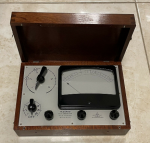
Years ago, I found an old Mark V complete with lid at a garage sale. It didn’t work and I tossed it into a box with other ‘future projects’.

Recently I ran across it and had time to spend on it. It presented as quite impressive with its dark wooden box and blue face. When I opened up this ‘religious artefact’, it was something of a letdown what with its meager circuit board; much like Scientology, you lift the hood on the mystery and it turns out to be rather mundane.

I found someone had replaced the original battery set with AA batteries. The batteries had leaked and encrusted the ‘after market’ battery holders. I cleaned them up as best I could and installed some fresh batteries.

The meter powered up but the TA at ‘set’ was too high and the needle motion was fairly erratic. I decided to replace the battery holders with a new 6 AA battery holder I had. I tapped the 1.5v circuit off of the first battery in the series. Replacing the holder worked to smooth out needle fluctuations but the TA would only ‘set’ at 5-6.

I put on my magnifiers and looked at the circuit board and found one of the circuits lines was damaged and broken. I cleaned and tinned both ends of the damaged portion and soldered in a small wire to jump the gap. The meter now ‘sets’ at a TA of 2. Fixed!

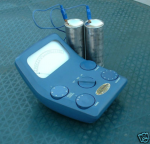
One of these days I’ll get some tin cans to replace the aluminum soda cans I am currently use for testing. Good enough for now.
 
Last edited:
I was a good friend of Allen Wright and know much about the Meter he designed. Rowland Barkley commissioned Allen to design a meter that was more sensitive than the Mark VI that was in vogue at the time. Two of the findings Allen made on examining the Mark IV was that the meter movement was a cheap piece of crap without any bearings in the movement (in an attempt to make it more sensitive by removing bearing friction) and the other was that the voltagea cross the cans when the TA knob was increased could cause burning of the skin and thus leading to less conductivity with the electrodes. Another key was analysing and determining the resonant frequency (or damping) of the meter movement and replicating that with his design.

Allens solution was to reverse the configuration of the "Wheatstone bridge" circuit and use constant voltage with a variable current rather than the other way around as used by the church. This produced a better meter response with greater reliability during high TA conditions. Also his circuit design used voltage regulators that prevented the "drift" that is inherent in the church design and so his meter never needed to be "trimmed". Allen found a local meter movement manufacturer who was able to make a movement that was more sensitive than the Mark VI movement but still retained the bearings and so was more robust.

As far as I know, Rowland owns the intellectual property of the circuit design as it was his commission. I believe that Hank Levan was licensed to produce the meters as well.

I personally used one of Allens meters for a number of years, first the meter as shown in the picture above and then as a modified Mark VI which had the church meter circuit board replaced with Allens and still provided the electronic TA counter via a separate board.

An issue with any of these designs was the use of tapped NiCad batteries that wear out or leak over time and can be difficult to replace.

I hope this information is useful.

Cheers

Hi Exthetan,

Good to hear from you. If you were a friend of Allen Wright then we probably know each other, unless you were one of the people he put through his OT course in Bondi. In any case, PM me. I have good idea who you might be actually. :)

I've been in contact with Rowland over the past couple of days and he says he may have one at home in Portugal, or maybe in his storage box in Slovenia, but for the next six weeks he's in Brazil. He tells me they used a modified ABC meter movement, and that the company who made them broke the mold and no more movements can be found, which is why it went out of production.

Interesting techy insights there, I look forward to getting hold of one and tracing out the circuit. I very much doubt that skin burning can occur with the Mk VI since the voltage at worst goes to 2.9V or so and at that point current is miniscule (microamps). I have read other claims that the e-meter can cause damage and I find them entirely baseless. But hey, a thetan can become sensitive to anything if they mock it up enough; my niece swears that she can't be in a house with wi-fi because of the radiation.

The voltage regulation will, of course, come at the cost of higher battery usage.

Hank Levin was, I believe, getting the same Excalibur meter as shown above, but with the Alphatronics nameplate. He went on to make his own meter, which seems to be an improvement of the original Allen Wright design, auto-centering being one example. Hank is sadly no longer with us according to his website.

I have no issue with replacing batteries and have just done my MK V, Mk VI and Mk Super VII in the past month. They have all been unused for many years, but now there is a need for them. My Mk VI actually uses 6 x AAA NiMH cells, which is what was fitted when I bought it.

Cheers,

Haiqu
 
Last edited:
Hi Haiqu. Damn my cover is blown lol 😂. I haven’t PM’d anyone here for ages and stupid me cant seem to find the correct button to push. Perhaps you could remind me how. If you live local you would be welcome to collect my emeter for free on an as-is basis. It has not been used for 20yrs and so may need some rejuvenation but sounds like you have the skills to do that. If that interests you then PM me.

Cheers
 
To start a conversation just click the person's name on the left and select Start Conversation.

I've PMed you with my details.

H
 
Actually I was thinking of doing some training videos under the banner of Super Squirrel Productions. ;-)
 
Sure. If we're gonna be called names, we might as well own it.
 
Sure. If we're gonna be called names, we might as well own it.
Well, I was going to run wild Whole Track processes on pre-clears and cause them to have cancer but I just thought it would be easier to simply leave Scientology and tell everyone I could that it is a cult. Apparently that is also an alteration of tech as well. :)
 
It is? Damn, can't get away with anything.
 
How does a person replace the batteries? I can use an external battery holder from an electronics supply house, but I would rather not. And I am certainly not going to mail it off to the eBay seller "The Tech Page" on eBay. Too much hassle to ship.

Someone told me I would need a "tab welder" since my 40-watt temperature controlled soldering station won't produce enough heat (although it's great for replacing bulging capacitors on, say, a Core 2 Duo board, and then building a spare Linux or older-version Windows computer).

I have an old Mark 5 with no leads or cans, and a Quantum Mark 7 with leads, cans and Halliburton case. I'm sure both could use new batteries. Does anyone have any "best practices" you all can share with me?
 
The Mk V will probably have six N280BC button cells. They are no longer available. The Mk Super VII has a PCB with seven generic AA NiCd cells. I haven't opened my Quantum but assume it will be the same as the Super VII.

The trick to soldering replacement cells is to thoroughly scuff the ends of the batteries prior to attempting soldering them. Batteries with welded tabs are rare and expensive, so just get regular AA NiCd batteries, the common size being 1000mAH which is 4X the original capacity of the Mk V & Mk VI batteries.

I use a whetstone (the thing you use for sharpening knives) to scuff both ends, then thoroughly wet them with fresh solder. Now you can easily join them together using a roll of SoderWick, which is very absorbent of solder, tough and cheaply available. Most electronics workshops should have some lying around too. A small strip of scotch tape or electrical insulation tape should be added to the Mk V bundle to keep them together. The Mk VII uses hot glue but can be omitted. Secure the pack mechanically before reassembly.

The Mk V has a tapping at 1.2V (one cell) wrt the negative end. It is the white wire. Black and Red and -ve and +ve as per standards.

It is common for surface corrosion to work its way down the three power wires over the years. It's wise to replace them if they're hard to solder.

Hope that helps. A 40 watt iron should work, I use a Weller solder station to do it.
 
Last edited:
I picked up a British Mk V off eBay UK last week. It's missing the front panel screws, cans, leads, manual and cardboard box. I paid just under AU$240.00 for it including shipping and import costs. Given that a bakelite meter movement of this type is worth AU$100 and I don't have to make the case and front panel, it will make a good test bed for Allen's circuit even if it's broken.

I always liked the look of the British version, but I bought the American Mk V in 1976 because it has the mechanical TA counter, which was never reliable anyhow. I still see the Delta Mk V come up for sale occasionally, it has a better counter with a belt internally. They weren't ever approved for use in Australia as far as I know, despite having the Hubbard name on the front. They probably work fine though.
 

Attachments

  • British Mk V.png
    British Mk V.png
    66.6 KB · Views: 5
Last edited:
Anybody seen one of these before? It's the Applied Scholastics "Learning Accelerator" which I assume would be used for Word Clearing.

Surprised that I've never seen it until tonight.

LA 2.png
 
The Mk V will probably have six N280BC button cells.

( ... )

The Mk V has a tapping at 1.2V (one cell) wrt the negative end. It is the white wire. Black and Red and -ve and +ve as per standards.

Just an FYI of which you, @haiqu, are probably aware but others may not know. The engineering datasheets for NiCad batteries show that their output voltage remains remarkably stable versus charge state, right down to about 95% discharged, then the voltage abruptly crashes. That is why the Don Breeding / Joe Harris transistor circuit doesn't bother with a voltage regulator.

Additionally, the patent details say that there is temperature compensation and voltage drift compensation provided for the three-stage DC amplifier.
 

Attachments

Last edited:
Yep. The bit that gets you is that initial voltage drop from 1.4v (fully charged) to 1.2v (stable region). After that they're fine up to 80% discharge.

NiCd batteries will also die due to self discharge if not used regularly, a factor that isn't present in more modern batteries like Lithium Ion cells.
 
Back
Top