ISNOINews
Independent Scientology and Nation of Islam news
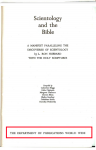
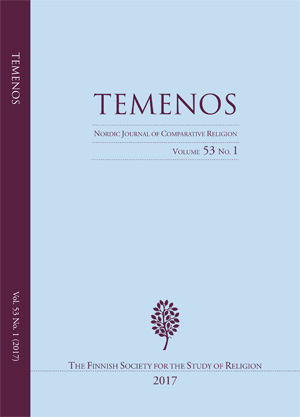
2017 Academic paper by Stefano Bigliardi -- On an Anomalous Piece of Scientology Ephemera: The Booklet Scientology and the Bible.
On an Anomalous Piece of Scientology Ephemera: The Booklet Scientology and the Bible | Temenos - Nordic Journal of Comparative Religion
* * * * * BEGIN EXCERPT * * * *
Abstract
On an Anomalous Piece of Scientology Ephemera:
The Booklet Scientology and the Bible.
The article scrutinizes the booklet Scientology and the Bible (1967), reconstructing the historical circumstances of its publication as well as analysing its potential for interreligious dialogue.
Author Biography
Stefano Bigliardi, Affiliated postdoctoral researcher - CMES Lund University Lecturer (Ethics, Contemporary Philosophy) - Tec de Monterrey CSF - Mexico City Fellow - FIIRD - Foundation for Interreligious and Intercultural Research and Dialogue
Affiliated postdoctoral researcher - CMES Lund University
Lecturer (Ethics, Contemporary Philosophy) - Tec de Monterrey CSF - Mexico City
Fellow - FIIRD - Foundation for Interreligious and Intercultural Research and Dialogue
[SNIP]
User Rights
Under the CC BY 4.0 license, the Author/s and users are free to:
* Share — copy and redistribute the material in any medium or format,
* Adapt — remix, transform, and build upon the material for any purpose, even commercially,
* However, the Work must be attributed to the original Author and source of publication.
The license of the published metadata is Creative Commons CCO 1.0 Universal (CC0 1.0)
* * * * * END EXCERPT * * * *
Direct link to the 28 page PDF:
https://journal.fi/temenos/article/view/53388/26256
* * * * * BEGIN EXCERPT * * * * *
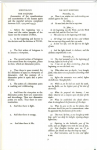
The text itself starts on page eight. each page is divided into two columns. The one on the left prints passages of Hubbard’s works. The one on the right prints passages from the Holy Scriptures. A section towards the end of the booklet displays the same structure but is entitled ‘Similarities between the discoveries of Scientology by L. Ron Hubbard and the aims and goals of the fathers of the Church’. The fathers of the church referred to are Saint Augustine (354–430 Ce), Leo the Great (390–461 Ce), and Saint Thomas Aquinas (1225–74 Ce). Their works referred to are: Augustine’s Confessions (398 Ce), Sermon on Passion Sunday (undated), On Christian Doctrine (397 Ce), The City of God (426 Ce); Leo the Great’s Sermon on the 4th Sunday in Lent (455 Ce); and Thomas’s Summa Contra Gentiles (1270–3 Ce). However, in the column on the right a quotation from the Proslogion (1077–8 Ce) of Anselm (1033–109 Ce) is also printed. Anselm’s name is mentioned here, although it does not occur in the section’s title. On page 48 the column on the right is abruptly headed ‘Anglican Church’ (without further explanation) and the texts quoted are the Catechism, Articles of Religion, the Apostles’ Creed, the Athanasian Creed, and further quotations from the Holy Scriptures.
Hubbard’s works quoted in the first column include Science of Survival (1951), ‘The Creation of Human Ability’ (1954), a piece for the magazine The Auditor (1964) and one from ‘Professional Auditor’s Bulletin’ (1965), as well as numerous and extensive quotations from unspecified material compiled between 1923 and 1953. Hubbard’s texts touch on both the theoretical tenets of Dianetics and Scientology, and the ethics of the auditors and of Scientologists in general.
The parallels are presented as self-evident. Indeed, there are occasional terminological connections between Hubbard’s passage and those from the Holy Scriptures. For example: ‘11. Never get angry with a pre-clear’ is paired with Proverbs 15: ‘A soft answer turneth away wrath. But grievous words stir up anger’ (p. 11). Sometimes the connection is vaguer. For example, the passage ‘18. Estimate the current case of your pre-clear with reality and do not process another imagined case’ is paired with Proverbs 20, ‘Counsel in the heart of man is like deep water; but a man of understanding will draw it out’. More often the connection is difficult to make, especially when Hubbard’s passages touching upon universe and knowledge are paired with scriptural ones. For example, ‘Bringing the static to create a perfect duplicate causes the vanishment of any existence or part thereof’ is paired with Psalm 32, which starts with ‘Blessed is he whose transgression is forgiven, whose sin is covered’ (p. 17). or again, axiom 26, ‘Reality is the agreed upon apparency of existence’ is paired with Proverbs 23 ‘Remove not the old landmark; (and enter not into the fields of the fatherless)’.
It should be noted, however, that the passages are not always paired one to one. Sometimes a long quotation in the left column is paired with a short one in the right, and vice versa. In two cases lengthy quotations in the right column, from Proverbs, Ruth, Psalms, Ecclesiastes, and the Gospels, are presented without being paired with any quotation from Hubbard, but we only read, in the corresponding left-hand column, the headings ‘On the Scientology ethics System’ (p. 42), ‘on receiving payment or emolument for such great service and benefit’ (p. 43) and ‘on disseminating Scientology’ (p. 44). The scriptural passages are sometimes repeated, i.e. identical ones are paired with different passages from Hubbard’s works. Occasionally, the column on the right presents small pieces of exegesis. For example, on page 13, after a quotation from Matthew 12, ‘For by thy words thou shall be justified, and by thy words thou shall be condemned’, we read: ‘justified = cleared’. On page 30, in the right-hand column, we read the comment: ‘People who have practiced listening – auditing - 1. Jesus 2. Solomon 3. Isaiah (possibly others)’.
[SNIP]
Conclusion
Scientology and the Bible’s overall theological and communicative weakness alone cannot have been a decisive factor in its prohibition or disappearance. Even in the absence of confirmation that the booklet was formally forbidden by Hubbard we can accept Jefferson Hawkins’s reconstruction as highly plausible. As we have seen, from the earliest period of Dianetics Hubbard was struggling with internal ‘scientific’ deviations. Where Scientology’s teaching was concerned, Hubbard was a ‘one-man lab’ and enterprise – or at least he wanted to be treated and perceived as such. He was likely to view any creative elaboration drawing on his teachings as a blow to his ego, besides constituting a dangerous precedent of intra-Scientology creativity (as the case of McMaster indirectly shows). Indeed, the problem was not that somebody else was helping Hubbard to elaborate his own ideas. This was actually a common practice, especially in the magazine Advance!, which directly addressed the continuity of Scientology with other religions (see Bigliardi 2015). But Advance! was strictly supervised by Hubbard, its real authors were scarcely credited, and it was not the forum in which major ‘discoveries’ were announced. The major problem with Scientology and the Bible was that somebody else’s authorship was clearly recognisable. Although there might have been a phase in which ‘satellite works’ were tolerated and perhaps even encouraged, it was only a matter of time that any publication that threatened Hubbard’s centrality (in his eyes as well as the eyes of Scientologists) would be forbidden.
It should be emphasised that the idea that a work such as Scientology and the Bible was likely to be perceived by Scientology’s founder as a threat is compatible both with the thesis of his sincerity and that which suggests he was opportunistically introducing new teachings. In this sense this interpretation should not be automatically thought of as instrumental to a more general interpretation of Hubbard’s doctrinal changes: even an inspired prophet (which, as we have seen, was technically not the case with Hubbard’s unfolding message) is interested in maintaining the revelation intact and incorrupt, and any external addition and discussion while the prophet is still alive can be perceived by the prophet as unnecessary and centrality-threatening.
If one considers internal Scientology dynamics, it appears quite natural that Scientology and the Bible had a short life. Over time PR with other religions (as well as with institutions by which Scientologists wanted to be perceived as a religious community engaged in a dialogue with other religious communities) was to become an increasingly important topic for Scientology. However, its publication and perceived usefulness was the result of a transient state of affairs that would rapidly disappear. Thus, under the ambitious title Scientology and the Bible all we are left with today is an anomalous piece of Scientology ephemera.
* * * * * END EXCERPT * * * * *
/
On an Anomalous Piece of Scientology Ephemera: The Booklet Scientology and the Bible | Temenos - Nordic Journal of Comparative Religion
On an Anomalous Piece of Scientology Ephemera: The Booklet Scientology and the Bible
On an Anomalous Piece of Scientology Ephemera: The Booklet Scientology and the Bible. The article scrutinizes the booklet Scientology and the Bible (1967), reconstructing the historical circumstances of its publication as well as analysing its potential for interreligious dialogue.
doi.org
* * * * * BEGIN EXCERPT * * * *
Abstract
On an Anomalous Piece of Scientology Ephemera:
The Booklet Scientology and the Bible.
The article scrutinizes the booklet Scientology and the Bible (1967), reconstructing the historical circumstances of its publication as well as analysing its potential for interreligious dialogue.
Author Biography
Stefano Bigliardi, Affiliated postdoctoral researcher - CMES Lund University Lecturer (Ethics, Contemporary Philosophy) - Tec de Monterrey CSF - Mexico City Fellow - FIIRD - Foundation for Interreligious and Intercultural Research and Dialogue
Affiliated postdoctoral researcher - CMES Lund University
Lecturer (Ethics, Contemporary Philosophy) - Tec de Monterrey CSF - Mexico City
Fellow - FIIRD - Foundation for Interreligious and Intercultural Research and Dialogue
[SNIP]
User Rights
Under the CC BY 4.0 license, the Author/s and users are free to:
* Share — copy and redistribute the material in any medium or format,
* Adapt — remix, transform, and build upon the material for any purpose, even commercially,
* However, the Work must be attributed to the original Author and source of publication.
The license of the published metadata is Creative Commons CCO 1.0 Universal (CC0 1.0)
* * * * * END EXCERPT * * * *
Direct link to the 28 page PDF:
https://journal.fi/temenos/article/view/53388/26256
* * * * * BEGIN EXCERPT * * * * *
The text itself starts on page eight. each page is divided into two columns. The one on the left prints passages of Hubbard’s works. The one on the right prints passages from the Holy Scriptures. A section towards the end of the booklet displays the same structure but is entitled ‘Similarities between the discoveries of Scientology by L. Ron Hubbard and the aims and goals of the fathers of the Church’. The fathers of the church referred to are Saint Augustine (354–430 Ce), Leo the Great (390–461 Ce), and Saint Thomas Aquinas (1225–74 Ce). Their works referred to are: Augustine’s Confessions (398 Ce), Sermon on Passion Sunday (undated), On Christian Doctrine (397 Ce), The City of God (426 Ce); Leo the Great’s Sermon on the 4th Sunday in Lent (455 Ce); and Thomas’s Summa Contra Gentiles (1270–3 Ce). However, in the column on the right a quotation from the Proslogion (1077–8 Ce) of Anselm (1033–109 Ce) is also printed. Anselm’s name is mentioned here, although it does not occur in the section’s title. On page 48 the column on the right is abruptly headed ‘Anglican Church’ (without further explanation) and the texts quoted are the Catechism, Articles of Religion, the Apostles’ Creed, the Athanasian Creed, and further quotations from the Holy Scriptures.
Hubbard’s works quoted in the first column include Science of Survival (1951), ‘The Creation of Human Ability’ (1954), a piece for the magazine The Auditor (1964) and one from ‘Professional Auditor’s Bulletin’ (1965), as well as numerous and extensive quotations from unspecified material compiled between 1923 and 1953. Hubbard’s texts touch on both the theoretical tenets of Dianetics and Scientology, and the ethics of the auditors and of Scientologists in general.
The parallels are presented as self-evident. Indeed, there are occasional terminological connections between Hubbard’s passage and those from the Holy Scriptures. For example: ‘11. Never get angry with a pre-clear’ is paired with Proverbs 15: ‘A soft answer turneth away wrath. But grievous words stir up anger’ (p. 11). Sometimes the connection is vaguer. For example, the passage ‘18. Estimate the current case of your pre-clear with reality and do not process another imagined case’ is paired with Proverbs 20, ‘Counsel in the heart of man is like deep water; but a man of understanding will draw it out’. More often the connection is difficult to make, especially when Hubbard’s passages touching upon universe and knowledge are paired with scriptural ones. For example, ‘Bringing the static to create a perfect duplicate causes the vanishment of any existence or part thereof’ is paired with Psalm 32, which starts with ‘Blessed is he whose transgression is forgiven, whose sin is covered’ (p. 17). or again, axiom 26, ‘Reality is the agreed upon apparency of existence’ is paired with Proverbs 23 ‘Remove not the old landmark; (and enter not into the fields of the fatherless)’.
It should be noted, however, that the passages are not always paired one to one. Sometimes a long quotation in the left column is paired with a short one in the right, and vice versa. In two cases lengthy quotations in the right column, from Proverbs, Ruth, Psalms, Ecclesiastes, and the Gospels, are presented without being paired with any quotation from Hubbard, but we only read, in the corresponding left-hand column, the headings ‘On the Scientology ethics System’ (p. 42), ‘on receiving payment or emolument for such great service and benefit’ (p. 43) and ‘on disseminating Scientology’ (p. 44). The scriptural passages are sometimes repeated, i.e. identical ones are paired with different passages from Hubbard’s works. Occasionally, the column on the right presents small pieces of exegesis. For example, on page 13, after a quotation from Matthew 12, ‘For by thy words thou shall be justified, and by thy words thou shall be condemned’, we read: ‘justified = cleared’. On page 30, in the right-hand column, we read the comment: ‘People who have practiced listening – auditing - 1. Jesus 2. Solomon 3. Isaiah (possibly others)’.
[SNIP]
Conclusion
Scientology and the Bible’s overall theological and communicative weakness alone cannot have been a decisive factor in its prohibition or disappearance. Even in the absence of confirmation that the booklet was formally forbidden by Hubbard we can accept Jefferson Hawkins’s reconstruction as highly plausible. As we have seen, from the earliest period of Dianetics Hubbard was struggling with internal ‘scientific’ deviations. Where Scientology’s teaching was concerned, Hubbard was a ‘one-man lab’ and enterprise – or at least he wanted to be treated and perceived as such. He was likely to view any creative elaboration drawing on his teachings as a blow to his ego, besides constituting a dangerous precedent of intra-Scientology creativity (as the case of McMaster indirectly shows). Indeed, the problem was not that somebody else was helping Hubbard to elaborate his own ideas. This was actually a common practice, especially in the magazine Advance!, which directly addressed the continuity of Scientology with other religions (see Bigliardi 2015). But Advance! was strictly supervised by Hubbard, its real authors were scarcely credited, and it was not the forum in which major ‘discoveries’ were announced. The major problem with Scientology and the Bible was that somebody else’s authorship was clearly recognisable. Although there might have been a phase in which ‘satellite works’ were tolerated and perhaps even encouraged, it was only a matter of time that any publication that threatened Hubbard’s centrality (in his eyes as well as the eyes of Scientologists) would be forbidden.
It should be emphasised that the idea that a work such as Scientology and the Bible was likely to be perceived by Scientology’s founder as a threat is compatible both with the thesis of his sincerity and that which suggests he was opportunistically introducing new teachings. In this sense this interpretation should not be automatically thought of as instrumental to a more general interpretation of Hubbard’s doctrinal changes: even an inspired prophet (which, as we have seen, was technically not the case with Hubbard’s unfolding message) is interested in maintaining the revelation intact and incorrupt, and any external addition and discussion while the prophet is still alive can be perceived by the prophet as unnecessary and centrality-threatening.
If one considers internal Scientology dynamics, it appears quite natural that Scientology and the Bible had a short life. Over time PR with other religions (as well as with institutions by which Scientologists wanted to be perceived as a religious community engaged in a dialogue with other religious communities) was to become an increasingly important topic for Scientology. However, its publication and perceived usefulness was the result of a transient state of affairs that would rapidly disappear. Thus, under the ambitious title Scientology and the Bible all we are left with today is an anomalous piece of Scientology ephemera.
* * * * * END EXCERPT * * * * *
/
Last edited: