Narcissist vs. Sociopath vs. Psychopath: What’s the Difference?

Teanntás

Well-known member
"One of the most provocative claims in the new memoir released Tuesday from the estranged father of Scientology leader David Miscavige is that he might fit the definition of a sociopath." Hollywood Reporter May 3, 2016 . What do you think?

More like a psychopath.

The sociopath doesn't care if he hurts people.

The psychopath likes hurting people.
 
More like a psychopath.

The sociopath doesn't care if he hurts people.

The psychopath likes hurting people.

one of the things that long confused me about the terms -- and i suspect i'm not the only one -- is that even though i read about these in passing in a psych class, i was left with the misconception that sociopaths were the ones who were able if not even very adept at socializing with (and manipulating) people, while psychopaths were more anti-social, but it's not the case.

i also think it's correct to refer to someone as say a narcissistic psychopath if they exhibit a lot of the former, even though all have some of it.

one of the things that i see in Hubbard and scientology, is that the founder had the psychopathic characteristic mentioned of having no sense of right or wrong -- he thought his amorality was a superior trait, and all his followers should be set up to be purged of constraints and freed to do whatever they wanted without remorse or conscience.

and i think the point that psychopaths can be identified as having different brain structures, conflicts with the idea that it's quite as simple as they are made and not born. one thing to keep in mind is that they are not necessarily bad people (as LRH might have us be); here's an interesting case of someone who apparently did just more or less just fine in society, but realized he was an inherent psychopath:


I am led to believe that most psycho/sociopaths are more of a danger to themselves than to those around them. However, that does leave a certain number of them who are harmful.

Most of those are business, social justice, activists and political leaders. They feel the need to trample others to rise to the top.

Yet others become the stuff of nightmares that many of us are led to believe that it is what most of them are. Murderers and torturers.
But only a very small number really are like that.
 
Most of those are business, social justice, activists and political leaders. They feel the need to trample others to rise to the top.

or are just willing to manipulate and exploit others to get what they want.

i know i've seen that business leaders are several times more likely to be psychopaths than average -- some say the rates are higher than even among criminals -- but that's still not to say that anywhere near all of them are.

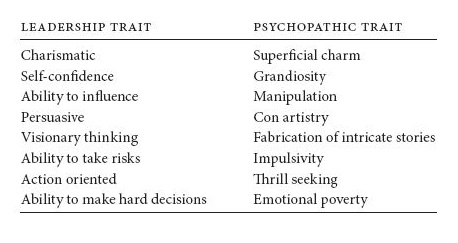
here's an interesting chart i found that i'd say characterizes the traits psychopaths have that they use to essentially impersonate real leaders -- and that are particularly obvious when they are the leaders of cults, rather than legitimate groups:

psycho-ceo.jpg
You got it.
 
More like a psychopath.

The sociopath doesn't care if he hurts people.

The psychopath likes hurting people.

That's the sadist; I don't think they're the same thing. Graham Young (the mass poisoner in England in the early 1970s) was obviously psychopathic but from what I've read in his biography, inflicting pain on people wasn't a prime motivation for him; he was just indifferent to it.

The understanding I have is that psychopaths are born the way they are whereas sociopaths are made (ditto).
 
Last edited:
The understanding I have is that psychopaths are born the way they are whereas sociopaths are made (ditto).

Well proper question is "What have the trained, qualified medical professionals (psychiatrists) to say about this notion in their peer-reviewed journals?". Lay persons very often have greatly erroneous notions of what is or is not the scientific position on such things.
 
Well proper question is "What have the trained, qualified medical professionals (psychiatrists) to say about this notion in their peer-reviewed journals?". Lay persons very often have greatly erroneous notions of what is or is not the scientific position on such things.
Of course we are all wrong aren't we?

Oh sorry, erroneous.

Opinions not permitted?

No, of course not

Of course you are welcome to perform a 3 year study of youtube to give us your [then] professional opinion.

Excuse us whilst we breathe whilst we wait....

Do you really know what is being said here in a nutshell?

I'll say it in Russian.

Fuck off, Michael.
 
Last edited:
Well proper question is "What have the trained, qualified medical professionals (psychiatrists) to say about this notion in their peer-reviewed journals?". Lay persons very often have greatly erroneous notions of what is or is not the scientific position on such things.

Oh sure, but I took some psychology courses (including ones about abnormal psychology) at university so I know more than average about the subject. My clinical psychology lecturer described psychopaths to us as "everybody's worst enemy".
 
There's a condition called secondary psycopathy that is distinct from primary psycopathy. It's thought that this condition is created by parenting.

.
 
Also, quite the eye opener is the psycopathy checklist.


Fairly recently I became aware of it and looked at it fully expecting a former business associate to be exposed...and while this person had few of the traits I was totally astonished to see a different person I know get exposed who had every single trait in spades.

What I thought I knew about psycopathy was completely wrong.

The person I thought was a psycopath wasn't while a problem person I knew is and like Tom Cruise's tooth once this was revealed it's completely obvious and predicts their behavior.
 
Here's the abuse cycle of the narcissist.

This has been put forth as the cycle of the psycopath and sociopath.

It definitely is the cult cycle:

Cornerstone-content-P-The-Narcissist-Cycle-of-Abuse.jpg

cult parallels (fully agree about similarities, just some varying ways of looking at it -- and is there really normally a 'discard' stage in cults, or does that take some other form):

slide_9.jpg


slide_5.jpg
 
Last edited:
Isolation, deprivation, neglect are forms of discarding.

In Scientology staff goes without pay while exorbitant amounts of money are lavished on bling and Miscavige.

They devalue, discard and then hoover. When the target is about to leave the idealization starts up.

Rinse and repeat.
 
Last edited:
Isolation, deprivation, neglect are forms of discarding.

good point. and come to think of it, don't most members end up in the sort of trouble -- often for no good reason at all -- that requires them to do a-e steps to get 'back into the group'? and then from what i've read, many have been in worse trouble, have blown staff or sea org and been on the outs for while, etc. (and of course RPF if they're in the sea org). so yeah it really fits....
 
More like a psychopath.

The sociopath doesn't care if he hurts people.

The psychopath likes hurting people.

I wonder are there other psychopaths in management. How do psychopaths interact with each other?
 
Back
Top