Hubbard became an "implanter" in September 1963.

My view is slightly different. I think a lot - though not all - of scn is hypnosis and that's not necessarily a bad thing in itself (I've had friends who have trained as hypnotherapists, and who I believe had done some good).

It all depends on what purpose it is put to, and it's that in Scn that is wrong - Scn uses hypnosis and the induction of hypnotic states in people in order to control them and get them to do what Scn wants them to do.


I agree with you on all points here. The more I learn about hypnosis the more I like it and the more I see it as a tool that can be tremendously helpful. But like any other tool, it can be used for evil purposes as well as positive ones.

When someone is in a trance state they're more suggestible, and Hubbard, who was an expert on hypnosis didn't warn us about this for some reason. :hmm:
 
Last edited:
didn't he also recommend Alice, or the reading of parts of it?

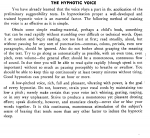
i find this, for example:


Yes, it's one of the first things a Scientologist does.


From Crowley's recommended reading list in the 1929 book Magick in Theory and Practice:

"Alice in Wonderland by Lewis Carroll. Valuable to those who understand the Qabalah."


After the introduction of TRs (Training Routines) during the mid 1950s, Hubbard, during a lecture, explained each TR, including TR 1, or "Dear Alice":

"How exactly is it done? We give a person a book. The book is Alice in Wonderland. Why Alice is wonderland? Well, that's just because it is, no further significance."

Ref. the discontinued 1975 (compilation) book Dianetics Today.
 
I first did it before becoming seriously involved, having only read some of Hubbard's books plus Ruth Minshull's Miracles for Breakfast, and was impressed when the person I was "processing" came "up tone," going from being grumpy and introverted to being cheerful and extroverted.
Many people are hungry for someone to listen to them and care about what's on their minds. Results can be gotten by just being a good and caring friend.

If "the tech" didn't contain SOME things which worked to get people better, at least in the intro materials, then Scientology would never have gotten off the ground.
 
Many people are hungry for someone to listen to them and care about what's on their minds.

That's true, but instances, where I used some part of what I knew as Scientology, usually involved directing or, in some fashion, influencing or controlling attention.

Only occasionally did such experiences involve persons who wanted someone to listen to them, etc.

For example, I stopped a mugging by repeating back to the mugger his exact words, in the exact volume, mood, and inflection that the mugger had just, seconds before, very seriously and ominously intoned.

The mugger went blank and wandered away in a daze.

At the time, I considered it an application of the idea of "as-Isness," which as an idea that impressed me early on. During frigidly cold winter days I would invite friends to take off their winter coats and stand in the cold without shivering. No one could. But, I, a novice Scientologist, could "as-Is" the cold. I actually converted some people into Scientology with this demonstration. It was very convincing. Of course, later on, I had to get those same people out of Scientology.

Many of these things could be called "mental tricks."

Some of it was quite clever.

Results can be gotten by just being a good and caring friend.

If "the tech" didn't contain SOME things which worked to get people better, at least in the intro materials, then Scientology would never have gotten off the ground.

True.
 
didn't he also recommend Alice, or the reading of parts of it?

i find this, for example:

Reading a children's book aloud is also recommmended practice for hypnotists.

1654651024338.png
 
@Riddick, with all due respect, I'm gonna save you some future grief. Maybe permanently change your life.

I think you're missing the boat on one thing about your fascination with rhetoric -- as everybody's "item" or "thing" or "main explanation" for their lives. In auditing, it's called a "wrong item" being pushed down someone's throat. Apart from scientology, there's some validity to it, IMO.

In real life, an example of a "wrong item" or "wrong indication" would be something like a president standing at a podium and calling out all hard-working, tax-paying, honest white people "white supremacists" or "racists." People will be in a huge apoplectic rage about this. It's a patently a false accusation.

In auditing, we'd call off a list and look for meter reads for a wrong item.

Let me assess one on myself here real quick to show you how it's done.

evaluation . . . . . x​
invalidation . . . . . x​
wrong item . . . . . sf​
not your item . . . . . x​
given a wrong why . . . . . x​
given a wrong item . . . . . sf​
given a wrong indication . . . . . sf​
false item forced on you . . . . . LFBD FN ---> dial wide FN​
​
[ Ind item to PC ]​

"Oh, hell yeah! That's all wrong. It's that fricking rhetoric thing. It's just​
all wrong. It has nothing to do with me. I'm tired of hearing about it. Every​
week, he tells me it's rhetoric. I feel so much better now after spotting that."​
:happydance::happydance::happydance::happydance:​

Show my "worksheet post" to your OT8 wife and ask her about this. She'll know. :coolwink:
That's life. :LOL:
still applying the technology of scientology?

"Let me assess one on myself here real quick to show you how it's done.

evaluation . . . . . x
invalidation . . . . . x
wrong item . . . . . sf
not your item . . . . . x
given a wrong why . . . . . x
given a wrong item . . . . . sf
given a wrong indication . . . . . sf
false item forced on you . . . . . LFBD FN ---> dial wide FN

[ Ind item to PC ]"

All that stuff was a logos appeal, or logic appeal why it would work.
 
Alright, when I count to three and snap my fingers, the time track will move to the first availablle incident containing the word "rhetoric" ....
when I snap my fingers, what was the reason you got involved?
 
It was, but it was more than that. I guess you had to be there.

the incident i described on the bus was more than just empathic listening -- but it started with that at the core. or started to describe, because it was so extraordinary you had to be there.... :)

i think i know what you're getting at.

ETA:

...instances, where I used some part of what I knew as Scientology, usually involved directing or, in some fashion, influencing or controlling attention.

Only occasionally did such experiences involve persons who wanted someone to listen to them, etc.

For example, I stopped a mugging by repeating back to the mugger his exact words, in the exact volume, mood, and inflection that the mugger had just, seconds before, very seriously and ominously intoned.

The mugger went blank and wandered away in a daze.

At the time, I considered it an application of the idea of "as-Isness," which as an idea that impressed me early on. During frigidly cold winter days I would invite friends to take off their winter coats and stand in the cold without shivering. No one could. But, I, a novice Scientologist, could "as-Is" the cold. I actually converted some people into Scientology with this demonstration. It was very convincing. Of course, later on, I had to get those same people out of Scientology.

Many of these things could be called "mental tricks."

that sounds like it might have worked in a way similar to what's shown in the Derren Brown videos i posted of people handing over their wallets, interruption of the expected norms of an interaction threw their minds into a state of confusion similar to mild hypnosis.

Hubbard definitely used techniques for harness confusion to influence and manipulate people....
 
Last edited:
Just as a footnote, I ran people on a selection of processes from the book Creation of Human Ability,
not any dianetics or track-running ones. They seemed more mind-expanding and creative and would
be easier for me at the time, an untrained novice and from-the-book beginner all alone in fly-over country.

Hubbard had written in the 1955 book that any person of moderate to high intelligence could run the
processes straight out of the book. I did, LOL, on four people. This was a long, long time ago, when I
was very young and in college. :innocent:

i skimmed over some of those processes, and it looks like they run the gamut from what might be compared to positive visualization exercises (one actually goes head to toe, body scan style), to giving the infamous command 'be three feet back of your head' which is the sort of thing i think risks throwing someone vulnerable into the wrong mental state if not an actual psychotic episode.

the things that we got away with when we were young, without somehow doing terrible harm to ourselves or others.... 😏
 
when I snap my fingers, what was the reason you got involved?

I liked the Incredible String Band who, I was told, were Scientologists.

The songs they played had all been written before their involvement with Scientology.

This was 1969.

At that time, I hadn't read any Hubbard books.


i skimmed over some of those processes, and it looks like they run the gamut from what might be compared to positive visualization exercises (one actually goes head to toe, body scan style),

It was a more than that.

to giving the infamous command 'be three feet back of your head' which is the sort of thing i think risks throwing someone vulnerable into the wrong mental state if not an actual psychotic episode.

Most people were sturdier than that.

Going on an account in the unauthorized Aberree, a magazine at the time, most didn't take the "three feet back of your head" seriously and ignored it.

The three feet back of the head command was a trick to make the person separate from mundane reality, either to manipulate him further, or, some claim, to actually allow him to do things - mentally - that would be impossible were he still trapped in that mundane reality.

The idea of leaving the body and then doing processes, exercises and drills, was exciting at the time.

It wasn't long though before Hubbard moved on to other actions.


the things that we got away with when we were young, without somehow doing terrible harm to ourselves or others.... 😏
 
Last edited:
when I snap my fingers, what was the reason you got involved?
You want me to say rhetoric? Alright, I'll say it: It was rhetoric. I went to hear an intro lecture because I had nothing else to do that night and the lecturer got me interested enough to buy the book (DMSMH). I read the book and thought the book was interesting and I wanted to know more.

I don't think anyone here is denying that rhetoric played a role in scn. I don't deny it, and I haven't seen anyone else here deny it. Hubbard definitely used rhetoric in his writing and in his lectures to persuade us.

But so does everybody. Hubbard was not unique in that respect. I use rhetoric to try to persuade people of my viewpoint. Other members who post here do it too. Even you, @Riddick, are constantly asking rhetorical questions in the threads you start.

Hubbard's use of rhetoric does not seem to me to be a very remarkable thing. He was a good persuader, but so are lots of people. I don't think he particularly stands out because of his use of rhetoric.

On the other hand, very few people use hypnosis in the way that Hubbard did. He used it overtly at first: in 1949 there was no pretense about it and Campbell, Winter, etc. knew that hypnosis was being used on them but were willing to submit because of the benefits they thought would come from it. But when DMSMH was published, Hubbard switched to calling it "dianetic reverie" and the hypnosis became covert. And I believe hypnosis is still an important component in scn today, especially but not only in dianetic auditing. Scn vigorously denies this.

I agree that both rhetoric and hypnosis play a part in scn. But I think Hubbard's use of rhetoric, which is widely used by almost everybody, is unremarkable. His use of covert hypnosis, on the other hand, is.
 
Last edited:
The three feet back of the head command was a trick to make the person separate from mundane reality, either to manipulate him further, or, some claim, to actually allow him to do things - mentally - that would be impossible were he still trapped in that mundane reality.
I think "Be three feet back of your head" is like a catalepsy test in hypnosis: if the subject can't open his eyes or lower his hand when the hypnotist tells him to try it, then he's hypnotized.

In COHA (Creation of Human Ability) those who could be three feet back of their heads when given the command went onto the Route One processes, which were done exterior (supposedly), while those who couldn't exteriorize got Route Two: objectives like Op Pro By Dup, until they did.

When I did the HQS course, exteriorization was still listed as part of the EP of Op Pro By Dup. My twin did well on the process, but for him I think it was a matter of catharsis or abreaction: he got mad and yelled and gave ridiculous answers to the questions. I let him do this and just continued the process. He was a very introverted guy and for him I think this was probably a unique experience of being allowed to express his emotions.

I wanted to continue the process to exteriorization but the C/S said, "Let the pc have his win."
 
Last edited:
When you were in scn, did you bullbait each other about being hypnotized, as a joke? We did. This was dangerously close to J&D (Joking and Degrading), but we did it anyway.

Your twin would be sitting there motionless, looking at you, and we'd say, "Oh no, Joe, what have they done to you? Why, you're hypnotized! Scientology has turned you into a fucking zombie! Joe, speak to me! Please, please, speak to me Joe!"

Maybe Joe would crack up at that point. If not, we'd continue: "Joe, can you hear me? Joe, if you can hear me, blink! If you can hear me, blink!" You'd get right up to the guy's eye, and say, "Blink, Joe!"

And very often, he would blink. Funny how often that produced a reaction. Was Joe in fact, somewhat hypnotized and responding to your command? Hmm, ,,, food for thought.
 
Last edited:
My view is slightly different. I think a lot - though not all - of scn is hypnosis and that's not necessarily a bad thing in itself (I've had friends who have trained as hypnotherapists, and who I believe had done some good).

It all depends on what purpose it is put to, and it's that in Scn that is wrong - Scn uses hypnosis and the induction of hypnotic states in people in order to control them and get them to do what Scn wants them to do.
Just as an aside, hypnosis proves there is a part of the mind or brain which is not normally accessible. I think I'll coin a term and call that part of the mind the Reactive Mind. :dizzy:
 
I think "Be three feet back of your head" is like a catalepsy test in hypnosis: if the subject can't open his eyes or lower his hand when the hypnotist tells him to try it, then he's hypnotized.

In COHA (Creation of Human Ability) those who could be three feet back of their heads when given the command went onto the Route One processes, which were done exterior (supposedly), while those who couldn't exteriorize got Route Two: objectives like Op Pro By Dup until they did.

When I did the HQS course, exteriorization was still listed as part of the EP of Op Pro By Dup. My twin did well on the process, but for him I think it was a matter of catharsis or abreaction: he got mad and yelled and gave ridiculous answers to the questions. I let him do this and just continued the process. He was a very introverted guy and for him I think this was probably a unique experience of being allowed to express his emotions.

I wanted to continue the process to exteriorization but the C/S said, "Let the pc have his win."

Here's some background, written by John Symonds and Kenneth Grant, editors of some of Crowley's works. Note: the 1913 'Batra' is the antecedent of Hubbard's Grand Tour from Creation of Human Ability. It may shed some light on what Hubbard thought he was doing with "Be three feet back of your head," and other similar techniques, or tricks, such as beginning the book What to Audit (later re-titled History of Man) with the announcement, "This is a cold blooded and factual account of your last sixty trillion years."*

Of course, Hubbard also admired P. T. Barnum and Genghis Khan and his motive may have been closer to his 1955 definition for Psychopolitics: "Asserting and maintaining dominion over thoughts and loyalties through mental healing."

(*Re. "Asserting and maintaining dominion": authoritatively telling a person not only his past, but sixty trillion years of past, while also owning and controlling the toll booths on his "next endless trillions," whether pleasant or "agonized," is one way of "asserting dominion.")

Each can decide for himself. :scratch:

This man is my guru. I think I'll marry him.
msh_what-to-audit.jpg

What could possibly go wrong?


7790babd2dcd0154eb05105345a90246.jpg


hqdefault.jpg
​


From Aleister Crowley's editors:

"An earlier essay entitled Batrachophrenoboocosmomachia, which was published in Crowley's periodical the Equinox during 1913, is included here because it deals with the magical practice of expanding consciousness to the stars and planets. The word 'Batrachophenoboocosmomachia' is made up of the Greek words for Frog Mind Ox World Battle, and is a play on the title of the Homeric mock epic, the Batrachomyomachia or 'Battle of the Frogs and Mice'. The idea behind the use of the barbaric name, Batrachophrenoboocosmomachia - that is in pronunciation or vibration - is that it is supposed to create a sense of vertigo in which the mind is freed from ordinary bounds. Consciousness - so the theory goes - is exalted to infinity by this method."


53789.jpg


​
 
.


.


hqdefault.jpg


I wonder if being arrested, indicted, tried, convicted and
sentenced to FEDERAL PRISON is an indicator of being "PTS"?


The Antisocial Personality​
There are certain characteristics and mental attitudes which cause about 20 percent of a race to oppose violently any betterment activity or group. Such people are known to have antisocial tendencies. When the legal or political structure of a country becomes such as to favor such personalities in positions of trust, then all the civilizing organizations of the country become suppressed and a barbarism of criminality and economic duress ensues. Crime and criminal acts are perpetrated by antisocial personalities. Inmates of institutions commonly trace their state back to contact with such personalities. Thus, in the fields of government, police activities and mental health, to name a few, we see that it is important to be able to detect and isolate this personality type so as to protect society and individuals from the destructive consequences attendant upon letting such have free rein to injure others. As they only comprise 20 percent of the population and as only 2 1/2 percent are truly dangerous, we see that with a very small amount of effort we could considerably better the state of society. Well-known, even stellar, examples of such a personality are, of course, Napoleon and Hitler. Dillinger, Pretty Boy Floyd, Christie and other famous criminals were well-known examples of the antisocial personality. But with such a cast of characters in history we neglect the less stellar examples and do not perceive that such personalities exist in current life, very common, often undetected. When we trace the cause of a failing business, we will inevitably discover somewhere in its ranks the antisocial personality hard at work. In families which are breaking up, we commonly find one or the other of the persons involved to have such a personality. Where life has become rough and is failing, a careful review of the area by a trained observer will detect one or more such personalities at work... - L. Ron Hubbard
- - -


Jeez! It sure seems like Mary Sue Hubbard went "PTS".
With Dr. Hubbard both auditing and C/Sing her case
it's pretty weird that she would have gone PTS
without
Ron obnosing it and finding her SP.

.
​
 
Last edited:
Just as an aside, hypnosis proves there is a part of the mind or brain which is not normally accessible. I think I'll coin a term and call that part of the mind the Reactive Mind. :dizzy:
So do dreams. In DMSMH Hubbard says, "Dreams are crazy-house mirrors by which the analyzer looks down into the reactive bank" (paraphrase). That may be the ONLY official statement about the source of dreams in all scn literature. It's the only one I ever recall seeing.

I remember that because when I first read the book, I thought, "What? That's it? That's all he's going to say about it?" I knew dreams were considered very important by some other mental researchers; Freud, for example. I couldn't believe scn dismissed them so easily.

But wait: if dreams "look down into the reactive bank," then clears, who have supposedly erased their reactive minds, shouldn't dream, should they?

Oh damn it, I forgot about the BT's, and their reactive minds. That explains it. :duh: But there were no BT's in 1950. How did they explain it then? Of course that was probably the least of the things they couldn't explain. Like the lack of eidetic memory or computer-like calculating ability ... or clears catching colds ....
 
So do dreams. In DMSMH Hubbard says, "Dreams are crazy-house mirrors by which the analyzer looks down into the reactive bank" (paraphrase). That may be the ONLY official statement about the source of dreams in all scn literature. It's the only one I ever recall seeing.

interesting you should bring that up. i think it's another of the major things that 'source' almost willfully ignored, because it had all sorts of inconvenient implications for his theories -- beyond the ones you mention.

in particular, dreams come from the same imaginative processes of the brain, that produce illusory 'past lives' -- which could be said to be a sort of guided lucid dreaming. both can seem as vivid as real memories, and dreams can even cause false memories as well.

dreams were a process that LRH could not really affect or control at all, such as with the sort of subtle cuing and suggestion that can creep into an auditing session (especially when using a list) or a process. and had followers started to pay close attention to them, they might have started to realize that there wasn't that much difference between them and past life imaginings (or the prenatal supposed traumas, and probably most infantile 'memories' as well).
 
Last edited:
You want me to say rhetoric? Alright, I'll say it: It was rhetoric. I went to hear an intro lecture because I had nothing else to do that night and the lecturer got me interested enough to buy the book (DMSMH). I read the book and thought the book was interesting and I wanted to know more.

I don't think anyone here is denying that rhetoric played a role in scn. I don't deny it, and I haven't seen anyone else here deny it. Hubbard definitely used rhetoric in his writing and in his lectures to persuade us.

But so does everybody. Hubbard was not unique in that respect. I use rhetoric to try to persuade people of my viewpoint. Other members who post here do it too. Even you, @Riddick, are constantly asking rhetorical questions in the threads you start.

Hubbard's use of rhetoric does not seem to me to be a very remarkable thing. He was a good persuader, but so are lots of people. I don't think he particularly stands out because of his use of rhetoric.

On the other hand, very few people use hypnosis in the way that Hubbard did. He used it overtly at first: in 1949 there was no pretense about it and Campbell, Winter, etc. knew that hypnosis was being used on them but were willing to submit because of the benefits they thought would come from it. But when DMSMH was published, Hubbard switched to calling it "dianetic reverie" and the hypnosis became covert. And I believe hypnosis is still an important component in scn today, especially but not only in dianetic auditing. Scn vigorously denies this.

I agree that both rhetoric and hypnosis play a part in scn. But I think Hubbard's use of rhetoric, which is widely used by almost everybody, is unremarkable. His use of covert hypnosis, on the other hand, is.
I'm sorry, I don't fall for the hypnosis crowd or theory. I've researched much on hypnosis including Braid and others.

James Braid | History of Hypnosis

You have to remember or recall or when I snap my fingers that Hubbard said 50% of the gains of going up the bridge to total freedom was by doing training, only a trained auditor will make it, that's rhetoric. And by doing training, guess what, you were listening and reading and word clearing and trying to get reads on the emeter by hubbard's rhetoric.

That was a logical appeal, but it's all false rhetoric including ethos, pathos and logos.
 
Back
Top